
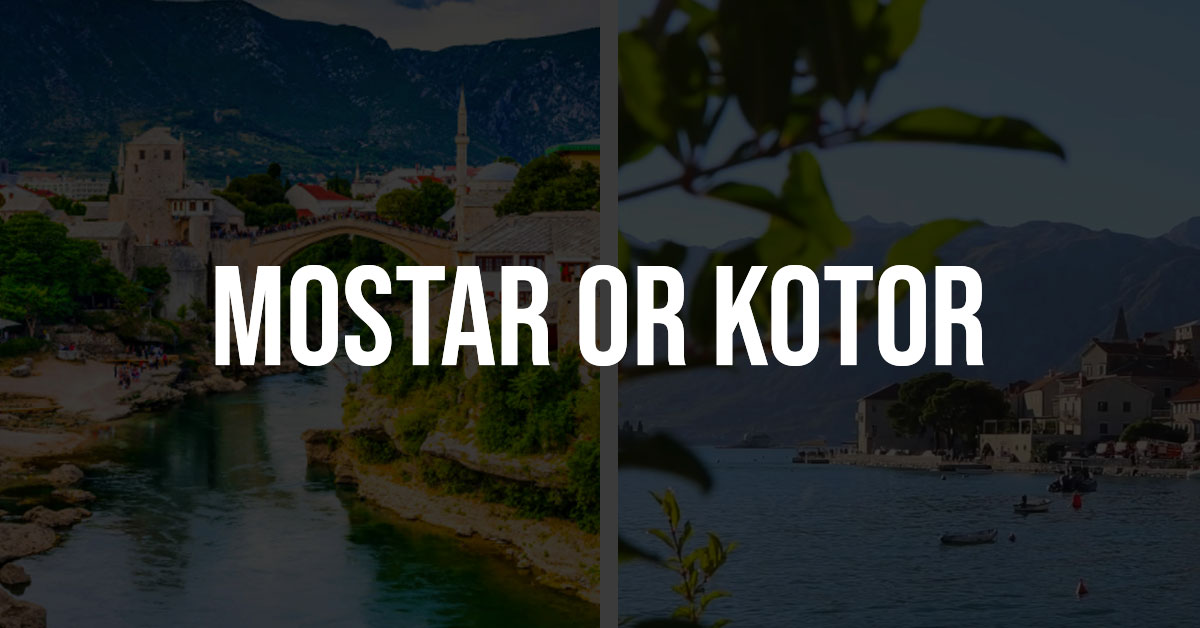
Picture yourself sitting at a riverside cafe, the air thick with the scent of grilled meat and strong coffee. The water rushing below you is a shocking shade of emerald green, so cold it creates its own microclimate against the scorching sun. Above you, a graceful stone arch suspended in the air connects two sides of a fractured city, and young men plunge from its apex into the depths below to the cheers of a crowd. This is the heart of Herzegovina. If you are starting your Balkan trip in the Bosnian capital, this detailed guide on how to get from Sarajevo to Mostar will help you plan the most scenic part of your journey.
Now, shift your imagination to a completely different scene. You are standing on the ramparts of a medieval fortress, breathless from climbing over a thousand stone steps. Below you lies a bay so deep and dark blue it looks like a Nordic fjord dropped into the Mediterranean. Ancient stone palaces are squeezed between the water and sheer limestone cliffs, and the air smells of salt, cypress trees, and centuries of maritime history. This is the jewel of the Adriatic.
Table of Contents
Introduction to the Dilemma: Mostar or Kotor
Deciding between these two stunning UNESCO World Heritage sites is one of the most common headaches for travelers planning a trip through the Balkans. They are separated by only about 120 kilometers, yet they feel like they belong to different continents, let alone different countries. One offers the mystique of the Orient, a place where the call to prayer echoes against church bells and the scars of recent history are worn with solemn pride. The other offers the grandeur of the Venetian empire, a labyrinth of marble streets protected by lions and fortifications that defied empires.
While many travelers try to cram both into a single itinerary, sometimes time constraints force a choice: Mostar or Kotor? This guide is designed to dissect every aspect of these two heavyweights. We will compare their atmosphere, their history, the day trips they offer, their food scenes, and their costs. Whether you are seeking a deep cultural dive into the Ottoman past or a scenic retreat on the coast, this detailed breakdown will help you decide which city deserves your precious vacation days.
The Atmosphere: The Oriental Soul of Mostar or Kotor and its Venetian Charm
When comparing the vibe of Mostar or Kotor, you are essentially comparing two different civilizations. The city in Bosnia and Herzegovina feels undeniably eastern. As you walk through the Kujundžiluk (the old bazaar), the streets are lined with copper workshops, colorful rugs, and Turkish lanterns. The architecture is low, with stone roofs and wooden verandas hanging over the river. There is a palpable sense of melancholy mixed with resilience here. It is a city that wears its heart on its sleeve, where the history of the 1990s conflict is still visible in bullet-riddled buildings just blocks away from the restored center, adding a layer of poignant gravity to your visit.
In contrast, the atmosphere when you choose Mostar or Kotor shifts dramatically on the coast. The Montenegrin contender feels Italian, specifically Venetian. It is grand, enclosed, and vertical. The streets are a stone maze designed to confuse invaders, opening up suddenly into sun-drenched piazzas filled with cafe tables and cats. If the presence of cats is one of the reasons you feel drawn to Kotor, you will probably enjoy visiting the Kotor Cats Museum, a quirky little spot that highlights just how much these animals are part of the town’s identity. The vibe here is more polished, more maritime, and significantly more tourist-heavy during the day when cruise ships dock. However, at night, when the day-trippers leave, the town takes on a romantic, almost gothic mystery as the lights of the fortress walls glow above the silent city.
The Main Event: Stari Most in Mostar or Kotor City Walls
The central landmark is often the deciding factor when choosing Mostar or Kotor. In the Bosnian city, everything revolves around the Stari Most (Old Bridge). Built by the Ottomans in the 16th century, destroyed during the war in 1993, and painstakingly rebuilt in 2004, it is more than a bridge; it is a symbol of reconciliation. The bridge is the epicenter of activity. You can spend hours just watching the bridge jumpers, members of the local diving club who solicit donations before leaping 24 meters into the freezing Neretva River. The view from the minaret of the Koski Mehmed Pasha Mosque offers the iconic postcard angle of the bridge, framing the turquoise water and the stone arch against the mountains. Beyond the bridge itself, Mostar offers an incredible range of experiences that make it worth more than just a quick stop, including mystical monasteries, refreshing waterfalls, and atmospheric old town explorations detailed in our guide to the 5 unmissable things to do in Mostar.
On the other hand, the architectural marvel that defines the debate of Mostar or Kotor changes when you cross the border. In Montenegro, the star is the fortification system itself. The City Walls loop for 4.5 kilometers, stretching not just around the town but straight up the vertical mountainside. The “thing to do” here isn’t watching someone jump; it is making the climb yourself. The hike to the Fortress of San Giovanni involves 1350 crumbling steps. It is a grueling ascent, especially in summer, but the reward is one of the most spectacular views in Europe; the red roofs of the old town contrasting with the ink-blue bay. While the bridge is a focal point for gathering, the walls are an invitation to active exploration. When you wander into Kotor’s main square, make sure you step inside St. Tryphon Cathedral, the city’s sacred heart, to see its relics, silver treasures, and balcony views that watch over the Old Town.
Day Trip Potential: Exploring Around Mostar or Kotor
Both cities serve as excellent bases for exploring the wider region, but the nature of these trips might sway your decision on Mostar or Kotor. If you base yourself in theBosnian city, your day trips are about water and spiritual history. Just a short drive away is Blagaj, home to a 600-year-old Dervish monastery (Tekke) built right into a cliff face at the source of the Buna River. It is a place of incredible serenity. Further south lies the Kravice Waterfalls, a massive natural amphitheater of water where you can actually swim under the falls; a perfect escape from the inland heat. You can also visit Počitelj, a stepped medieval stone village that looks like an open-air museum. If you are planning a wider Herzegovina itinerary around Mostar, Radimlja Necropolis is a powerful stop where medieval tombstones, family history and quiet countryside all come together.
If you lean towards the coastal option in the Mostar or Kotor debate, your day trips will be maritime. The most popular excursion is to the nearby town of Perast to take a boat to Our Lady of the Rocks, a man-made island with a church founded on a legend. You can also take speedboat tours to the Blue Cave, where the light reflects off the sandy bottom to create iridescent blue water. For mountain lovers, the drive up the Lovćen serpentine road to the Njeguši village offers a chance to taste famous prosciutto and see the bay from the clouds. If you choose Montenegro and want to go beyond the Bay of Kotor, you can also head north to explore the Durmitor National Park for world class rafting through the Tara Canyon, glacier lakes and dramatic mountain hiking trails. Essentially, one offers river valleys and waterfalls, while the other offers bay cruising and coastal drives.
The Culinary Battle: Dining in Mostar or Kotor
Food is a massive part of the Balkans experience, and the menu differs significantly depending on whether you pick Mostar or Kotor. In Herzegovina, the cuisine is hearty, meat-heavy, and influenced by Turkish traditions. The staple here is ćevapi, small grilled minced meat sausages served in somun bread with raw onions. You will also find endless varieties of burek (meat pie) and sirnica (cheese pie). River trout is a local delicacy, usually grilled simply with lemon. The coffee culture is distinct; Bosnian coffee is prepared in copper pots (džezva) and served with a ritualistic flair, accompanied by a cube of sugar and a Turkish delight (rahat lokum).
The dining scene changes when navigating the choice of Mostar or Kotor towards the Adriatic. The Montenegrin diet is Mediterranean. Here, the focus is on fresh seafood; mussels in buzara sauce (wine, garlic, and parsley), grilled sea bream, and octopus salad. The Venetian influence means you will find excellent pasta, risotto, and stone-baked pizzas. The region is also famous for its smoked ham (pršut) and cheese from the mountains, often served as an appetizer. While you can find meat in the coastal town, the prices for fresh fish are what draw foodies here.
Wine lovers might prefer the south, as Herzegovina produces excellent Žilavka (white), while Montenegro is famous for Vranac (red).
Budget and Costs: Is Mostar or Kotor Cheaper?
For budget-conscious travelers, the question of Mostar or Kotor has a clear winner. Bosnia and Herzegovina is generally significantly cheaper than Montenegro. The currency in Mostar is the Convertible Mark (BAM), which is pegged to the Euro at a favorable rate. You can find high-quality accommodation, hearty meals, and coffee for a fraction of Western European prices. Entrance fees to museums and mosques are nominal, and parking, while chaotic, is affordable. It is a destination where your money stretches very far, allowing for a more luxurious experience on a backpacker budget.
In contrast, when weighing the costs of Mostar or Kotor, the Montenegrin town is pricier. Montenegro uses the Euro, and due to the influx of cruise ship passengers and yacht tourism, prices inside the Old Town can be inflated. Accommodation in the summer season commands a premium, and dining at prime waterfront locations can rival prices in Italy or Croatia. However, compared to Dubrovnik, it is still a bargain. If you are on a strict budget, you can still make it work by staying outside the city walls and eating at bakeries, but generally, your daily spend will be higher here than in its neighbor to the north.
Accessibility and Weather: When to Visit Mostar or Kotor
The climate and ease of access are practical factors in the Mostar or Kotor decision. The Bosnian city is located in a valley and is known for being one of the hottest cities in Europe during the summer. Temperatures in July and August regularly exceed 40 degrees Celsius (104 Fahrenheit). The stone city traps the heat, making sightseeing in the middle of the day exhausting. However, this makes the cold river water incredibly refreshing. It is accessible from Sarajevo or Dubrovnik, though the train ride from Sarajevo is renowned as one of the most scenic in the world.
The coastal contender in the Mostar or Kotor comparison has a typical Mediterranean climate. It is hot in summer but often has a sea breeze. However, it is also one of the wettest places in Europe during the winter, so off-season travel can be very rainy. Getting there is easy via the Tivat airport nearby, or by driving from Dubrovnik. A crucial note for drivers is that traffic along the bay road can be gridlocked in summer, and parking is notoriously difficult and expensive. The inland city is generally easier to navigate with a car once you find a spot.
Practical Tips for Visiting Mostar or Kotor
If you are planning to visit both or trying to decide on Mostar or Kotor, keep in mind that they are in two different countries, which means a border crossing is involved. The border between Bosnia and Herzegovina (non-EU) and Montenegro (non-EU) can get extremely busy in the summer months. It is not uncommon to wait two or three hours at the main crossings like Deleuša or Klobuk. If you are doing a day trip from one to the other, start as early as possible, ideally leaving at 6:00 AM, to avoid the worst of the queues.
Currency is another major difference when choosing Mostar or Kotor. Montenegro unilaterally adopted the Euro, making it very convenient for travelers coming from the EU. Bosnia uses the Convertible Mark (KM or BAM). While many places in the tourist zones of the Bosnian city will accept Euros (usually bills, giving change in Marks), it is respectful and often cheaper to use the local currency. ATMs are plentiful in both cities. Credit cards are widely accepted in hotels and nicer restaurants, but small souvenir shops, bakeries, and cafes often prefer cash.
When packing for Mostar or Kotor, footwear is critical. Both old towns are paved with slippery, uneven cobblestones. In the Bosnian town, the stones on the bridge are polished smooth and can be like ice even when dry; high heels or flip-flops are a recipe for a twisted ankle. In the Montenegrin town, climbing the fortress walls requires sturdy sneakers or hiking boots, as the path is rocky and crumbling in places. Also, respect the dress codes. In the Bosnian city, if you plan to visit mosques, women will need to cover their heads and everyone needs to cover knees and shoulders (scarves are usually provided at the entrance).
Conclusion: Which is the Winner, Mostar or Kotor?
Ultimately, the choice between Mostar or Kotor depends on what moves you as a traveler.
Choose the Bosnian option if you are a history buff fascinated by the intersection of cultures. It is a place for those who want to feel the soul of a city, to sit and drink coffee slowly, and to reflect on resilience. It is better for budget travelers, meat lovers, and those who want to experience a culture that feels distinctly different from the rest of Europe. It is a city of emotion, where the tragedy of the past highlights the beauty of the present.
Choose the Montenegrin option if you are seeking dramatic natural beauty and physical activity. It is the right choice for hikers, photographers who love landscapes, and anyone who wants that classic Mediterranean summer vibe. It is better for those who handle heat better with a sea breeze, seafood enthusiasts, and travelers who appreciate Venetian architecture and cats. It is a place of visual majesty, where the mountains meeting the sea creates a spectacle that never gets old. If you choose to spend a few days in the coastal town and want a structured plan for making the most of your visit, consider reading our comprehensive guide to the top 5 things to do in Kotor to ensure you experience everything from the fortress hike to boat tours and hidden squares.
Ideally, you wouldn’t have to choose. A perfect itinerary combines both, perhaps staying in one and taking a long day trip to the other. But if you must pick Mostar or Kotor, know that you cannot lose. Both are survivors, both are stunning, and both will leave a mark on you long after you have returned home.
Frequently Asked Questions About Mostar or Kotor
Can I visit both cities in one day?
Yes, it is possible to do a day trip from one to the other as they are only about 2.5 to 3 hours apart by car. However, border crossings can add significant time in summer, so it makes for a very long day.
Do I need a visa to travel between them?
Most tourists from Europe, North America, and Australia do not need a visa for stays up to 90 days in either Bosnia and Herzegovina or Montenegro, but you must have a valid passport to cross the border.
Which city has better nightlife?
The coastal option generally has a more active nightlife scene in the summer, with open-air bars and clubs within the old town walls, whereas the inland city is quieter at night with a focus on relaxed cafes and bars.
Which city is more family-friendly?
The coastal town is generally more family-friendly due to the lack of traffic inside the walled city and the proximity to beaches, although the inland city is also welcoming, just harder to navigate with a stroller due to cobblestones.
Which destination is better for solo travelers?
Both are excellent and safe for solo travelers. The inland city has a strong hostel culture which makes meeting people easy, while the coastal town has a bustling social scene and organized tours.
Our Most Popular Tours To Sarajevo
We offer many tours that include a visit to Sarajevo and its most popular locations:
- Full Day tour from Sarajevo to Belgrade (Most Popular)
- Full Day tour from Sarajevo to Međugorije & Mostar
- Full Day Tour from Sarajevo to Travnik and Jajce
- Full-Day 5 Cities Tour from Sarajevo to Herzegovina (Mostar)
- Full day Tour from Sarajevo to Dubrovnik (Kotor or Split)
Don’t Hesitate To Say Hi!
Got any questions about our tours or the city? Don’t hesitate to contact us anytime for more info and booking.
Use the following phone number and email: