
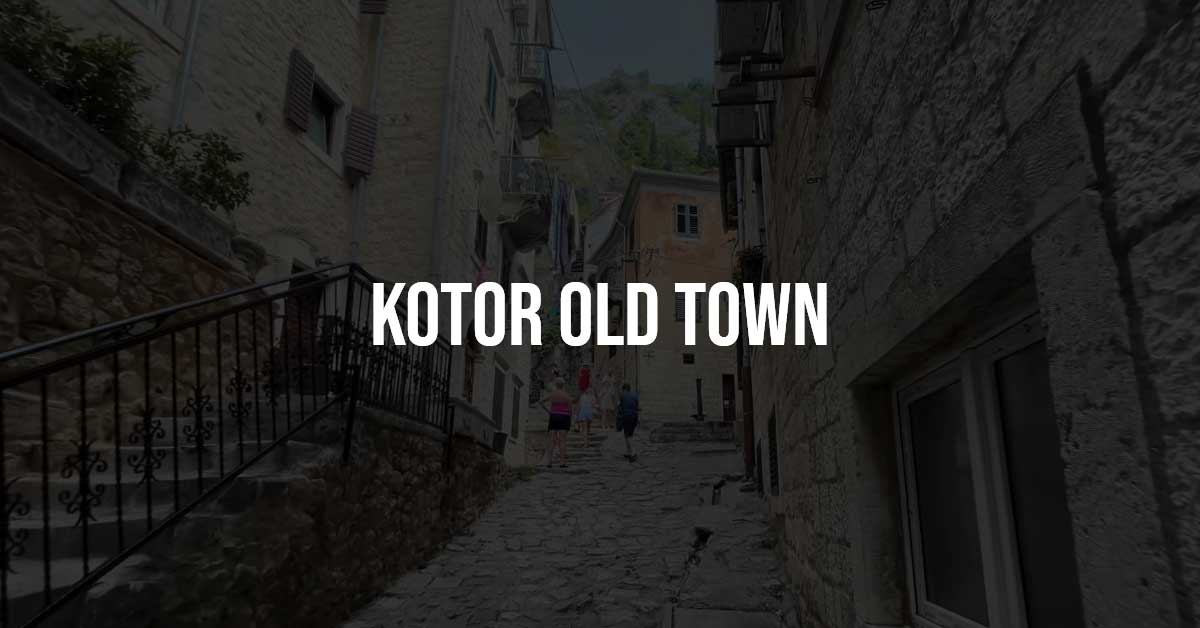
Most medieval cities in Europe feel like open-air museums. They are polished, predictable, and frankly, a bit soulless. But Kotor is different. It is chaotic, loud, confusing, and incredibly alive. It is a place where laundry still hangs from green shutters above centuries-old stone alleys, where hundreds of cats sleep on ancient monuments like they own them (because they do), and where you can accidentally stumble into a 12th-century church while looking for a slice of pizza.
If you look at Kotor from above, it looks like a triangle dropped at the foot of a massive mountain. But once you step inside its walls, geometry goes out the window. The streets have no names. The locals call them by what they are used for, “The Street of the Flour,” “The Street of the Milk.” It is a labyrinth designed to confuse pirates in the past, and tourists in the present.
Table of Contents
The Sea Gate: Entering the Time Capsule of Kotor Old Town
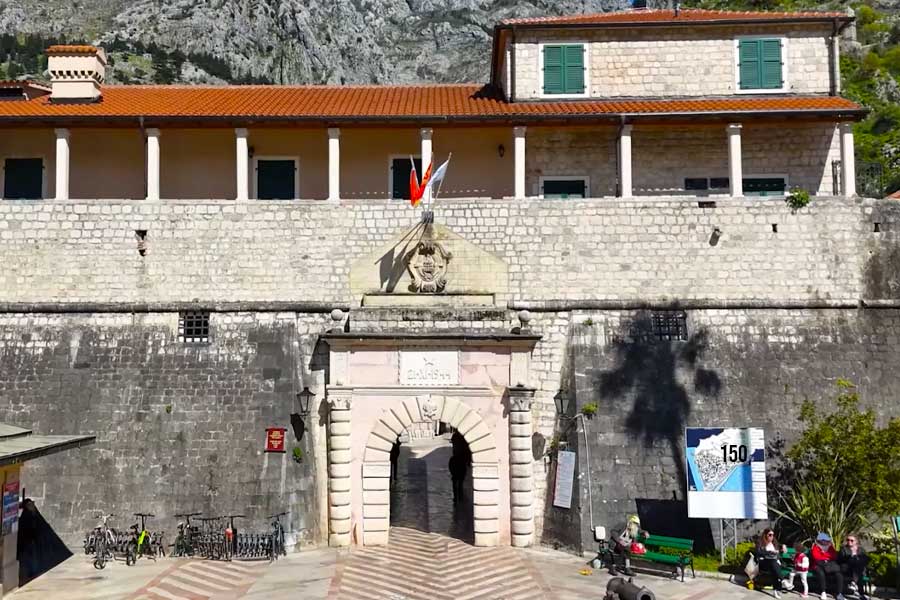
Your journey usually begins at the Sea Gate (Morska Vrata), the main entrance to Kotor Old Town. Built in 1555 during the Venetian rule, this gate is not just a hole in the wall; it is a history lesson carved in stone.
Above the arch, you will see a winged lion, the symbol of Venice. This tells you immediately who built this city. But look lower, and you will see a communist star and a quote from Tito, the Yugoslav leader: “What belongs to others we don’t want, ours we don’t give.” It is a bizarre mix of medieval aristocracy and socialist defiance, all on one wall.
As you walk through the thick stone tunnel of the gate, notice the relief of the Madonna and Child flanked by St. Tryphon and St. Bernard. They are the spiritual bouncers of the city. Once you step out into the sunlight on the other side, you are in the Arms Square (Trg od Oružja). It is loud, it is busy, and it is beautiful. The Clock Tower stands slightly tilted (thanks to the 1979 earthquake), and beneath it is the “Pillar of Shame,” where criminals were once tied up and mocked by the citizens.
The Defensive Walls of Kotor Old Town
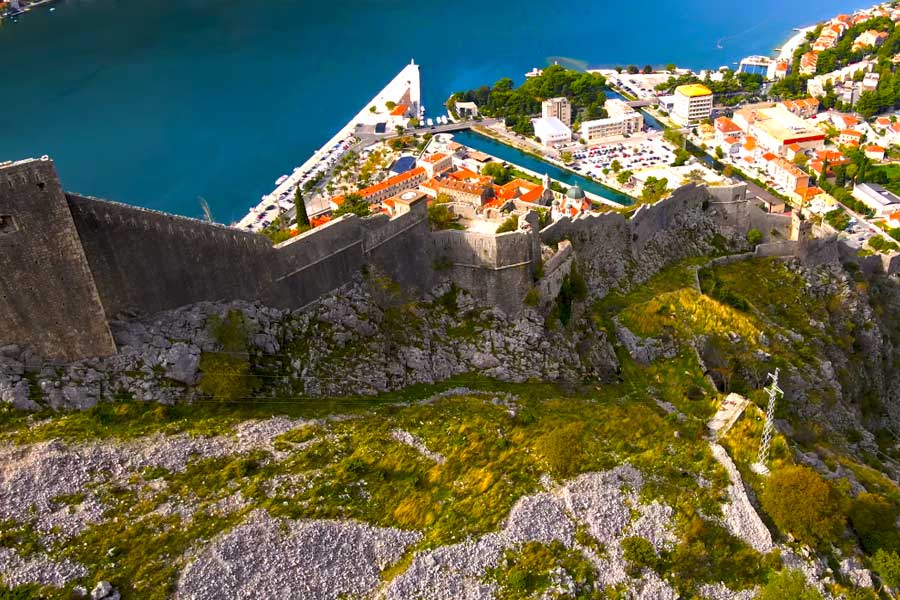
You cannot talk about Kotor Old Town without talking about the walls. They are the reason the city survived for so long. These are not just decorative garden fences; they are 4.5 kilometers of military muscle that climb straight up the mountain.
The walls were started in the 9th century and reinforced by everyone who conquered the city, Byzantines, Serbians, and especially the Venetians. They are up to 15 meters thick in some places.
You can walk along the lower ramparts near the sea for free. Start near the Kampana Tower, the squat, round bastion at the corner of the town near the river. From here, the view is spectacular. You have the emerald green waters of the Škurda River on one side and the red-tiled roofs of the city on the other.
The Palaces of Kotor Old Town: A Show of Wealth
Kotor was a city of sailors and merchants, and when they made money, they wanted everyone to know it. The result is a stunning collection of palaces squeezed into the narrow streets of Kotor Old Town.
Walk towards the St. Tryphon Cathedral, and you will pass the Drago Palace with its beautiful Gothic windows decorated with dragons. Then there is the Pima Palace, arguably the most beautiful building in the city. Its long balcony and Renaissance arches make it look like something straight out of Verona.
But do not just look at the architecture; look at the details. The Grgurina Palace, which houses the Maritime Museum, has a Baroque layout that screams power. The Beskuća Palace has a stone portal with a relief that belongs to a completely different family, legend says Count Beskuća wanted to have “100 houses” (his name literally means “Homeless”) and bought the portal to show off his ambition. These buildings are not empty shells; they are the ghosts of the families that built Kotor.
The Churches of Kotor Old Town: Two Faiths, One City
One of the most unique things about Kotor Old Town is how two branches of Christianity, Catholicism and Orthodoxy, have coexisted here for centuries. In a region often torn apart by religious conflict, Kotor is a rare example of harmony.
You have already heard about St. Tryphon Cathedral, the Catholic masterpiece. But just a few steps away lies Saint Nicholas Church, a grand Orthodox church built in the early 20th century. It is imposing, with its black domes and the scent of incense wafting out the doors.
Even more fascinating is the tiny Saint Luke’s Church. Built in 1195, it was originally Catholic. But as the Orthodox population grew, the city didn’t build a new church; they just added a second altar inside. For a long time, both faiths held services under the same roof. It is a powerful symbol of the tolerance that defines the spirit of Kotor.
The Cats of Kotor Old Town: The Real Rulers
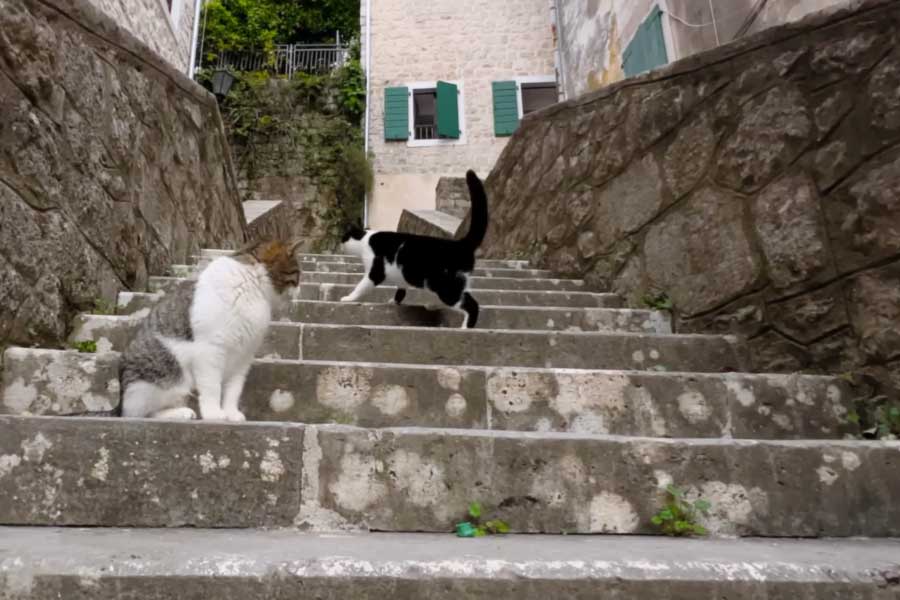
You will notice them immediately. Cats. Everywhere. Sleeping on cafe chairs, fighting in the alleys, posing for photos on the steps of the cathedral. The cats of Kotor Old Town are not pests; they are citizens.
There is a legend that says the cats saved Kotor from the plague by killing the rats coming off the ships. Whether that is true or not, the locals treat them with reverence. You will see bowls of food and water on every corner.
There is even a Cat Museum (Museo del Gatto) located in an old monastery building near the Cinema Square. It is a quirky, small museum filled with vintage postcards, posters, and coins featuring cats. It might seem like a tourist trap, but the entry fee goes towards feeding and sterilizing the street cats. So, visiting it is actually a charitable act.
The Market of Kotor Old Town: A Taste of the Mountains
Just outside the Sea Gate, hugging the city walls, is the famous Kotor Market (Markat). This is where the mountains meet the sea on a plate.
Every morning, but especially on Saturdays, farmers from the nearby mountains and fishermen from the bay bring their goods here. It is a sensory explosion. You will smell the smoked ham (pršut) from Njeguši, the sharp sheep cheese, and the fresh fish caught that morning.
Do not be shy. The vendors will shout at you to taste their olives, their pomegranate syrup, and their figs. This is the best place to buy a cheap and delicious lunch. Grab a loaf of bread, some cheese, and a bag of tomatoes, and find a bench in the park nearby. It is an authentic Kotor experience that costs a fraction of a restaurant meal.
Climbing to the Fortress of San Giovanni above Kotor Old Town
If you have strong legs and a strong heart, the ultimate experience of Kotor Old Town is the climb to the Fortress of San Giovanni (St. John). Also, you can hike Ladder of Kotor.
The entrance to the trail is hidden in the back alleys of the town. Once you find it, you have 1350 stone steps ahead of you. It is a grueling climb, especially in the summer heat. But as you ascend, the noise of the town fades away, replaced by the wind and the cry of seagulls.
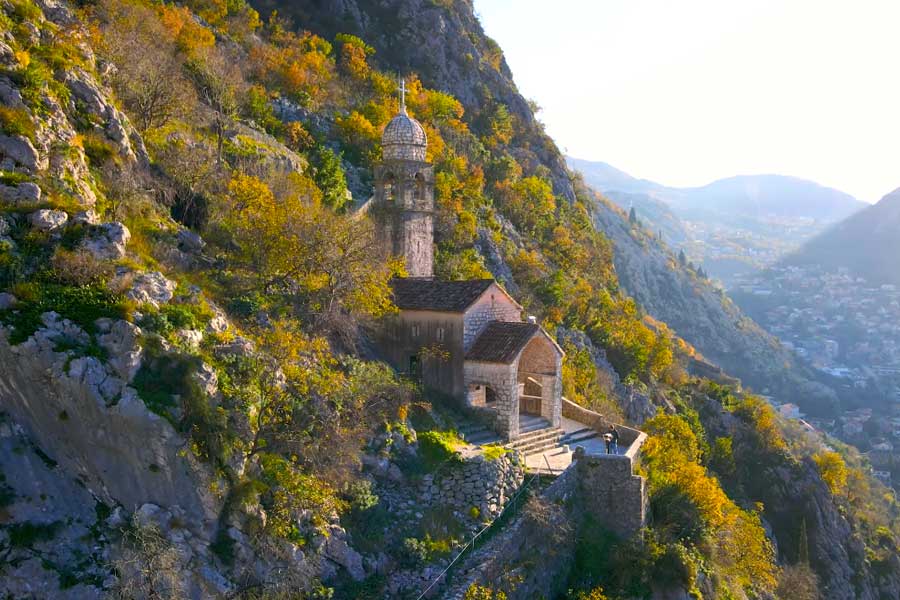
About halfway up, you will reach the Church of Our Lady of Health (Gospa od Zdravlja). It was built by survivors of the plague in the 15th century. It is a perfect resting spot. Turn around, and the view will knock the wind out of you (if the stairs haven’t already). You see the entire bay, the red roofs of Kotor Old Town, and the massive cruise ships looking like toys in a bathtub.
Continue to the top, to the fortress itself. It is a ruin now, but exploring the crumbling walls and looking down a sheer drop into the moat is exhilarating. Standing there, you understand why no one ever conquered Kotor by force.
The River Gate and Gurdic Gate: The Back Doors of Kotor Old Town
While everyone enters through the Sea Gate, the other two entrances to Kotor Old Town are just as interesting and much quieter.
To the north, there is the River Gate (South Gate), built in 1540 to commemorate the victory over the famous admiral Hayreddin Barbarossa. Yes, that Barbarossa. He tried to take Kotor with 70 ships and failed. The gate leads out to a bridge over the Škurda River, where the water is so clear you can see trout swimming.
To the south lies the Gurdic Gate. This is a brilliant piece of medieval engineering. It has a triple-locking system and a drawbridge that used to be raised every night. The weird thing about the Gurdic Spring here is that it is a “submarine spring”, during heavy rains, the fresh water pushes the sea water out, creating a boiling effect on the surface. It is a strange natural phenomenon guarding the city entrance.
The Secret Squares of Kotor Old Town
The beauty of Kotor Old Town is in getting lost. The main squares like the Arms Square and St. Tryphon Square are great, but the real magic is in the smaller ones.
Look for the “Square of the Flour” (Trg od Brašna), where the Pima and Buća palaces are located. It is quieter, more intimate. Or find the “Square of Milk” (Trg od Mlijeka), which is tiny and charming.
There is also the “Cinema Square” (Trg od Kina), named after the old cinema that used to be there. Now it is home to a lonely tree and several excellent cafes. These are the places where you can sit with a coffee for two hours, watch the locals gossip, and feel the pulse of the city.
Practical Guide to Visiting Kotor Old Town
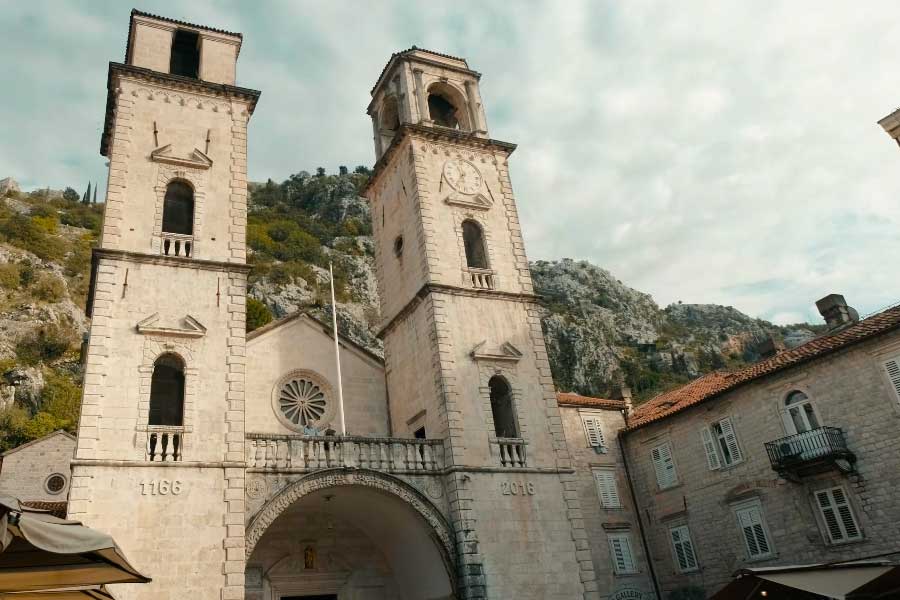
Kotor Old Town is a pedestrian-only zone. No cars are allowed inside, which preserves the medieval atmosphere but makes luggage handling a workout.
The town is open 24/7. There are no gates that close at night, so you can walk the empty streets at 3 AM, which is a hauntingly beautiful experience.
Most shops and museums open around 9 AM and stay open late in the summer, often until 10 or 11 PM. However, in winter, the town goes into hibernation, and many places close early or shut down completely for the season.
If you are visiting in summer, be aware of the cruise ship schedule. When a massive ship docks, the town can get overwhelmingly crowded between 10 AM and 3 PM. The trick is to explore early in the morning or late in the afternoon when the day-trippers have left. That is when Kotor Old Town returns to being a magical, silent stone city. If you have an extra day in Kotor, consider taking a boat tour to the Blue Cave, where the underwater light show creates an otherworldly experience that perfectly complements the historic charm of the Old Town.
If you are looking for more structured recommendations beyond just wandering the Old Town, our comprehensive guide covers the top 5 things to do in Kotor with detailed tips on timing, costs, and what to expect at each attraction.
Frequently Asked Questions About Kotor Old Town
Is there an entrance fee for Kotor Old Town?
No, entering the Old Town itself is completely free; you can wander the streets and squares without paying anything, although specific museums and the fortress walls hike do charge fees.
How much does it cost to hike to the Fortress of San Giovanni?
The entrance fee for the hike up the city walls to the fortress is typically 8 Euros per person during the season (May to October), usually collected at the turnstiles near the start of the stairs.
Is Kotor Old Town wheelchair accessible?
The Old Town is mostly flat and paved with stone slabs, so it is possible to move around in a wheelchair, but it can be bumpy; however, accessing buildings with stairs or the upper city walls is not possible.
Can I drink the tap water in Kotor Old Town?
Yes, the tap water in Kotor is generally safe to drink, and there is also a famous public fountain (Karampana) where you can refill your bottle with fresh water.
What is the best currency to use in Kotor Old Town?
Montenegro uses the Euro (€) as its official currency, even though it is not yet part of the European Union, so make sure to have some cash on hand for smaller shops.
Our Most Popular Tours To Sarajevo
We offer many tours that include a visit to Sarajevo and its most popular locations:
- Full Day tour from Sarajevo to Belgrade (Most Popular)
- Full Day tour from Sarajevo to Međugorije & Mostar
- Full Day Tour from Sarajevo to Travnik and Jajce
- Full-Day 5 Cities Tour from Sarajevo to Herzegovina (Mostar)
- Full day Tour from Sarajevo to Dubrovnik (Kotor or Split)
Don’t Hesitate To Say Hi!
Got any questions about our tours or the city? Don’t hesitate to contact us anytime for more info and booking.
Use the following phone number and email: