
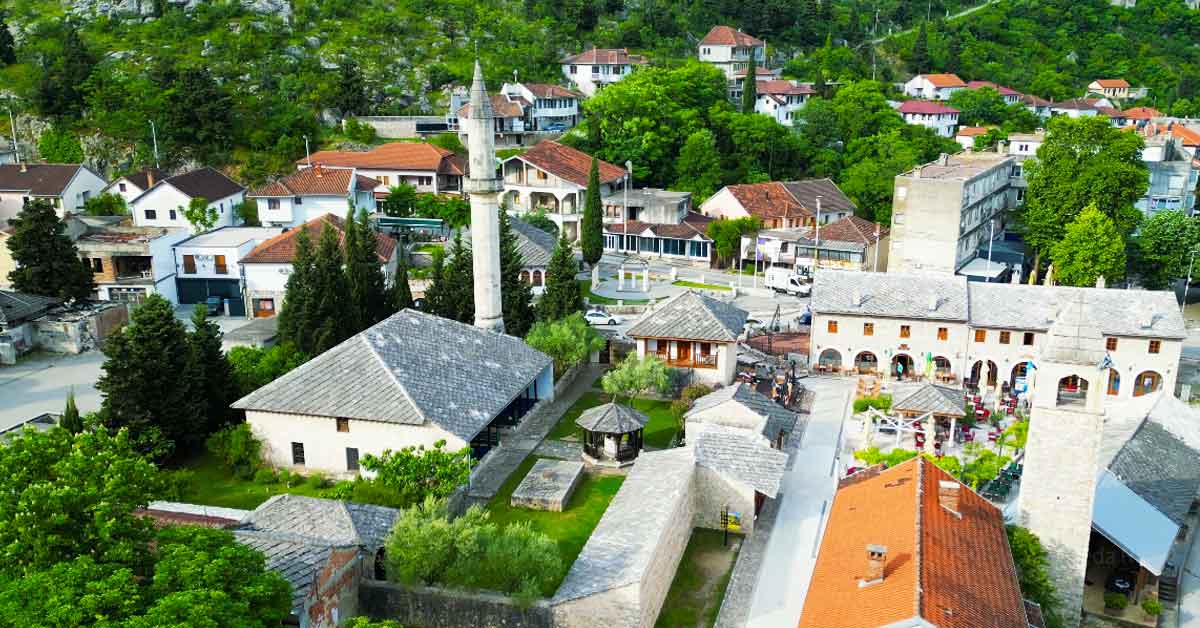
Imagine a town where 16,000 years of continuous human habitation are visibly layered into the landscape – from Paleolithic cave art to ancient Illyrian stone fortifications to Ottoman mosques to Austro-Hungarian architecture. Welcome to Stolac, Bosnia and Herzegovina’s most historically dense destination and one of southern Europe’s most profoundly underestimated towns. Located just 30 kilometers south of Mostar in Herzegovina’s lower Neretva Valley, Stolac remains virtually unknown to mainstream tourism despite possessing exceptional heritage that rivals far more famous Balkan destinations.
Stolac represents a different experience entirely from the crowded streets of Mostar or Dubrovnik. This is a town where you’ll encounter more stećci (medieval tombstones) in single afternoon than most European travelers witness in lifetime. Where you can ascend a 2,000-year-old fortress within 20-minute hike from town center. Where restaurants serve fresh trout caught same morning from pristine river. Where ancient Illyrian princes once ruled, Ottoman governors once administered, and contemporary Bosnians continue living in narrow Ottoman-era streets largely unchanged from the 15th century.
Yet Stolac remains remarkably underdeveloped for tourism – a deliberate choice reflecting the town’s character. There are no cruise ship tours, no commercialized attractions, no chain hotels. Instead, you encounter authentic Bosnian hospitality, traditional cuisine, archaeological wonders, and landscapes of extraordinary beauty maintained by people who live here year-round rather than performing heritage for seasonal visitors. This comprehensive guide reveals how to experience Stolac’s remarkable depth within a single day – though after visiting, most travelers wish they had allocated multiple days.
Table of Contents
Stolac’s Extraordinary Historical Timeline – From Ice Age to Present
What renders Stolac uniquely significant is the sheer temporal depth of inhabitation. Unlike most European towns with documented history extending back perhaps 1,000-2,000 years, Stolac can claim continuous human presence spanning 16 millennia – longer than the entire history of written civilization.
The Paleolithic Period (14,000 BC) is documented at Badanj Cave, located 7 kilometers outside Stolac. Archaeological evidence indicates that hunter-gatherers occupied the cave during Ice Age, leaving behind one of the Balkans’ most significant Paleolithic artifacts – horse engravings carved into stone approximately 14,000 years ago. These engravings represent some of Europe’s oldest art, contemporary with famous cave paintings in France and Spain. The artistic sophistication suggests sophisticated cognitive capabilities and cultural traditions extending back to the dawn of human art itself.
The Bronze and Iron Ages (1200-400 BC) brought development of the Daorsi, an Illyrian tribe that established the powerful city of Daorson near contemporary Stolac. Archaeological excavation reveals massive Cyclopean walls constructed without mortar – enormous stones fitted together using only weight and engineering skill. Daorson flourished as military stronghold and trading center controlling routes connecting the Balkans interior to Mediterranean coast. The city was destroyed around 50 BC during Roman conquest but never rebuilt – its remains visible today suggest a sophisticated pre-Roman civilization.
The Medieval Period (7th-16th centuries) witnessed emergence of the Kingdom of Bosnia and flowering of the unique culture now recognized through UNESCO World Heritage stećci necropolis sites. The Radimlja Necropolis contains 133 medieval tombstones (stećci) dating 13th-16th centuries, with 63 adorned with intricate artistic carvings – knights, vines, religious symbols, and mysterious figures whose meanings remain partly unknown. The nearby Boljuni Necropolis holds 274 stećci, some featuring unique artistic motifs including a lion, women cradling children, and elaborate rosettes. These sites represent the most complete inventory of medieval Bosnian culture – a civilization that mysteriously disappeared yet left behind stone testimony to sophisticated artistic traditions. Master craftsman Grubač created many of these pieces, and his own tomb within the necropolis honors his extraordinary artistic legacy.
Simultaneously, Stari Grad Stolac (Old Town Fortress) was constructed as defensive stronghold, with origins reaching back to Illyrian and Roman periods but substantially developed during Ottoman era. In the 15th century, the fortress became residence of Stjepan Vukčić Kosača, one of southern Bosnia’s most powerful medieval rulers, who declared himself “Duke of Saint Sava.” The fortress served as administrative center, military garrison, and noble residence – controlling access to Mediterranean trade routes and administering regional governance.
The Ottoman Period (1465-1878) transformed Stolac from fortress town into urban center. The Sultan Selim Mosque, constructed 1519, became the oldest and most prominent mosque in Herzegovina – still functioning today as spiritual center. The Ottoman town district developed along the Bregava River with traditional mahala (neighborhood) layout – residential complexes facing inward onto courtyards in typical Ottoman fashion. The Velagić House complex represents highest-quality Ottoman domestic architecture surviving in Herzegovina, demonstrating sophisticated urban living standards.
The Austro-Hungarian Period (1878-1918) brought architectural modernization. The Sara Kašiković Girls’ Bridge, built 1896, honors a tragic love story – architectural memorial to personal tragedy transformed into cultural heritage. The fortress was expanded with Austro-Hungarian military infrastructure, though original Ottoman structures remained visible beneath new construction.
This extraordinary historical layering – Paleolithic to contemporary – creates unusual situation where visitors can literally walk through 16,000 years of continuous human civilization within single afternoon.
Morning in Stolac – Radimlja Necropolis and Medieval Tombstones
Begin your Stolac day at Radimlja Necropolis, located on the road from Čapljina toward Stolac approximately 2 kilometers before town center. Arriving early (8:00-9:00 AM) ensures you’ll encounter the site before day-trippers arrive and provides optimal early-morning light for photography. The necropolis is completely free to visit, open 24 hours, with no infrastructure beyond basic informational signs.
Radimlja’s appearance is deceptively simple – a field of approximately 133 stone tombstones (stećci) arranged in regular east-west alignment, as if the deceased are sleeping and awaiting resurrection toward the rising sun. The rocks themselves are unadorned at first glance – rectangles of pale limestone arranged in orderly rows. However, walking among the stones reveals extraordinary artistic detail carved into their surfaces. Approximately 63 of Radimlja’s stećci feature intricate decorations – scenes depicting armed knights (suggesting noble burials), vine tendrils (symbolizing life’s continuity), geometric patterns, and enigmatic figures whose meanings archaeologists continue debating.
The artistic quality varies dramatically – some stones feature crude carvings suggesting local artisans, while others demonstrate sophisticated skill consistent with master craftsmen. The iconic image is the male figure with raised hand – a gesture of welcome or benediction greeting visitors at the necropolis entrance. This image appears on tourist materials throughout Bosnia, recognized as symbol of medieval Bosnian culture.
The necropolis raises profound historical questions that remain unanswered centuries later: Who were these individuals memorialized? What prompted the distinctive artistic conventions? Why were stećci concentrated in this region? Did they reflect Bosnian Christian (Bogumil) heresy, as some historians suggest? Or do they represent purely local cultural traditions? The mystery adds emotional resonance – these stones represent real people whose stories have largely vanished, leaving only stone silhouettes and speculative historical narratives.
Photography Note: The early morning light creates dramatic shadows across the stone field, making 8:00-10:00 AM optimal for photographers. The uniform east-west orientation means golden-hour light perfectly illuminates the carved surfaces.
Time Required: 60-90 minutes allows thorough exploration and contemplation.
Late Morning in Stolac – Boljuni Necropolis and Artistic Mastery
Continue approximately 10 kilometers to Boljuni Necropolis, another UNESCO World Heritage stećci site featuring 274 tombstones with even greater artistic diversity than Radimlja. The journey between sites takes approximately 20 minutes by vehicle; the necropolis is slightly more remote and attracts fewer visitors, providing contemplative experience.
Boljuni distinguishes itself through artistic originality attributed largely to Grubač, the most prolific medieval master-craftsman specializing in stećak decoration. His signature style appears throughout the necropolis – distinctive vine scrollwork, elaborate geometric patterns, and narrative scenes suggesting storytelling traditions embedded in stone. Unique motifs found primarily at Boljuni include a lion (suggesting heraldic pride or power), a woman cradling an infant (suggesting maternal devotion or specific historical narrative), stylized rosettes (floral symbolism), and representations of “round dance” scenes – possibly depicting social celebrations or ceremonial gatherings.
The artistic sophistication indicates medieval Bosnian culture possessed sophisticated artistic traditions, skilled craftsmen, and presumably wealthy patrons willing to commission elaborate tombstones. The concentration of elaborate stećci in this region suggests this area was culturally significant – perhaps a regional administrative center or important trading hub where accumulated wealth enabled artistic investment.
The contrast between Radimlja and Boljuni is instructive – Radimlja displays broader representation of Bosnian stećak tradition; Boljuni showcases elite artistic expression. Together they provide comprehensive overview of medieval Bosnian mortuary practices and aesthetic values.
Time Required: 60 minutes (travel plus site exploration).
Lunch – Riverside Dining at Stolac Mlinica (Old Mill)
Return to Stolac center for lunch at Stolac Mlinica (Old Mill), the town’s finest dining establishment, situated directly on the Bregava River. This beautifully restored 15th-century mill building has been lovingly converted into restaurant preserving original stone architecture while providing contemporary comfort. The riverside location offers shaded outdoor seating with water views – the perfect ambiance for leisurely Bosnian meal.
The signature dish is fresh trout – caught same morning from the pristine Bregava, prepared simply (grilled or pan-fried) to showcase the fish’s delicate flavor. Trout from this river is exceptionally sweet, reflecting the cold mineral-rich water flowing from karst sources. Pair the fish with traditional sides – fresh vegetables, bread, local wine – creating authentic Herzegovina dining experience. The proprietors take genuine pride in sourcing locally and preparing traditional recipes passed through generations.
Alternative restaurants include Restoran Han (traditional Bosnian cuisine in central location), Restoran Behar (Mediterranean-influenced dishes), and Caffe Restoran Gorica (café atmosphere with lighter options). All restaurants in Stolac emphasize traditional Bosnian cuisine – ćevapi (grilled meat rolls), burek (pastry parcels), dolma (stuffed vegetables), and japrak (cabbage rolls) – with fresh local ingredients.
Meal Cost: Expect 12-20 euros for complete lunch including drink.
Time Required: 90 minutes allows leisurely meal without rushing.
Afternoon – Old Town Stolac Fortress and Town Exploration
After lunch, begin the ascent to Stari Grad Stolac – the medieval fortress perched dramatically on the hill overlooking the town. The hike from downtown center requires approximately 20-25 minutes uphill, ascending perhaps 100-150 meters elevation gain on a well-marked trail. The physical difficulty is mild-moderate – accessible for most fitness levels, though sturdy shoes are advisable for rocky terrain.
The fortress itself is extraordinary – a multi-layered historical complex revealing construction across multiple civilizations. The foundational megalithic wall dates to the 4th century BCE when Illyrians built the initial defensive structure. Roman additions followed, then Ottoman construction, then Austro-Hungarian military expansion. The resulting structure integrates architectural styles spanning 2,400 years – each conquest adding infrastructure reflecting contemporary military technology.
The fortress covers approximately 2+ hectares – substantial defensive complex suggesting significant administrative and military importance. Multiple towers remain partially intact, offering panoramic views across the Bregava Valley, surrounding mountains, and toward the distant Adriatic coastline. On clear days, visibility extends 40+ kilometers – the strategic value is immediately apparent. From this vantage point, medieval rulers could observe approach routes, monitor the river traffic, and control access to the valley.
Disappointingly, informational displays about the fortress are sparse – there are no museum facilities, detailed interpretive signs, or guides available. The fortress is essentially un-excavated – much remains beneath vegetation, making it impossible to perceive the complete original structure. However, this minimal infrastructure preserves authentic character – the fortress feels discovered rather than curated, genuine rather than touristic.
Photography Opportunity: Late afternoon provides golden light illuminating the fortress stones while casting dramatic shadows across the valley. The viewpoints offer stunning landscape photography – Bregava River winding through valley, surrounding mountains, and distant horizons.
After descending from the fortress, explore Stolac’s Old Town district – the Ottoman-era settlement featuring narrow streets, traditional stone houses, and preserved medieval/Ottoman architecture. The Sultan Selim Mosque (1519) stands prominently, and though non-Muslims cannot enter during prayer times, the exterior architecture reflects Ottoman sophistication. The Ćuprija Bridge (possibly medieval, reconstructed 17th century) spans the Bregava with distinctive irregular arches – local legend claims the bridge was built “out of spite” by a builder offended by community insult, resulting in the nickname “Spite Bridge.”
Walking the Old Town’s narrow cobblestone streets, observing traditional courtyard layouts, and encountering locals living their daily lives provides authentic cultural experience. This is not reconstructed heritage – these are functioning neighborhoods where families have lived for generations, preserving traditions through ordinary life rather than touristic performance.
Time Required: 3-4 hours for fortress hike plus Old Town exploration.
Optional Afternoon Activity in Stolac – Badanj Cave
If time permits, the Badanj Cave represents Bosnia’s most significant Paleolithic site, located approximately 7 kilometers outside Stolac. The cave contains the famous horse engravings dated 14,000 years ago – contemporary with the earliest European art. The cave is accessible for visits, though facilities are minimal – this is an authentic archaeological site rather than commercialized tourist cave.
The journey to Badanj requires vehicle and basic navigation (signage limited), and the experience involves entering an actual archaeological site with modest interpretation. However, standing before stone engravings created 14,000 years ago – attempting to imagine the hunter-gatherer who carved the horse – creates profound connection to human continuity. These engravings represent the artistic impulse extending back to the Ice Age, evidence that humans 14,000 years ago possessed the same cognitive and creative capacities as contemporary people.
Time Required: 1-2 hours including travel, cave exploration, and reflection.
Evening – Sunset and Departure from Stolac
As afternoon transitions to evening, return to town center for relaxation before departure. The Bregava River is particularly beautiful at sunset – the water reflects golden and orange light, creating photographic magic. The narrow Old Town streets assume quieter character as day-trippers depart, revealing authentic community life.
For evening meal, Pizzeria Amadeus offers Italian cuisine, Ring A Guy features grilled specialties, or return to Stolac Mlinica for repeat dinner experience if the food justified continuation. Most restaurants remain open until 10:00-11:00 PM.
Depart Stolac late evening to Mostar (30-minute drive) or overnight in Stolac if staying longer to explore further archaeological sites like Daorson fortress or less-visited heritage locations.
Practical Considerations for Visiting Stolac
Location and Access: Stolac is located 30 kilometers south of Mostar, 85 kilometers south of Sarajevo, and 35 kilometers north of the Croatian border. Vehicle is essential – there is minimal public transportation. From Mostar, driving requires 45 minutes; from Sarajevo approximately 2 hours. The town is easily combined with Mostar (1 hour apart), Blagaj (20 minutes), Kravice (45 minutes), or Medjugorje (20 minutes) in multi-day itineraries.
When to Visit: Spring (April-May) and autumn (September-October) offer optimal weather – 15-25°C temperatures, clear skies, and lower crowds. Summer (June-August) reaches 25-35°C with occasional crowding during peak season. Winter (November-March) brings cool temperatures but clear days with excellent archaeological site visibility. The annual Stolačka Tarča medieval fair (May) features historical reenactments, traditional crafts, medieval costumes, and authentic cultural celebration – timing a visit to coincide with this festival adds exceptional value.
Accommodation: Stolac offers limited but authentic accommodation – family-run guesthouses (15-30 euros per night), traditional houses converted to boutique hotels (25-50 euros), and basic hostels (10-15 euros). Booking in advance is recommended during summer months. Many travelers combine Stolac with nearby Mostar accommodation, staying in Mostar while day-tripping to Stolac.
Dining and Costs: Restaurants emphasize traditional Bosnian cuisine with fresh local ingredients, particularly trout from Bregava River. Meals cost 10-20 euros for complete dish plus drink. Coffee costs 1-2 euros; local wine 3-5 euros per glass. Cash is advisable – not all establishments accept cards.
What to Bring: Sturdy walking shoes (fortress hike involves rocky terrain), sun protection (hat, sunscreen), water bottle, camera, and modest clothing (respect local customs, particularly near mosques). Bring cash (euros) – ATMs exist but aren’t universal. Insect repellent useful during warm months near river areas.
Photography: Badanj Cave horse engravings, stećci necropolis layouts, fortress panoramas, and Old Town architecture provide exceptional photographic subjects. Early morning and late afternoon light optimal. Respect local customs – ask permission before photographing individuals.
FAQ – Stolac Questions
What makes Stolac unique compared to other Bosnian heritage sites?
Stolac encompasses 16,000 years of continuous human habitation – Paleolithic cave art, Illyrian fortifications, medieval kingdoms, Ottoman towns, and contemporary communities all visible in landscape. No other Bosnian destination spans such temporal depth.
How long does visiting Stolac require, and can it be done as day trip from Mostar?
A satisfying day visit requires 6-8 hours – Radimlja/Boljuni necropolis, fortress hike, Old Town exploration, and lunch. Day trips from Mostar are feasible; two days enable relaxed experience including Badanj Cave and archaeological depth.
Are the stećci necropolis sites actually UNESCO World Heritage recognized?
Yes, stećci necropolis sites (including Radimlja, Boljuni, and others) are UNESCO World Heritage sites recognized as most distinctive monuments of medieval Bosnian civilization. The artistic and historical significance is internationally acknowledged.
What is the best time of year to visit Stolac, and what are seasonal differences?
Spring/autumn ideal – 15-25°C, clear skies, moderate crowds. Summer hot (25-35°C) but enables all activities. Winter cool (5-15°C) but clear days provide excellent archaeological site visibility. May features annual medieval fair.
Is Stolac suitable for families with children, and what age recommendations?
Yes, accessible for families. Fortress hike appropriate for children 6+ with regular water breaks. Necropolis walks easy for all ages. Medieval fair particularly appeals to families. The quiet, safe town environment suits children.
How much does it cost to visit Stolac’s attractions?
Everything is free – Radimlja and Boljuni necropolis sites are open access, fortress hiking free, Old Town walking free. Only meals cost money (10-20 euros per person). Exceptionally affordable heritage destination.
Our Most Popular Tours To Sarajevo
We offer many tours that include a visit to Sarajevo and its most popular locations:
- Full Day tour from Sarajevo to Belgrade (Most Popular)
- Full Day tour from Sarajevo to Međugorije & Mostar
- Full Day Tour from Sarajevo to Travnik and Jajce
- Full-Day 5 Cities Tour from Sarajevo to Herzegovina (Mostar)
- Full day Tour from Sarajevo to Dubrovnik (Kotor or Split)
Don’t Hesitate To Say Hi!
Got any questions about our tours or the city? Don’t hesitate to contact us anytime for more info and booking.
Use the following phone number and email: