
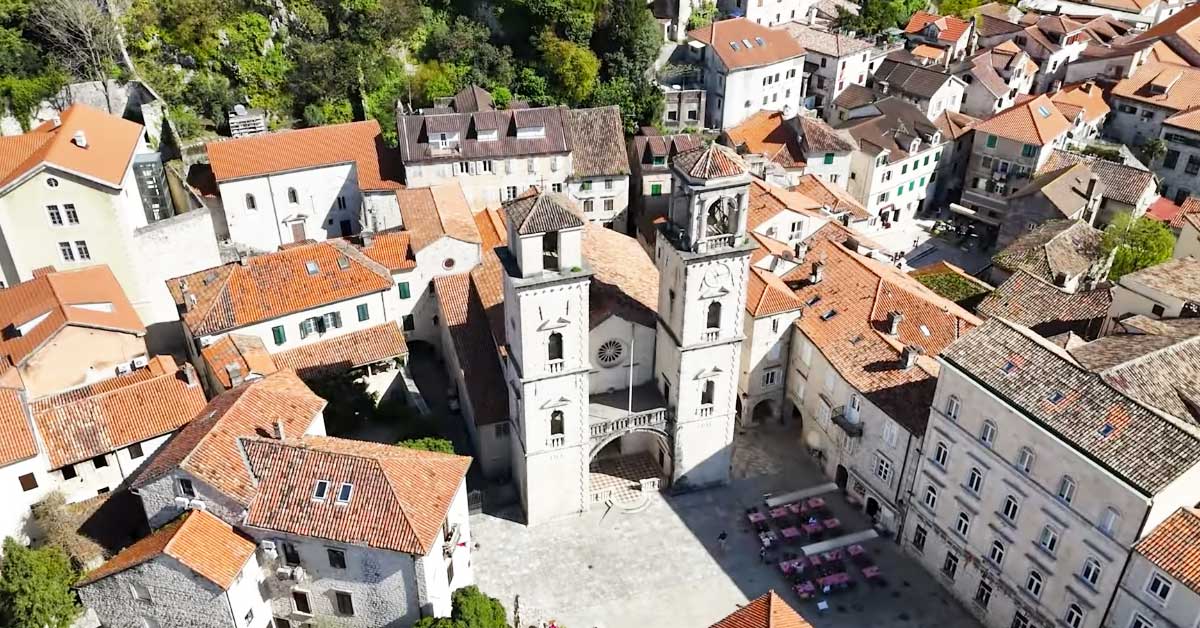
If you are standing in the middle of Kotor’s old town, surrounded by the towering limestone cliffs of Mount Lovćen on one side and ancient stone walls on the other, you might feel small. But turn your gaze to the largest square in the city, and you will see a building that has stood tall against earthquakes, empires, and time itself. This is St. Tryphon Cathedral.
St. Tryphon Cathedral is not just a pile of old stones. It is the reason Kotor exists as we know it. It is older than Notre Dame in Paris by 69 years. It houses treasures that would make Indiana Jones jealous. And inside its cool, quiet walls lies a story of a city that bought its own patron saint because they refused to be just another dot on the map.
Table of Contents
The Legend of How St. Tryphon Came to St. Tryphon Cathedral
Before we admire the architecture of St. Tryphon Cathedral, you need to know the story of why it is even here. St. Tryphon was a young martyr from Phrygia (modern-day Turkey) who was killed for his faith in the 3rd century. He had absolutely nothing to do with Kotor.
So, how did he become the boss of the bay?
The legend says that in the year 809, a Venetian ship carrying the body of St. Tryphon from Constantinople to Venice was caught in a terrible storm. They sought shelter in the Bay of Kotor. The storm raged for days, and every time the ship tried to leave, the winds would push it back. The sailors took this as a divine sign: the saint did not want to go to Venice; he wanted to stay here.
The clever citizens of Kotor, sensing an opportunity to put their city on the religious map, made the captain an offer he couldn’t refuse. They bought the relics of the saint for 300 gold pieces. It was a fortune back then, but it was the best investment Kotor ever made. They built a church to honor him, which later became the magnificent St. Tryphon Cathedral we see today.
A Survivor of Earthquakes: The Architecture of St. Tryphon Cathedral
When you stand in the square and look at the facade of St. Tryphon Cathedral, you will notice something odd. The two bell towers are not the same. One is slightly taller, and the other looks a bit unfinished. This is not a stylistic choice; it is a scar from a disaster.
In 1667, a massive earthquake shook Dubrovnik and Kotor to their foundations. The original face of the cathedral was destroyed, and both towers came crashing down. When they rebuilt them, the city ran out of money. The stone needed to finish the second tower was expensive, so they just… stopped.
The cathedral was damaged again in the horrific earthquake of 1979, but it was lovingly restored. Today, St. Tryphon Cathedral is a beautiful mix of Romanesque strength and Baroque elegance. The interior is surprisingly bright for such an old building, with slender Corinthian columns made of pink stone that support the roof. It feels ancient, yet resilient, much like the people of Kotor.
The Silver Ciborium: The Masterpiece Inside St. Tryphon Cathedral
Walk down the main aisle towards the altar, and your eyes will be drawn to a stunning structure standing over the holy table. This is the Ciborium (a canopy over the altar), and it is one of the finest examples of Gothic sculpture in the entire Adriatic.
Carved in the 14th century, the Ciborium of St. Tryphon Cathedral tells the life story of the saint in four stone reliefs. You can see scenes of his miracles and his martyrdom. It is supported by four columns of red marble, which were brought here from who-knows-where by Kotor’s seafaring captains.
But look even closer. Behind the Ciborium, on the wall of the apse, is the “Golden Altarpiece” (Pala d’Oro). It is a silver-gilded panel made by local Kotor goldsmiths in the 15th century. It features Christ, the Virgin Mary, St. John the Baptist, and St. Tryphon. The level of detail is insane so you can see the individual hairs on the saints’ beards. It proves that Kotor was not a backwater fishing village, but a wealthy center of art and culture.
The Reliquary Chapel: Where the Saint Sleeps in St. Tryphon Cathedral
Climb the narrow stairs to the upper level of the cathedral, and you will enter the most sacred part of the building: the Reliquary Chapel. This is where the magic happens. Or rather, where the history is kept.
The centerpiece of this chapel in St. Tryphon Cathedral is the silver coffin (sarcophagus) of St. Tryphon. It is not hidden away in a crypt; it is right there. The sides of the coffin are decorated with intricate reliefs showing more scenes from the saint’s life. It is a masterpiece of silverwork, hammered out by local artisans who wanted to give their protector the best bed money could buy.
But that is not all. The chapel is lined with glass cabinets filled with reliquaries. These are silver containers shaped like arms, legs, and even heads, containing the bones of various saints. It might seem a bit macabre to modern sensibilities, but in the Middle Ages, these were the most valuable things a city could own. They were spiritual batteries, charging the city with divine protection.
Among them is the famous “Glorious Head” of St. Tryphon, kept in a separate reliquary. On his feast day (February 3rd), these relics are paraded through the town, a tradition that has survived for over 1200 years.
The Museum of Sacral Art in St. Tryphon Cathedral
While you are upstairs, do not miss the Museum of Sacral Art. It is located in the gallery space that overlooks the nave of the church, and honestly, it punches well above its weight. This isn’t just a dusty room with a few old candlesticks; it is a treasure trove that rivals collections in much larger European cities.
The collection is a testament to the immense wealth Kotor accumulated through maritime trade, featuring the valuable silver polyptych by local goldsmith Hans of Basel, but the true stars are the paintings. You will find masterpieces by the famous local Baroque artist Tripo Kokolj, the same genius who painted the stunning interior of Our Lady of the Rocks in Perast, whose works are dramatic, emotional, and full of rich colors, alongside gems by Marin Lovra Dobričević, a 15th-century master whose delicate Virgin with Child bridges the gap between stiff Byzantine style and natural Italian Renaissance art.
But it’s not just about flat art. The museum houses a breathtaking collection of silver bas-reliefs. These are not just decorative items; they are votive offerings given by captains who survived shipwrecks or storms. The silver was often melted down from coins earned on trading voyages. You can see the dents and the hand-hammered details that tell you a human being made this by candlelight 500 years ago.
Perhaps the most haunting object is the wooden crucifix from 1288. It is one of the oldest preserved wooden sculptures in the region. The figure of Christ is raw and agonizing, stripped of the gold and glamour you see elsewhere. It offers a stark, powerful contrast to the shimmering silver around it.
Finally, take a moment to admire the liturgical vestments. These are not just clothes; they are historical documents woven in silk and gold thread. Some of these robes date back to the 17th and 18th centuries and were worn by bishops during the most important feasts. The embroidery is so dense that the fabric feels heavy just looking at it, featuring floral patterns and religious symbols that have barely faded over hundreds of years. This collection gives you a tangible sense of the pomp and ceremony that once filled the cathedral below.
The View from the Balcony of St. Tryphon Cathedral
There is a secret bonus to visiting the upper level of St. Tryphon Cathedral. There is a door that leads out onto the small balcony between the two bell towers.
Step outside, and you have the best view of St. Tryphon Square. You can look down on the tourists sipping their coffees, watch the kids chasing pigeons, and see the sheer cliff of the Lovćen mountain rising straight up behind the clock tower.
It is a fantastic photo spot, framing the red-tiled roofs of the Old Town with the grey limestone of the mountains. You feel like a town crier or a bishop addressing his flock. Just do not drop your phone; it is a long way down.
Why St. Tryphon Cathedral is More Than a Church
It is easy to think of St. Tryphon Cathedral as just a Catholic church. But in Kotor, it is a symbol of identity. For centuries, Kotor was a Catholic island in a sea of Orthodox and Ottoman territories. The cathedral was the fortress of their culture, their connection to the West, to Venice and Rome.
Even today, although the Catholic population in Kotor is small, the cathedral belongs to everyone. St. Tryphon is the patron of the city, not just the Catholics. His flag flies over the city walls. His name is on the lips of the Boka Navy members during their annual dance.
When the 1979 earthquake nearly destroyed the town, the first building they rushed to save was St. Tryphon Cathedral. It is the anchor that holds Kotor in place.
Practical Information for Visiting St. Tryphon Cathedral
St. Tryphon Cathedral is located in St. Tryphon Square (Trg Svetog Tripuna), the main square of the Old Town. You cannot miss it; it is the building that dominates the space.
The cathedral is open to visitors all year round. In the summer season (April to October), it is usually open from 9:00 AM to 6:00 PM. In the winter, the hours are shorter, typically 9:00 AM to 1:00 PM. Sunday mornings are reserved for mass, so tourist visits might be restricted until the service is over.
The entrance fee is very reasonable, usually around 3 to 4 Euros. This ticket includes access to the main church, the Reliquary Chapel upstairs, the Museum of Sacral Art, and the balcony. It is one of the best value tickets in town.
There is a small souvenir shop inside the entrance where you can buy rosaries, guidebooks, and postcards. Please remember that this is a functioning place of worship. Dress modestly (no beachwear), and take your hat off when you enter.
Frequently Asked Questions About St. Tryphon Cathedral
What are the opening hours for St. Tryphon Cathedral?
The cathedral is typically open for tourists from 9:00 AM to 6:00 PM during the summer season, while winter hours are reduced, often closing by 1:00 PM.
Is there an entrance fee for St. Tryphon Cathedral?
Yes, there is a small entrance fee of approximately 3 to 4 Euros which goes towards the maintenance of the building and includes access to the upper museum and relics.
Can I see the relics of St. Tryphon inside the cathedral?
Yes, the relics, including the silver casket and the “Glorious Head,” are kept in the Reliquary Chapel on the upper floor and are visible to visitors.
Is there a dress code for visiting St. Tryphon Cathedral?
As with most active churches, visitors are expected to dress modestly; this means covering shoulders and knees, and men should remove their hats.
Why are the two towers of St. Tryphon Cathedral different heights?
The towers were rebuilt after the 1667 earthquake, but the city ran out of funds to complete the left tower, leaving it unfinished and shorter than the right one.
Our Most Popular Tours To Sarajevo
We offer many tours that include a visit to Sarajevo and its most popular locations:
- Full Day tour from Sarajevo to Belgrade (Most Popular)
- Full Day tour from Sarajevo to Međugorije & Mostar
- Full Day Tour from Sarajevo to Travnik and Jajce
- Full-Day 5 Cities Tour from Sarajevo to Herzegovina (Mostar)
- Full day Tour from Sarajevo to Dubrovnik (Kotor or Split)
Don’t Hesitate To Say Hi!
Got any questions about our tours or the city? Don’t hesitate to contact us anytime for more info and booking.
Use the following phone number and email: