
Standing in the Luža Square in front of Sponza Palace for the first time, you encounter one of those rare architectural moments where history and beauty collide so dramatically that you can almost feel the centuries pressed into the stone. This is not a palace built for a king or a noble family. It is something far more interesting. It is a palace built for commerce, for the administration of power and for the careful management of resources that kept an entire maritime republic solvent for nearly a thousand years.
Sponza Palace, also called Divona from the Italian word for customs, is arguably the most perfectly preserved expression of Dubrovnik’s Golden Age when it functioned as a sophisticated trading republic rivaling Venice. Understanding Sponza Palace means understanding how medieval Dubrovnik actually worked beneath the propaganda and poetry. It is where money was counted, where taxes were collected, where goods were weighed and measured and where the bureaucracy of an empire was conducted with enough integrity that merchants from across Europe trusted their valuable cargo to Dubrovnik’s care.
This guide explores the architecture, history and contemporary significance of Sponza Palace. You will learn why this building matters, what you see when you visit, how to access the State Archives that now live within its walls and why Dubrovnik residents themselves consider this monument one of the most important surviving witnesses to their city’s past.
Table of Contents
The Construction of Sponza Palace: Building Sophistication in the 16th Century
Sponza Palace was constructed between 1516 and 1522, a moment in history when Dubrovnik was at the height of its maritime power and commercial influence. This seven-year construction process created a building so well engineered and so aesthetically considered that it survived virtually unchanged for 500 years and still stands almost exactly as visitors in 1525 would have seen it.
The architect responsible for the design was Paskoje Miličević Mihov, a Croatian Renaissance builder whose name appears attached to multiple Dubrovnik buildings. Miličević designed a rectangular structure with an inner courtyard that solved several simultaneous problems. The building needed to function as a customs house where international merchants’ goods could be inspected, weighed and taxed. It needed to house the city’s treasury and mint. It needed to serve as a bonded warehouse where goods could be stored securely. It needed to impress foreign traders with Dubrovnik’s wealth and sophistication. Miličević’s solution addressed all these requirements while creating something that is also genuinely beautiful.
The construction team included the brothers Andrijić, renowned stonecutters who executed the detailed carving and sculptural work that gives Sponza its character. The building was constructed from pale limestone sourced from nearby quarries, which gives it a luminous quality, especially in morning light or when spotlights illuminate it at night. The stone was carefully chosen for both beauty and durability, a practical decision that allowed the palace to resist earthquakes, wars and centuries of exposure to Mediterranean weather.
The palace measures roughly rectangular in plan and occupies a prominent corner position in the city, with its main facade facing the Luža Square and additional facades addressing the surrounding streets. This position was deliberately chosen. It places the building at the intersection of Dubrovnik’s main commercial and administrative zones, exactly where merchants traveling through the city would encounter it. The architecture had to communicate trustworthiness and competence to international traders who would decide whether to conduct business in Dubrovnik or route their caravans through Venice or other competing ports.
Architectural Brilliance of Sponza Palace: Gothic and Renaissance Fusion
The most immediately striking characteristic of Sponza Palace is its architectural style, which blends Gothic and Renaissance elements in a way that defines a unique Dubrovnik aesthetic. This is not accidental eclecticism. It represents the historical moment Dubrovnik inhabited during the early 16th century, when European architecture was transitioning from medieval forms to Renaissance sophistication but that transition was happening unevenly across different regions.
On the ground floor, the building features an elegant covered portico supported by pointed arches, which is a Gothic form. These arches create a shaded passage running the length of the facade, providing protection from summer heat and winter rain. This covered space functioned as part of the trading operation. Merchants could display goods here. Business could be conducted beneath the arches. The ground floor also features multiple entrances leading to storage areas where imported goods were kept under controlled conditions.
The upper floors show increasingly Renaissance influences. The windows are arranged with geometric precision and symmetry, characteristic of Renaissance design principles. The openings are rectangular rather than pointed. The vertical and horizontal lines of the facade create proportional relationships that Renaissance architects considered aesthetically ideal. Stone carving becomes more refined and more ornamental on the upper levels, with decorative reliefs and sculptural elements that have no practical function but exist purely for beauty.
The overall effect is one of visual harmony. The building does not shout or compete for attention through size or flashiness. Instead, it commands respect through proportion, careful detail and the obvious quality of craftsmanship throughout. If you stand in the Luža Square and look at Sponza, then look at surrounding buildings, you notice that Sponza seems to occupy more visual space than its actual footprint would suggest. This is how Renaissance architects trained the eye, through proportion and balance rather than through decoration and ornament.
The most famous interior feature is the atrium, a covered courtyard surrounded by the building’s four walls on the ground floor. This atrium served multiple functions. It was where goods were inspected and weighed. It was where merchants negotiated deals. It was a meeting place where the elite of Dubrovnik’s society conducted business. A famous Latin inscription carved above one of the arches in the atrium reads: Fallere nostra vetant et falli pondera. Meque pondero cum merces ponderat ipse deus. Translated, it means: “Our weights do not permit cheating. When I measure goods, God measures with me.” This inscription perfectly encapsulates Dubrovnik’s commercial philosophy. The integrity of weights and measures was the foundation of trust. Without it, the entire trading system collapsed.
Historical Functions of Sponza Palace: Customs House to Cultural Center
Sponza Palace was never a residential palace in the traditional sense. It was always public property and always functioned as a government building devoted to economic and administrative purposes. This distinguishes it from Rector’s Palace, another major Dubrovnik building, which served as the official residence of the elected ruler and as the ceremonial center of power.
In its original function as a customs house, Sponza was where merchants arriving in Dubrovnik by sea had to register their goods, pay taxes and receive permission to trade. The building’s location near the harbor made this practical. Merchants disembarking from ships literally walked through the city passing Sponza early in their commercial interactions with Dubrovnik. The architecture’s message was clear. This city has systems. This city has procedures. This city can be trusted.
Beyond its customs functions, Sponza housed Dubrovnik’s mint, where the city’s currency was produced. The security implications were obvious. A heavily protected building with multiple chambers and locked storage areas was essential for minting operations. The same security allowed Sponza to serve as the city’s treasury, the place where tax revenue, tariffs and other income were stored. At various points in Dubrovnik’s history, the building also served as an armoury where weapons were kept and as a bank where merchants could store valuables and conduct financial transactions.
In the 16th century, Sponza became the home of the Academia dei Concordi, a literary academy founded to encourage humanist learning and promote Dubrovnik’s cultural sophistication. This transformation was significant. It represents the moment when medieval cities began to see themselves as centers of culture and learning, not just commerce and politics. The academy hosted scholars, poets and intellectuals who shaped Dubrovnik’s intellectual identity. By the 17th century, Sponza had become the cultural heart of the Republic of Ragusa, hosting concerts, literary readings and intellectual discussions.
The building survived the catastrophic 1667 earthquake that destroyed much of medieval Dubrovnik and killed approximately 5,000 residents. While most medieval structures required extensive repairs and reconstruction, Sponza emerged relatively unscathed, a testament to the quality of its original construction and the structural engineering that Miličević had incorporated into the design.
The Modern Sponza Palace: Archives, War and Continuity
In the 20th century, Sponza Palace became the home of the Dubrovnik State Archives, one of the most important medieval archives in Europe. The State Archives had previously been housed in Rector’s Palace, but space constraints and concerns about preserving the irreplaceable documents led to the decision to move them to Sponza. The archives contain approximately 7,000 volumes of manuscripts and about 100,000 individual documents dating from 1022 to the present. Some of these documents are among the oldest surviving administrative records from any European city. They chronicle the history of Dubrovnik and the Republic of Ragusa with incredible detail.
These are not merely historical curiosities. The documents contain the actual correspondence of medieval and Renaissance merchants, contracts for trade agreements, records of governmental decisions, letters from diplomats negotiating with the Ottoman Empire and personal correspondence that reveals intimate details about how people lived. Scholars from across Europe visit Sponza Archives to research medieval commerce, diplomatic history and social history. The physical presence of these documents, their preservation in the building where many were originally created, creates a sense of continuity across centuries.
This historical continuity was nearly broken during the war of the 1990s. In December 1991, when Dubrovnik came under artillery bombardment, Sponza Palace was directly hit. Shells struck the roof and upper floors. The impact destroyed windows and damaged interior spaces. The protective shields that had been erected around the building’s most vulnerable areas prevented even worse damage, but Sponza was clearly wounded. Photographs from the immediate aftermath show the building with blown out windows and visible shrapnel scars in the pale limestone facade.
The restoration of Sponza Palace after the war took years and required meticulous work. The destroyed roof sections had to be rebuilt to match the original medieval specifications. Windows had to be carefully reconstructed using historical research to determine exactly how they appeared in the 16th century. Damaged stonework had to be repaired or replaced, matching the original material as closely as possible. The archives themselves, which had been moved to safer locations before the shelling, were gradually returned as the building’s structural integrity was restored.
Today, the visible scars of the war remain. If you look carefully at the pale limestone facade, you can still see the marks where shrapnel struck. Rather than being hidden or covered up, these marks have been left visible as a reminder of what happened. They transform Sponza into something more than just a historical monument. They make it a contemporary witness to recent history, a building that has endured destruction and emerged again, much like the city itself.
Visiting Sponza Palace: What You Will See and Experience
Visiting Sponza Palace as a tourist differs from visiting it as a researcher accessing the archives. The building is located in the Luža Square, immediately north of the clock tower and easily accessible by walking through the Old Town. If you are standing at the western end of Stradun near the Pile Gate and facing east, walking toward the Ploče Gate, you will reach the Luža Square after about ten minutes of walking. Sponza occupies the northern side of this square.
The exterior can be appreciated from the square at any time. The portico on the ground floor is open to the public and can be entered freely. You can walk beneath the Gothic arches, experience the cool shade and imagine merchants two centuries ago conducting business in this same space. The contrast between the bright Mediterranean sunlight outside the portico and the shadow within creates a visceral sense of the building’s function. The Latin inscription over the arch is visible and can be read and contemplated.
The Luža Square itself is used for the opening ceremony of the Dubrovnik Summer Festival each year, which means that Sponza’s atrium and the space around it transform into a performance venue. If you visit during the festival season from July through August, you may encounter concerts, theatrical performances or other cultural events happening directly in front of the palace. The palace remains an active cultural venue, not just a museum.
Access to the State Archives inside Sponza Palace is available to researchers but requires advance notice and appropriate credentials. Individual tourists cannot simply walk into the archive and look around. However, occasional exhibitions of documents from the archive are displayed in public spaces, and specialized historical tours sometimes include access to specific archive areas. Contact the Dubrovnik Tourism Office or the State Archives directly before your visit if you have interest in seeing archive materials.
Architectural Legacy and Significance of Sponza Palace
Sponza Palace represents a particular moment in European architectural history when medieval and Renaissance forms were in dialogue with each other rather than in opposition. This makes it exceptionally valuable for understanding how architectural transitions happen in actual practice. Architects and historians regularly visit Sponza specifically to study how Miličević and his team managed the transition between Gothic and Renaissance vocabulary.
The palace also represents an unusual democratic principle in medieval architecture. Most grand medieval buildings were built for royalty, nobility or the church. Sponza was built for a municipality’s administrative and commercial functions. This is architecture created for public purposes rather than personal display. The sophistication of the design and the quality of execution demonstrate that a society can invest artistry and resources in public buildings with the same care that it invests in palaces for kings.
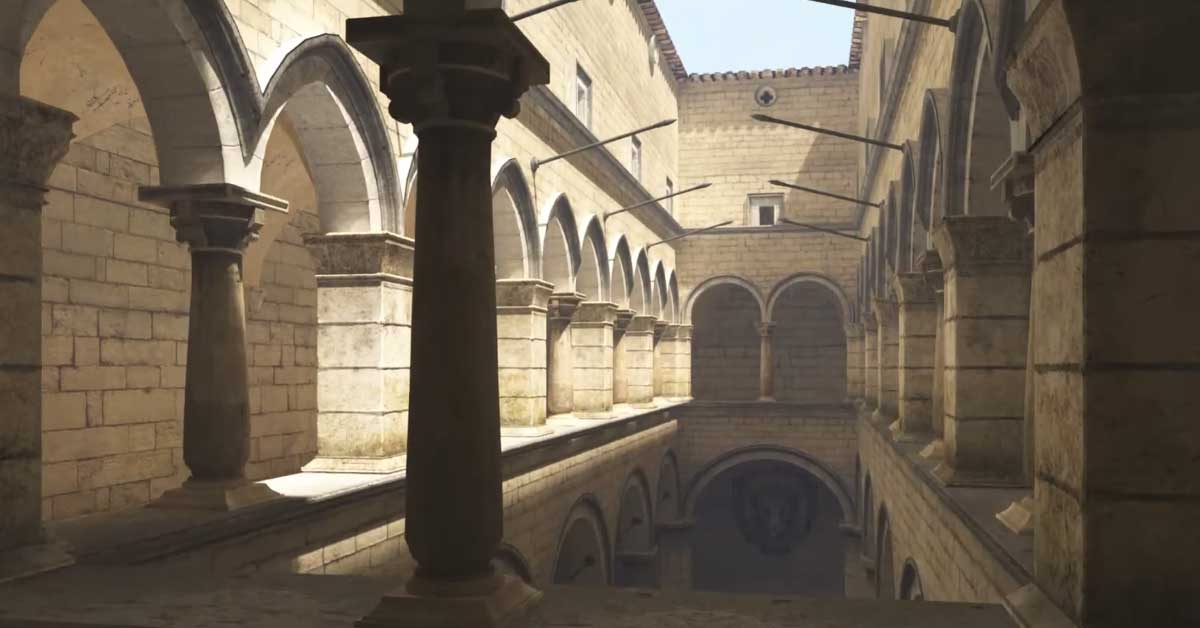
Modern 3D computer graphics researchers have used Sponza Palace’s atrium as a reference model for developing global illumination rendering algorithms, which means the palace has become not just an historical monument but also a technical standard used by computer scientists worldwide. This strange intersection between medieval architecture and cutting-edge computer science represents another facet of Sponza’s ongoing relevance.
FAQ – Sponza Palace Frequently Asked Questions
Who built Sponza Palace and when was it constructed?
Sponza Palace was designed by architect Paskoje Miličević Mihov and built between 1516 and 1522. The stone carving and sculptural work was executed by the brothers Andrijić and other skilled craftspeople.
What does the name Sponza mean?
The name derives from the Latin word spongia, which means sponge. The original name Divona comes from the Italian word dogana, meaning customs. The name refers to where rainwater was collected on the building.
What was Sponza Palace originally used for?
Sponza Palace originally functioned as a customs house where goods entering Dubrovnik were inspected and taxed. It also housed the city’s mint, treasury, armoury and served as a bonded warehouse for merchants’ goods.
What architectural styles are visible in Sponza Palace?
Sponza Palace blends Gothic and Renaissance architectural styles. The ground floor features pointed Gothic arches and covered porticos. The upper floors show Renaissance influences including geometric symmetry and refined stone carving.
What is the most important feature inside Sponza Palace?
The atrium, a covered courtyard at the center of the building, is the most significant interior space. The famous Latin inscription over the arch in the atrium reads: “Our weights do not permit cheating. When I measure goods, God measures with me.”
What is housed in Sponza Palace today?
The Dubrovnik State Archives are housed in Sponza Palace. The archives contain approximately 7,000 volumes of manuscripts and 100,000 individual documents dating from 1022 to the present, making it one of the oldest continuous municipal archives in Europe.
Our Most Popular Tours To Sarajevo
We offer many tours that include a visit to Sarajevo and its most popular locations:
- Full Day tour from Sarajevo to Belgrade (Most Popular)
- Full Day tour from Sarajevo to Međugorije & Mostar
- Full Day Tour from Sarajevo to Travnik and Jajce
- Full-Day 5 Cities Tour from Sarajevo to Herzegovina (Mostar)
- Full day Tour from Sarajevo to Dubrovnik (Kotor or Split)
Don’t Hesitate To Say Hi!
Got any questions about our tours or the city? Don’t hesitate to contact us anytime for more info and booking.
Use the following phone number and email: