
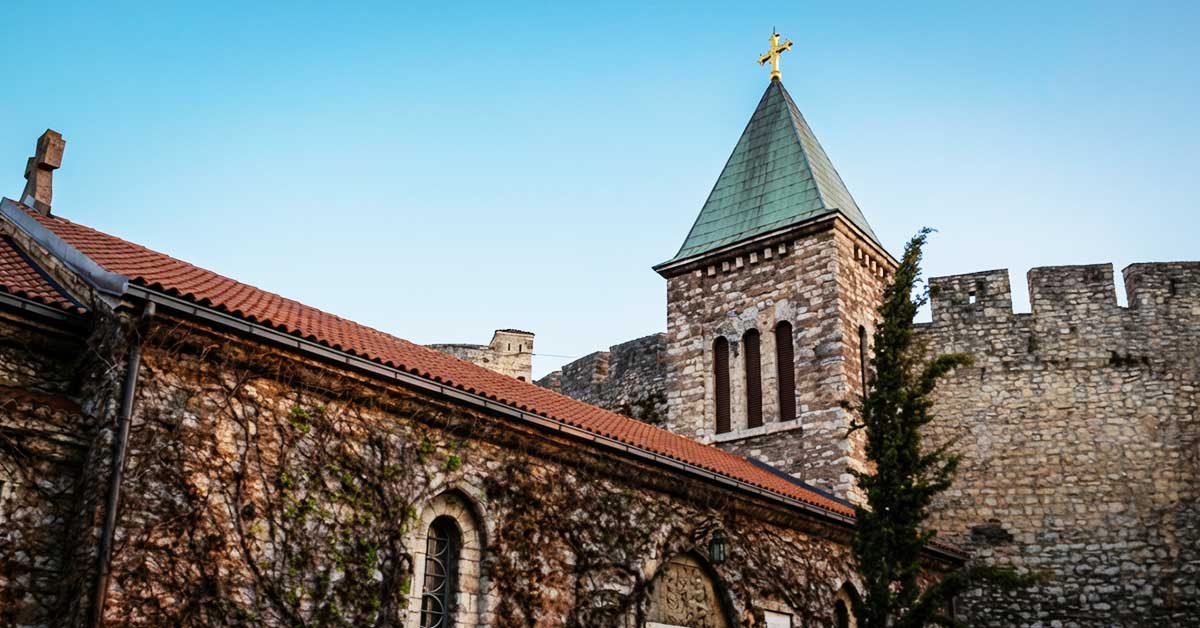
Ružica Church is the kind of place that 90% of tourists walk past while rushing to the big viewpoints over the Danube and Sava from Kalemegdan. It is a miniature Orthodox church hidden in the greenery of Belgrade Fortress, below Zindan Gate, which looks harmless from the outside, but inside hides one of the strangest and strongest details in all of Belgrade: chandeliers and candelabras made from weapons from World War I.
If you like places that have a story, detail and atmosphere you cannot reproduce on Instagram, Ružica Church Belgrade is a mandatory stop. It does not require more than 15 minutes of your time, but you will remember it longer than half an hour on Knez Mihailova Street.
Table of Contents
Where exactly Ružica Church Belgrade is and how to approach it
Ružica Church Belgrade is located inside Belgrade Fortress, in Kalemegdan, in the northern part of the complex. If you are already at Kalemegdan, the easiest way is to start from the main entrance towards the Victor Monument, but instead of going straight to the Great War Island, turn right and go to the northern part of the fortress, below Zindan Gate.
The church is a bit hidden, overgrown with ivy and greenery, which gives it that feeling of “accidental discovery”. There are no huge signs or advertisements. You simply emerge from a path and suddenly see a small church that looks like it has been there for centuries and nobody has touched it.
If you are completely new to Belgrade, the safest way is to tell your phone “Ružica Church” and let it guide you. Or simply ask a local, most know where it is, even those who have never been inside.
Legends and brief history of Ružica Church Belgrade
The story of Ružica Church Belgrade begins somewhere in the 15th century, during the reign of Despot Stefan Lazarević. There are traces that the church existed in the Middle Ages, but the exact circumstances of its construction are unclear. One legend says that three sisters built three churches in Belgrade Fortress and named them after themselves: Ružica, Petka and Nedelja.
Over the centuries, the space where the church is located was used by various conquerors. The Turks turned it into a gunpowder warehouse. Later, after the liberation of Belgrade, the Austrians kept an arsenal there. Only in 1867 was the space converted back into a church, this time as a military chapel.
The real restoration came in 1925, when the church was completely restored. That is when frescoes, an iconostasis and, most importantly, the famous chandeliers and candelabras made from the remains of war materials were added.
Interior of Ružica Church Belgrade: details you easily miss
From the outside, Ružica Church Belgrade looks like a modest, small church, almost harmless. But when you go inside, the atmosphere completely changes.
The first thing that attracts attention are the frescoes. The walls were painted by Russian academic painter Andrey Bicenko, who left a strong visual mark in this small space. The frescoes have that typical Orthodox depth, dark tones and gold accents.
The iconostasis was made by Kosta Todorović, and the icons are the work of Rafailo Momčilović. Everything is done with attention to detail and respect for tradition.
But the real show are the chandeliers and candelabras. They are made from swords, bullet casings, parts of cannons, ammunition boxes and other war material that Serbian soldiers from World War I brought from the battlefield. Masters from Kragujevac used Austro-Hungarian remains and melted them into light objects that hang in the church as silent reminders of the war that was supposed to be the last.
The symbolism is clear: light through war material, wax dripping on weapons, peace that transcends destruction. Today the chandeliers use light bulbs instead of candles, but the message remains the same.
In addition to the chandeliers, two statues from 1925 are also placed in the church: one represents a lancer, the other an infantryman. They are also made from war waste, a continuation of the same idea.
When to go to Ružica Church Belgrade
Ružica Church Belgrade is small and intimate, which means the atmosphere depends heavily on how many people are inside.
The best time to visit is early morning or late afternoon, when there are fewer tourist groups. Then you can calmly enter, look at the details, feel the silence, possibly light a candle if that suits you.
Summer is okay because Kalemegdan is already full of people, so Ružica is often on walking routes. In winter the church gets an additional, almost mysterious atmosphere, especially if snow falls and everything is quiet.
If you are going in a group or with a guide, it is always better to check the opening hours, because the church can sometimes be closed to individual visitors during religious services or maintenance.
How to fit Ružica Church Belgrade into your Belgrade tour
If you are planning a tour of Kalemegdan, Ružica Church Belgrade easily fits in as a bonus stop between the bigger points.
A typical route looks like this: entrance to the fortress from Knez Mihailova, walk to the Victor Monument, view from the ramparts over the Danube and Sava, then turn towards Ružica Church, then continue to the Military Museum or exit the fortress towards Dorćol.
If you are with a group, a tour guide will probably include Ružica in the program because it is visually strong and has a story that works well in combination with the history of Kalemegdan.
If you are a solo traveler, you can do Ružica independently: go in, look around, take photos (discreetly), let the atmosphere wash over you and move on. The whole experience takes you between 10 and 20 minutes, no more.
Is Ružica Church Belgrade a “must see” or “on the way”
Honestly, if you only have three hours in Belgrade, you might not consider Ružica Church mandatory. But if you have at least half a day, or you like places with a story, Ružica Church Belgrade is definitely a must see.
The reason is simple: it is not big, it is not commercial, but it is authentic and has that one unique detail (chandeliers made from weapons) that you will not see anywhere else. It is the type of place that helps you understand that Belgrade is not just Knez Mihailova and clubs on river barges.
Also, if you like small, hidden places that do not have a million tourists and selfie sticks, this is the perfect stop. No crowds, no merchandise, just you, the church and history whispering.
FAQ: Ružica Church Belgrade questions that will come to mind
Is there an entrance fee for Ružica Church Belgrade?
Usually not. The church is an active place of worship and entrance is usually free. If you want, you can leave a donation or buy a candle, but it is not an obligation.
How much time is needed to visit Ružica Church Belgrade?
Between 10 and 20 minutes is quite enough to see the interior, read the inscriptions, look at the chandeliers and feel the atmosphere. If you like to delve into details and stand longer, you can stay 30 minutes.
Is Ružica Church Belgrade always open?
Usually yes, but sometimes it can be closed to visitors during worship services or maintenance. It is best to come during the day and check on the spot, or call ahead if you are planning a group visit.
Is photography allowed inside Ružica Church Belgrade?
Photography is generally allowed, but you should be discreet and respect the fact that it is an active church. Do not use flash, do not make noise and respect people who may be praying or lighting candles.
Our Most Popular Tours To Sarajevo
We offer many tours that include a visit to Sarajevo and its most popular locations:
- Full Day tour from Sarajevo to Belgrade (Most Popular)
- Full Day tour from Sarajevo to Međugorije & Mostar
- Full Day Tour from Sarajevo to Travnik and Jajce
- Full-Day 5 Cities Tour from Sarajevo to Herzegovina (Mostar)
- Full day Tour from Sarajevo to Dubrovnik (Kotor or Split)
Don’t Hesitate To Say Hi!
Got any questions about our tours or the city? Don’t hesitate to contact us anytime for more info and booking.
Use the following phone number and email: