
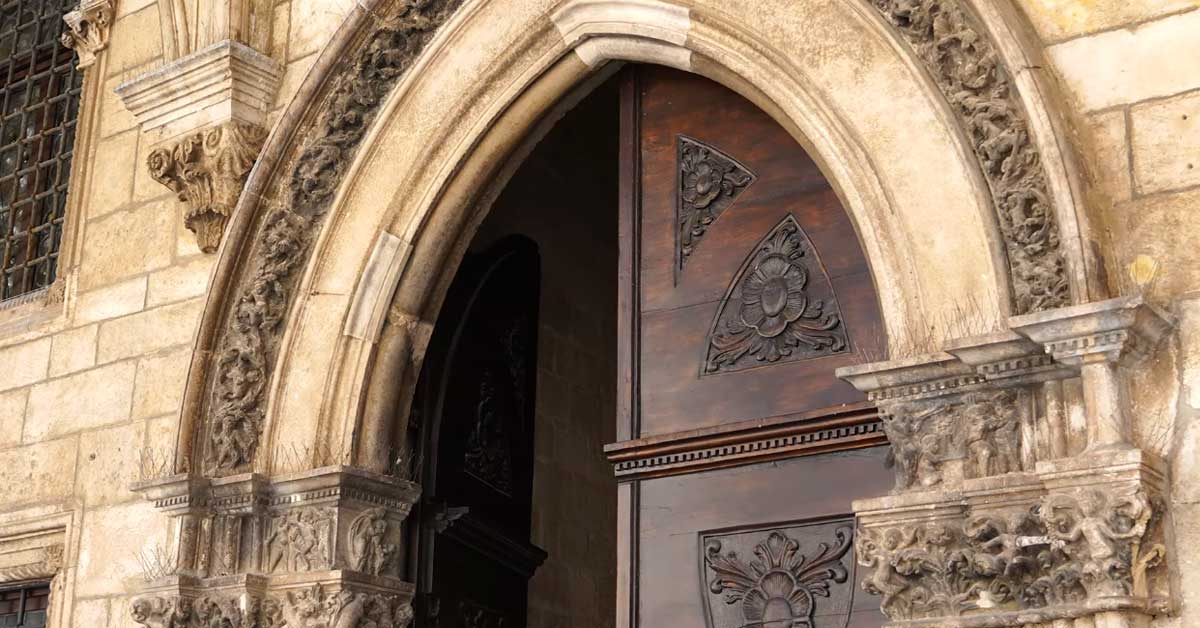
If there is one building in Dubrovnik where the old Republic still seems to whisper from every stone, it is Rector’s Palace, the stately Knežev dvor pressed between marble streets and Adriatic light. This is where, for centuries, the small but stubborn Republic of Ragusa was governed with almost obsessive discipline, behind elegant arches that today look calm and noble, but once meant power, responsibility and a healthy dose of fear.
Rector’s Palace is not just another museum you rush through between the city walls and Stradun. It was once the seat of the Rector, the Minor Council and state administration, home to an armoury, powder magazine, watch house and prison, all wrapped in a subtle blend of Gothic, Renaissance and Baroque architecture. Today, it is the Cultural History Museum and one of the most atmospheric concert venues in Dubrovnik, a place where history literally keeps you company as you wander through the cool stone atrium.
Table of Contents
History of Rector’s Palace: from fortress to refined power
Long before souvenir shops and day-trip crowds, a plain medieval defensive fort stood on the site of Rector’s Palace, more functional than beautiful, built to protect rather than impress. In the 14th century, as Ragusa grew into a serious maritime and trading power, the city began transforming this fort into a representative palace worthy of its new status and ambitions.
The building’s story, however, is anything but peaceful. In 1435, a gunpowder explosion heavily damaged the palace, forcing a major reconstruction led by Neapolitan architect Onofrio della Cava, who was at the same time designing Dubrovnik’s famous aqueduct and fountains. That first major rebuild gave the palace much of its late Gothic character and refined façade, including the arcaded portico with its richly sculpted capitals.
Misfortune did not stop there. Further explosions and, above all, earthquakes in the 16th century and the devastating 1667 earthquake damaged the palace again, pushing the city to rebuild and adapt. Each reconstruction added a new architectural layer: Renaissance details influenced by Michelozzo, then Baroque elements and a new staircase after 1667, so that Rector’s Palace became a stone diary of disaster and renewal.
From the 14th century until 1808, when Napoleon abolished the Republic of Ragusa, the palace served as the administrative heart of the state, a kind of “mini Capitol Hill” in Adriatic style. In the late 19th century it formally became a museum space, and since 1872 it has housed what is today the Cultural History Museum, preserving objects that tell the story of city government, trade and everyday life across the centuries.
Long before souvenir shops and day-trip crowds, a plain medieval defensive fort stood on the site of Rector’s Palace, more functional than beautiful, built to protect rather than impress. In the 14th century, as Ragusa grew into a serious maritime and trading power, the city began transforming this fort into a representative palace worthy of its new status and ambitions. Discover more essential Dubrovnik experiences in our Top 5 things to do in Dubrovnik.
The role of the Rector: one month of power under watch
The Rector (knez) of Ragusa was something between a president and a carefully supervised prisoner. Elected from the patrician families, he served a mandate of just one month, an almost comically short reign designed to prevent anyone from getting too comfortable with power.
During his mandate, the Rector was allowed to leave the palace only on official occasions, such as ceremonies or important state duties. This strict rule was meant to prevent corruption, private deals and close informal ties with the citizens, because the Republic was obsessed with balance of power, control and a kind of institutional paranoia that kept everyone in check.
Inside Rector’s Palace were the halls of the Minor Council and Great Council, the courtroom, administration offices and the Rector’s private residence. In the same complex you also had prisons, an arsenal and gunpowder storage, so this was both the centre of government and the nervous system of the city’s security. It is easy to imagine how each decision and each spark inside these walls could lead to either stability or immediate crisis.
Architecture of Rector’s Palace: Gothic bones, Renaissance face, Baroque heart
At first glance, Rector’s Palace may simply look “beautiful”, another elegant stone building in a city full of them. But if you slow down and really look, you realise this is an architectural patchwork of centuries, a carefully layered mix that reflects every blow history has dealt the city.
The core of the palace is Gothic, still visible in its overall proportions, window forms and some of the surviving decorative details. The elegant portico at the front, with its arcades opening onto the square, carries a strong Renaissance influence, especially in the rhythm of its columns and the refined sculpted capitals, including the famous one with the figure of Asclepius, the Greek god of medicine. This Renaissance touch is largely connected to Michelozzo from Florence, even though some of his more ambitious proposals were considered too bold by the cautious Dubrovnik Senate.
The great 1667 earthquake brought the Baroque layer: a monumental staircase in the atrium, some interior restructuring and a slightly more dramatic sense of space. The palace seems to lift itself up out of the ruins, adding curves and movement where once everything was straighter and stricter. Today, this combination of a Gothic base, a Renaissance facade and Baroque interior elements makes Rector’s Palace one of the most important monuments of secular architecture on the Croatian coast, and a must for anyone who wants more than just pretty views from the city walls.
Rector’s Palace atrium and courtyard: the atmospheric centre
If Stradun is Dubrovnik’s living room, then the atrium of Rector’s Palace is its private salon, the place where the city takes off its public mask. The moment you step from the bright open square into the shaded courtyard, the sound of the Old Town softens, and stone, shadow and arcades create a self-contained world.
The rectangular courtyard is framed by arcades and dominated by the Baroque staircase that leads to the upper floors, its stone balustrade catching light and casting shadows throughout the day. In the centre you may find exhibition elements, temporary installations or simply empty space that lets your eyes breathe, while visitors sit along the walls, looking up at the sky framed by stone. In one corner stands a modest but important monument to Miho Pracat, a wealthy shipowner from Lopud who left his fortune to the Republic, the only commoner to receive a public statue from the Senate – a quiet reminder of how deeply trade and loyalty were valued here.
Today, the atrium is also a stage. During the Dubrovnik Summer Festival, classical concerts and recitals fill this space, using the natural acoustics of the stone, the warm night air and the intimacy of the courtyard. If you are lucky enough to catch a performance here, the combination of music, architecture and history will likely stay with you far longer than any souvenir.
Inside Rector’s Palace: what to see in the Cultural History Museum
Rector’s Palace today houses the Cultural History Museum, which means you are not only admiring architecture but also stepping into what was once a functioning seat of power. Instead of neutral museum halls, you move through rooms that had specific roles in the life of the Republic.
You will find period rooms furnished with original or period-appropriate furniture, paintings and portraits of Dubrovnik’s nobles, giving you a sense of how people actually lived and worked in this palace. Walking through the Rector’s chambers and reception rooms, you can almost feel the weight of ceremony, the importance of every decision made over the tables and under the chandeliers.
There is also a collection of weapons, coins, seals, coats of arms and official insignia that tell the story of diplomacy, trade and defence in Ragusa. Documents, maps and everyday objects line the rooms, from finely crafted silverware to simple items that show how carefully ordered and disciplined urban life used to be. The old courtroom and council halls still carry an atmosphere of judgement and debate, as if someone has just rolled up a parchment and sealed it with wax.
Rector’s Palace today: concerts, culture and living history
Rector’s Palace is not frozen in time; it continues to live, only in a different way. Beyond daytime visitors, its atrium and selected halls become a stage for classical music, chamber ensembles and special events, especially during the Dubrovnik Summer Festival when the city turns itself into an open-air theatre.
A concert in the atrium of Rector’s Palace is an experience that fuses everything Dubrovnik does best: stone, sound and starlight. The notes of a violin or piano bounce softly off the walls, light grazes the columns and steps, and the audience sits so close to history that even silence between movements feels charged. Many travellers plan their visit to Dubrovnik specifically to match these festival dates, just to experience one evening under the arches.
Throughout the year, temporary exhibitions, cultural programmes and commemorations bring new life into the palace. This means that returning visitors often find something different: a new exhibition, a different performance, another angle on the city’s long memory. Rector’s Palace remains what it always was – a place where Dubrovnik negotiates between past and present, formality and emotion.
Practical visitor guide to Rector’s Palace Dubrovnik
No “ultimate” guide to Rector’s Palace is complete without a few practical details. The palace is located in the very heart of the Old Town, at Ulica Pred Dvorom 3, only a few steps from the Church of St. Blaise and close to Stradun, the main street. Once you reach the main square, you can hardly miss its arcaded facade opening onto the lively space in front.
Opening hours usually run from morning to early evening, with shorter hours in winter. In most seasons the museum opens around 9:00 and closes around 18:00, with variations depending on time of year, holidays and special events. Before your visit, it is wise to check the latest schedule on the official museum or local tourist office website, especially if you are travelling outside peak season.
Ticket prices change over time, but you can typically buy a single-entry ticket or visit as part of a broader pass, such as a city or museum card that includes several attractions. If you plan to walk the city walls, visit other museums and use public transport, this type of card often pays off quickly. Combine the numbers with your energy level: there is no point “saving” on tickets if you are too rushed to enjoy what you are seeing.
Most visitors spend about an hour to an hour and a half inside Rector’s Palace, though history and architecture enthusiasts easily stay longer. The best times to visit are early morning, when tour groups are fewer and the air is still fresh, or late afternoon, when the light becomes softer and the stone courtyard turns into a calm oasis after the heat of the day.
While exploring the Old Town’s historic core, don’t miss climbing the nearby Jesuit Stairs for stunning views and a taste of Baroque grandeur just steps away.
Tips for visiting Rector’s Palace: how to make it memorable
To make sure Rector’s Palace doesn’t become just “another stop” on a packed Dubrovnik itinerary, give it time. Plan at least 45–60 minutes and resist the urge to hurry from room to room. Pause in the atrium, lean on a column, watch how light moves across the staircase and listen to the muffled echoes from the square outside.
Try to pair your visit to Rector’s Palace with nearby landmarks such as Sponza Palace or the city walls, because together they form a triangle in which Dubrovnik reveals its full character: mercantile, proud and quietly dramatic. If possible, arrange your day so that you tour the palace in the afternoon and, on another evening, attend a concert in the same courtyard – seeing it in daylight and under the night sky are two completely different experiences.
Photography inside can be challenging because of the mix of shadowy interiors and bright light from the courtyard and windows, so be prepared for some trial and error if you want perfect shots. More importantly, allow yourself a few moments without any camera at all; some spaces are best remembered by feeling rather than by pixels. Respect the site: this was once the heart of a small but remarkable state, and it is still a place of culture and quiet, where a little awareness and calm behaviour go a long way.
If you enjoy places where everyday objects tell the story of local people rather than just rulers and battles, make time for the quieter but deeply atmospheric Ethnographic Museum Dubrovnik, where traditional costumes, textiles and household items bring Dalmatian folk culture to life.
FAQ about Rector’s Palace Dubrovnik
What is Rector’s Palace in Dubrovnik?
Rector’s Palace (Knežev dvor) is the former seat of the government and Rector of the Republic of Ragusa, now a Cultural History Museum and major historic landmark.
Where is Rector’s Palace located in Dubrovnik?
It is located in the very centre of the Old Town, at Ul. Pred Dvorom 3, right next to the Church of St. Blaise and a short walk from Stradun.
How long do I need to visit Rector’s Palace?
Most visitors spend about 1 to 1.5 hours exploring the museum and atrium, though history and architecture lovers often stay longer.
Is Rector’s Palace included in city or museum passes?
In many seasons, entrance to Rector’s Palace is included in Dubrovnik’s combined passes or city cards, which can be good value if you plan to visit several attractions.
Can I attend concerts at Rector’s Palace?
Yes, the atrium is one of the main venues for classical and chamber concerts, especially during the Dubrovnik Summer Festival and selected cultural events.
What makes Rector’s Palace architecturally special?
It is unique for its blend of Gothic core, Renaissance facade and Baroque interior elements, shaped by centuries of reconstructions after explosions and earthquakes.
Our Most Popular Tours To Sarajevo
We offer many tours that include a visit to Sarajevo and its most popular locations:
- Full Day tour from Sarajevo to Belgrade (Most Popular)
- Full Day tour from Sarajevo to Međugorije & Mostar
- Full Day Tour from Sarajevo to Travnik and Jajce
- Full-Day 5 Cities Tour from Sarajevo to Herzegovina (Mostar)
- Full day Tour from Sarajevo to Dubrovnik (Kotor or Split)
Don’t Hesitate To Say Hi!
Got any questions about our tours or the city? Don’t hesitate to contact us anytime for more info and booking.
Use the following phone number and email: