
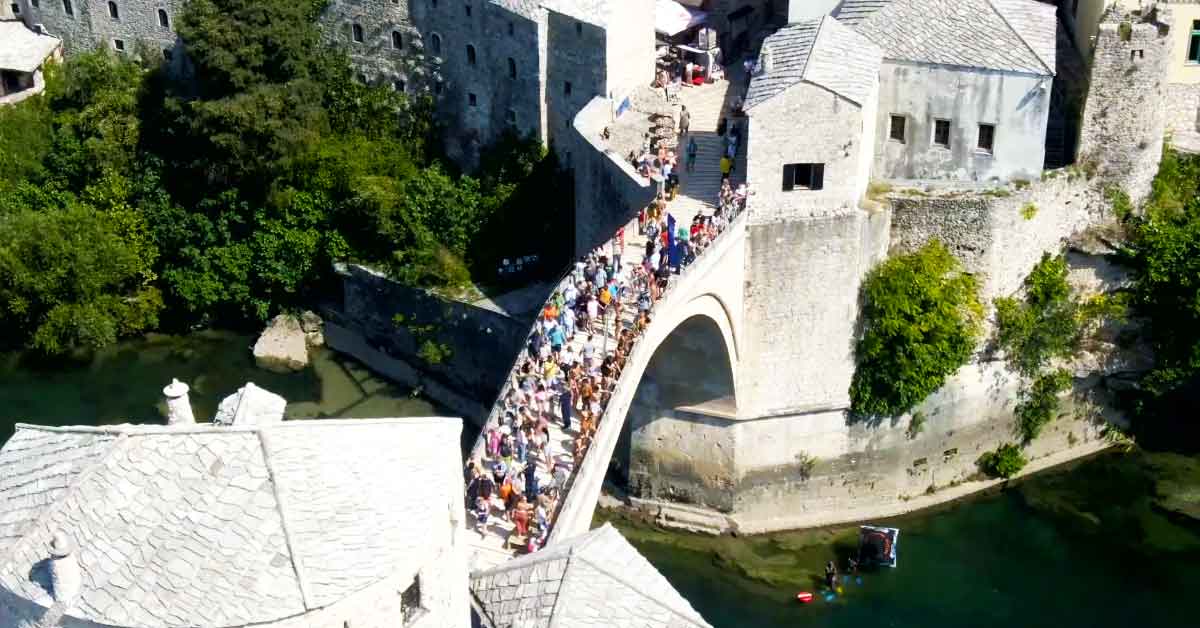
Some moments define a place so completely that they become inseparable from its identity. For Mostar, bridge diving is exactly that – a tradition spanning 450 years of young men and women launching themselves from Stari Most’s towering arch into the emerald Neretva River below, reaching speeds of nearly 80 kilometers per hour before plunging into water cold enough to induce shock within seconds. Locals call these daring souls “Mostari” – a name that originally meant “bridge keepers” during Ottoman times but evolved to describe those brave enough to leap.
The first recorded bridge jump dates to 1664, nearly a century after the bridge’s 1567 completion. By the 19th century, bridge jumping had become Mostar’s most recognizable feature, drawing European travelers specifically to witness locals launching themselves into apparent death. For nearly 450 years, this tradition persisted through empires, wars, and modernization. Then came 1993, when Croatian forces destroyed Stari Most during the Bosnian War. The bridge collapsed into the Neretva, silencing the jumpers for 11 years. When Stari Most was reconstructed and reopened in July 2004, the bridge divers returned immediately, viewing their return as cultural resistance against erasure.
Today, approximately five to six professional divers earn modest income from tourist tips (20-30 euros typical), jumping multiple times daily during summer months. Hundreds of tourists annually join these professional divers by attempting the jump themselves under proper training. What was once purely local tradition has become internationally recognized extreme sport, attracting elite athletes, extreme sports enthusiasts, and ordinary travelers seeking life-changing experiences.
Table of Contents
The Physics and Psychology of Mostar Bridge Diving (27 Meters)
The bridge stands 27 meters above summer water level – equivalent to jumping from a nine-story building. A jumper accelerates at 9.8 meters per second squared, reaching impact velocity of approximately 80 kilometers per hour by the time water arrives. The jump duration from cliff to water is merely three seconds – time enough for consciousness to register terror but not sufficient for panic intervention.
The actual impact creates forces approximately 400-500% body weight compression upon entry. An improperly angled jump distributes this force unevenly, potentially causing injuries from broken ribs to spinal compression. The Neretva’s water temperature hovers around 8-12°C year-round, shockingly cold enough to induce gasping reflex that can lead to water inhalation if unprepared.
The river’s flat, mirror-like surface creates particular danger – your eyes cannot judge impact point accurately. The river bed contains rocks, branches, and debris creating hazards beneath the surface. Water level fluctuations (up to 5 meters seasonally) mean the jump height varies significantly. Professional Mostari divers mitigate these dangers through generations of accumulated knowledge, physical conditioning, and technique refined to perfection. They’ve absorbed every variable through experience, knowing precisely how water level changes affect impact dynamics and where hazards cluster.
Mostar Diving Club: Training for Mostar Bridge Diving
The Mostar Diving Club occupies a modest tower structure beside Stari Most. Year-round, between five and fifteen divers operate out of this clubhouse – local men trained since childhood in jumping technique, river behavior, rescue procedures, and tourist management. These aren’t recreational athletes but serious practitioners of an extreme discipline requiring absolute precision.
Participating in a Mostar Diving Club training session represents one of Bosnia’s most intense tourist activities. The standard cost is approximately 30-50 euros total (20-30 euros training, additional 20-30 euros for the actual Stari Most jump). The first phase involves dry-land technique instruction. The diver demonstrates correct jumping form repeatedly: standing upright, feet together, arms against sides, core tightened, slight forward lean. Trainees practice the motion repeatedly on shore – jumping while maintaining perfect alignment, landing in predictable stances.
The second phase moves to practice platforms below the bridge. The first platform sits approximately 10-13 meters above river level. A trainee climbs, receives final form confirmation, and launches. The sensation is shocking – 10 meters feels genuinely high, the water rushes up incomprehensibly fast. Successful completion proves the technique works, proving survival is achievable. Additional practice jumps (typically 2-4 more) from similar heights reinforce technique and build psychological resilience.
Only when the diver is fully confident does the party return to Stari Most’s center. The trainee changes into a wetsuit providing thermal protection and psychological reassurance. The diver guides the climber over the railing, positioning them safely at the jump point. Upon successful completion, the Mostar Diving Club enters the diver’s name into the official record book – approximately 2,000 names accumulated over the years. The diver receives a certificate of achievement proclaiming membership in the “24 Meter Club.”
Red Bull World Series: The Peak of Mostar Bridge Diving
Since 2016, the Red Bull Cliff Diving World Series has transformed Mostar’s bridge into an elite global sporting stage. This prestigious competition brings the world’s best cliff divers to the bridge annually (typically late July), creating festival atmosphere where thousands of spectators gather to witness athletes competing in one of sport’s most extreme disciplines. The event elevated Mostar bridge diving from local tradition and tourist attraction to professional sport with legitimate athletic credentials.
The Red Bull World Series competitors are genuinely exceptional – athletes who’ve dedicated their lives to cliff diving, training year-round at specialized facilities, competing across multiple global venues. They’ve competed from cliffs in Mexico, Switzerland, Portugal, and beyond. Yet competing at Stari Most holds unique significance – it’s the oldest active cliff diving location, the most historically significant, the most culturally resonant. Winning the Mostar event means something profoundly different than victory elsewhere.
The competition format challenges divers across multiple dimensions beyond pure jump height. Athletes compete in categories including distance jumps (launching furthest from the bridge), form judging (technical execution, style, control), and head-to-head matchups against competitors. The bridge’s historical significance demands respect – performers deliver interpretive jumps honoring Mostar’s heritage alongside purely athletic displays. Dives often incorporate creative elements: flips, twists, synchronized pairs, artistic poses that transform jumping into kinetic art.
The event draws substantial international attention – Red Bull broadcasts live, international media covers stories of athletes competing on 450-year-old bridge, online viewership reaches millions. For Mostar, the event provides economic stimulus, international publicity, and global recognition of the city beyond war history. Young Mostari dream of qualifying for Red Bull, treating bridge diving as potential professional career rather than purely cultural tradition. The professionalization simultaneously preserves tradition and transforms it, creating bridge between ancient custom and modern extreme sport.
Motivations for Mostar Bridge Diving Beyond Adrenaline
Interestingly, tourists’ motivations for jumping vary far more than outsiders might assume. Yes, some are pure thrill-seekers pursuing adrenaline addiction. Many others jump to overcome specific phobias – people terrified of heights use the jump as confrontation therapy, physically proving fears can be survived. Some treat it as birthday gift to themselves, milestone celebration, personal test of capabilities. Some jump for romantic reasons – couples doing it together, individuals jumping to prove self-worth to themselves.
What unites jumpers is recognition that this is significant. Nobody wakes up casually deciding to jump from a 27-meter bridge. The decision requires contemplation, courage, and genuine commitment. This seriousness transforms it from simple adrenaline activity into something approaching ritual – a formal acknowledgment that you’re choosing to do something genuinely dangerous, genuinely difficult, and genuinely memorable.
For some, the jump becomes transformative. Survivors describe afterward profound gratitude for surviving, heightened awareness of life’s preciousness, and lasting confidence that they can accomplish previously unimaginable things. The jump rewires your understanding of personal capability – if you can do this, what else might be possible? This psychological shift explains why so many tourists describe the experience as life-changing.
Practical Safety Considerations for Mostar Bridge Diving
Attempting Mostar bridge diving demands absolute honesty about risk. People have died jumping without proper training. Common injuries include concussions, broken ribs, spinal compression, internal organ damage, and near-drowning. The Mostar Diving Club’s training and supervision significantly reduce (but doesn’t eliminate) these risks. Training exists precisely because untrained jumpers die at alarming rates.
Physical fitness requirements are moderate – the jump demands zero athletic conditioning, only courage and willingness to practice technique. However, certain conditions contraindicate participation: fear of heights sufficiently severe to prevent rational decision-making, cardiovascular conditions potentially triggered by extreme cold water shock, spinal or joint problems vulnerable to impact forces, and intoxication (the club refuses visibly drunk participants).
Logistically, the entire experience (training plus jump) typically requires 60-90 minutes from approaching the divers to surfacing after the jump. The best time to participate is May-September when professional divers are most available and water temperatures are least shocking. Winter jumpers must accept cold water approaching 8°C and reduced diver availability.
FAQ – Mostar Bridge Diving Questions
How dangerous is bridge jumping, and what’s the actual injury rate?
Training through Mostar Diving Club significantly reduces injury risk compared to untrained jumping. Deaths among trained tourists are extraordinarily rare; injuries more common when improper form occurs. Untrained jumpers face much higher danger.
What if I chickened out mid-jump after paying?
Professional divers absolutely respect backing out – forcing yourself off creates panic-jumps risking injury. You won’t lose payment if requesting additional practice jumps instead. Some people require multiple sessions building confidence.
Is it really 27 meters, or is that exaggeration?
The bridge spans approximately 24-27 meters depending on river water level. Summer low water makes the practical jump approximately 27 meters; spring snowmelt reduces it to perhaps 24 meters. The actual measurement is genuinely high and genuinely dangerous.
Can women jump, or is it exclusively male?
Women absolutely participate and have for years. The 2023 Red Bull World Series saw female athletes competing alongside men, proving gender doesn’t determine capability or courage.
What happens if something goes wrong during the jump?
Divers stationed at the water’s edge monitor every jump and assist anyone struggling post-landing. The swimmers are competent rescuers and the river’s current is predictable. Serious injury requiring hospital transport has happened but remains rare among trained jumpers.
When does the Red Bull Cliff Diving World Series occur, and can I watch?
The competition typically occurs late July annually. It’s free to watch – spectators gather along Stari Most and surrounding areas. It’s among Europe’s best extreme sports spectacles, attracting thousands of fans witnessing elite athletes competing on history’s bridge.
Our Most Popular Tours To Sarajevo
We offer many tours that include a visit to Sarajevo and its most popular locations:
- Full Day tour from Sarajevo to Belgrade (Most Popular)
- Full Day tour from Sarajevo to Međugorije & Mostar
- Full Day Tour from Sarajevo to Travnik and Jajce
- Full-Day 5 Cities Tour from Sarajevo to Herzegovina (Mostar)
- Full day Tour from Sarajevo to Dubrovnik (Kotor or Split)
Don’t Hesitate To Say Hi!
Got any questions about our tours or the city? Don’t hesitate to contact us anytime for more info and booking.
Use the following phone number and email: