
If you have ever walked through the maze of the Old Town of Kotor, you know the feeling. You are lost in the stone streets, dodging tour groups, and suddenly you stumble upon a square that feels a bit more majestic than the others. You look up and see two iron cannons guarding the entrance of a Baroque palace. You have found the Maritime Museum Kotor.
The Maritime Museum Kotor is not just a building full of dusty boat models. It is a tribute to the men who risked everything to put this tiny town on the world map. It is located in the Grgurina Palace, a masterpiece of 18th-century architecture that is an exhibit in itself. Inside, you will find stories of pirates, shipwrecks, and a captain who circled the globe before it was cool.
Table of Contents
The Grgurina Palace: The Home of the Maritime Museum Kotor
The museum occupies the stunning Grgurina Palace, located in the Boka Navy Square (Trg Bokeljske mornarice), one of the finest examples of baroque architecture in Kotor Old Town, where every room tells stories of the sea captains and shipbuilders who once ruled these waters.
The family moved here from the Pula region and wanted to show everyone that they had arrived. And they did it in style. The palace is a perfect example of Baroque architecture, with stone balconies that were once used by ladies to watch the street life below without getting their dresses dirty.
But the most interesting detail is right at the entrance. The two cannons you see are not just decoration. They are authentic 18th-century symbols of the constant battle Kotor had to fight against pirates, against the Ottomans, and sometimes even against rival Venetian towns.
When you step inside the Maritime Museum Kotor, notice the layout. It is one of the few palaces in Kotor that has been completely preserved. The stone staircase, the layout of the rooms which are referred to as “salons,” and the heavy wooden ceilings are all original. You are not just visiting a museum; you are walking into the living room of an 18th-century shipping tycoon.
The Boka Navy Uniforms and Weapons at the Maritime Museum Kotor
One of the most important sections of the Maritime Museum Kotor is dedicated to the Boka Navy (Bokeljska mornarica). Now, do not get confused. This is not a modern military navy with aircraft carriers. This is the oldest maritime fraternity in the world, founded in the year 809. That makes it older than most countries in Europe.
Originally, it was a brotherhood of seafarers formed to protect the city and help the families of sailors lost at sea. Over time, it became the backbone of Kotor’s society. If you were a captain in the Boka Navy, you were royalty.
In the Maritime Museum Kotor, you can see their stunning uniforms on the first floor. They are not the stiff, boring military uniforms you might expect. They are works of art, black coats heavily embroidered with gold thread, colorful sashes, and incredible weapons.
Look closely at the weapons display case. The long rifles (“džeferdari”) and the pistols tucked into their belts (called “ledenice”) were not just for show. These flintlock guns are decorated with mother-of-pearl and silver. The museum displays these weapons with pride, showing that the wealth of Kotor was protected by gunpowder and steel.
Captain Ivo Visin: The Legend of the Maritime Museum Kotor
If there is one superstar in the Maritime Museum Kotor, it is Captain Ivo Visin. You might not know his name, but in Kotor, he is a legend. Born in the nearby village of Prčanj, Visin did something extraordinary in the 19th century.
In 1852, he set sail on his ship, the Splendido. He did not plan to make history; he just wanted to trade. But one thing led to another, and seven years later, he returned to Kotor having circumnavigated the globe. He was the first South Slav to do so under the Austrian flag.
The Maritime Museum Kotor holds the ship’s original logbook, his navigation instruments, and portraits of the captain. Imagine navigating the treacherous waters of Cape Horn without GPS, without a radio, and without a weather app. All he had were the stars, a compass, and his instincts.
When he returned, the Austrian Emperor Franz Joseph was so impressed he gave him a flag of honor, “Merito Navale,” which is the only one ever awarded for a merchant voyage. Standing in front of his portrait in the museum, you realize that these were not just sailors; they were explorers of the highest order.
The Ship Models Collection at the Maritime Museum Kotor
There was a time when Kotor had a fleet that rivaled Venice. During the 17th and 18th centuries, the captains of Boka Bay were the logistics backbone of the Adriatic. They carried grain, olive oil, and luxury goods between the East and the West.
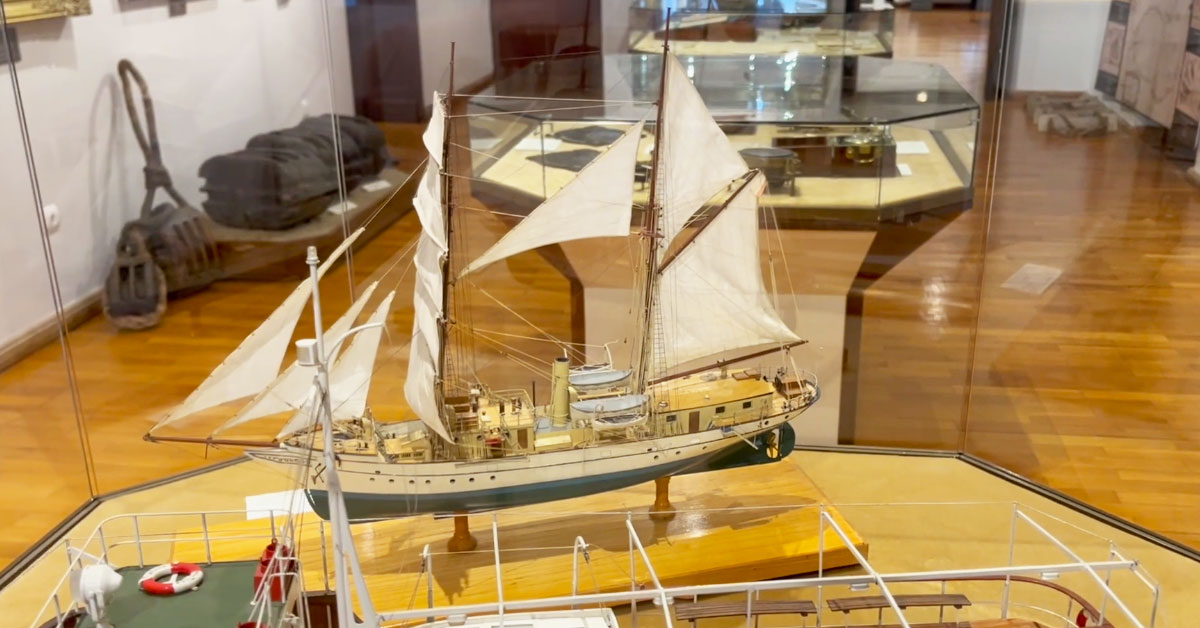
The Maritime Museum Kotor has an incredible collection of ship models that show this evolution. You can see the transition from the heavy, slow carracks that relied on wind and muscle, to the sleek sailing ships (clippers) of the 19th century.
One specific model to look for is the galley. Kotor was famous for its galleys, which fought in the Battle of Lepanto in 1571. This was one of the biggest naval battles in history, where the Christian fleet defeated the Ottoman Empire. The Kotor galley, “Saint Tryphon,” was right in the thick of the fight, and the museum tells the story of the brave men who died that day to stop the Ottoman advance into Europe.
The Pirate Hunting Exhibits at the Maritime Museum Kotor
We often romanticize pirates today, thanks to Hollywood. But for the people of Kotor, pirates were a terrifying reality. The Adriatic was full of them, from the Uskoks of Senj to the Ulcinj pirates and the Barbary corsairs from North Africa.
The Maritime Museum Kotor dedicates a significant part of its exhibition to this struggle. You will see the heavy weaponry used to defend the ships. But more interestingly, you will see documents and letters detailing the ransoms paid to free captured sailors.
It was a brutal business. If a captain was captured, his family had to sell everything to buy him back. The museum displays the “sea chests” of these captains and those are heavy, iron-bound boxes with complicated locks. These were not just luggage; they were portable safes designed to keep the ship’s gold out of pirate hands.
The Earthquake Restoration of the Maritime Museum Kotor
The building you are standing in has survived more than just wars. In 1979, a catastrophic earthquake devastated the Montenegrin coast. The Old Town of Kotor was brought to its knees. The Grgurina Palace was heavily damaged, and the Maritime Museum Kotor had to close its doors.
But just like the city, the museum rebuilt itself. It took years of painstaking restoration to bring the palace back to its former glory. As you walk through the rooms, pay attention to the walls. You might see cracks or lines in the stone, scars from that terrible day.
The restoration was not just about fixing the roof. It was about saving the identity of the city. The curators worked tirelessly to salvage the artifacts, the paintings, and the furniture. Today, the museum stands as a symbol of Kotor’s resilience. It proves that you can shake the ground beneath them, but you cannot break the spirit of the people of Boka.
The Ethnographic Salon at the Maritime Museum Kotor
While the ships and guns get all the glory, the Maritime Museum Kotor also offers a glimpse into the domestic life of these wealthy families. The captains were often away for years, leaving their wives to run the estates and the businesses.
The “Salon” rooms in the museum are set up exactly as they would have been in the 1800s. You will see fine Italian furniture, portraits of stern-looking ancestors, and delicate porcelain from China. Wait, China? Yes. Remember Captain Visin? The sailors of Kotor brought back luxury goods from all over the world.
This part of the Maritime Museum Kotor is fascinating because it shows the cosmopolitan nature of the city. While the rest of the Balkans was often isolated, Kotor was connected to London, Venice, and Constantinople. The women of Kotor wore the latest Parisian fashions, drank tea from English sets, and read books in Italian and French.
Practical Information for Visiting the Maritime Museum Kotor
Before you go, here is what you need to know. The Maritime Museum Kotor is open all year round. During the peak summer season (May to October), it usually operates from 8:00 AM to 11:00 PM, giving you plenty of time to visit after dinner. In the winter months, hours are shorter, typically closing around 5:00 PM, and it is closed on Mondays.
The ticket price is very affordable, usually around 4 Euros for adults and 1 Euro for children. The best part is that the price includes an audio guide. You will get a device that allows you to punch in the number of the exhibit and hear the story in English, Italian, German, Russian, or French. Do not skip the audio guide; it provides the context that the small plaques sometimes miss.
You should plan to spend about 45 minutes to an hour inside. It is a perfect break from the summer heat since the thick stone walls keep the interior cool naturally. Also, there is a small souvenir shop at the entrance where you can buy books about Kotor’s history and replicas of old maps.
Frequently Asked Questions About Maritime Museum Kotor
What are the opening hours of the Maritime Museum Kotor?
The museum is generally open every day, but hours vary by season; in summer it is usually open from 8:00 AM to 11:00 PM, while in winter it closes much earlier, often around 2:00 PM or 5:00 PM.
How much does the ticket cost for the Maritime Museum Kotor?
The ticket price is typically around 4 to 5 euros for adults, with huge discounts available for children and groups.
Is the Maritime Museum Kotor wheelchair accessible?
Due to the historic nature of the Grgurina Palace and its many stairs, the museum is unfortunately not wheelchair accessible for the upper floors.
Where exactly is the Maritime Museum Kotor located?
It is located in the heart of the Old Town on the Boka Navy Square, easily recognizable by the two cannons at the entrance.
Is the Maritime Museum Kotor suitable for children?
Yes, children often enjoy the ship models and the collection of old weapons, making it a relatively engaging history lesson for them.
Our Most Popular Tours To Sarajevo
We offer many tours that include a visit to Sarajevo and its most popular locations:
- Full Day tour from Sarajevo to Belgrade (Most Popular)
- Full Day tour from Sarajevo to Međugorije & Mostar
- Full Day Tour from Sarajevo to Travnik and Jajce
- Full-Day 5 Cities Tour from Sarajevo to Herzegovina (Mostar)
- Full day Tour from Sarajevo to Dubrovnik (Kotor or Split)
Don’t Hesitate To Say Hi!
Got any questions about our tours or the city? Don’t hesitate to contact us anytime for more info and booking.
Use the following phone number and email: