
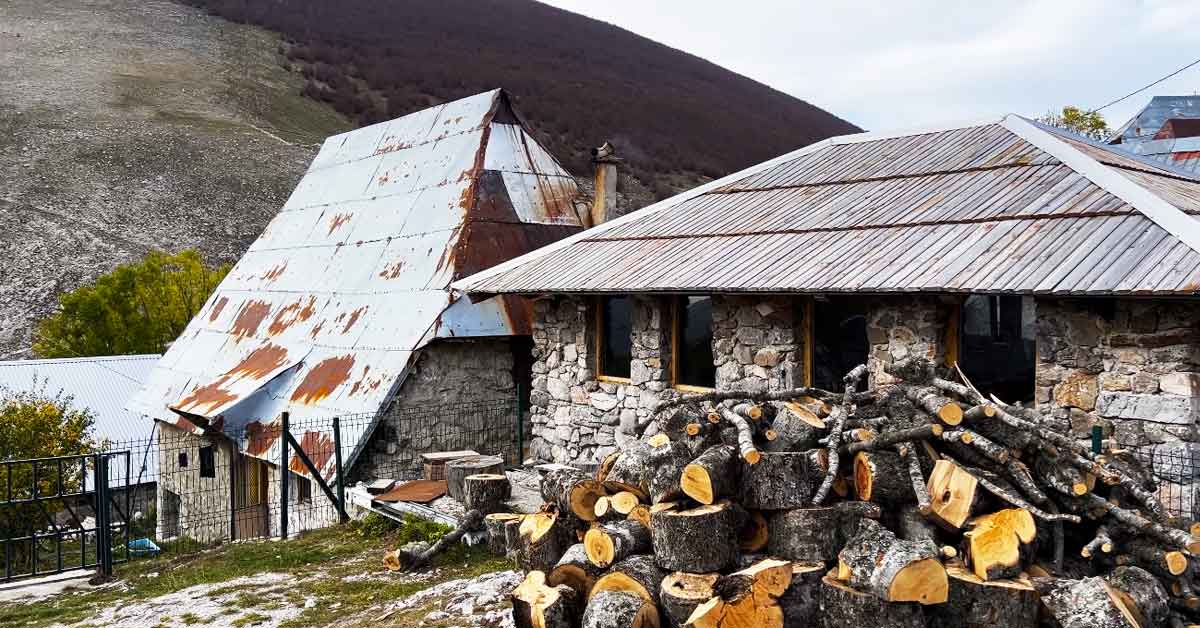
At 1,495 meters above sea level, perched on the southern slopes of Bjelašnica Mountain on the edge of the magnificent Rakitnica Canyon, lies Lukomir – Bosnia and Herzegovina’s highest permanently inhabited village and arguably one of the most authentic cultural experiences the Balkans has to offer. This is not a reconstructed village designed for tourists or a museum with operating hours. Lukomir is a living, breathing community where centuries-old traditions persist as daily practice rather than performance, where stone houses with cherry wood shingle roofs have stood for generations watching over alpine meadows, and where the pace of life remains dictated by seasons, livestock, and the unforgiving mountain environment rather than modern schedules and digital notifications.
The village’s name is believed to derive from “luka” (harbor) and “mir” (peace) – a fitting description for this tranquil but challenging highland settlement where approximately 50 stone houses cluster together for mutual protection against the elements. During summer months, roughly 17 families return to tend their livestock – primarily sheep numbering up to 4,000 animals during peak grazing season – and maintain their traditional way of living. Winter transforms Lukomir into an almost ghostly place, with meter-high snowfalls making the village inaccessible from December through April except by skis or on foot. For this reason, most residents migrate to warmer lowland areas during winter months, leaving only a handful of elderly residents who have chosen permanence over comfort.
Table of Contents
History and Heritage of Lukomir Village – Six Centuries of Mountain Resilience
The origins of Lukomir stretch back at least 600 years, with archaeological evidence suggesting even deeper historical roots. Medieval stećci tombstones – UNESCO-protected monuments carved with symbols depicting aspects of medieval life – scattered throughout the village dating to the 14th and 15th centuries provide tangible proof of continuous human settlement in this isolated location. These monolithic markers tell stories of families, their relationships, their faith, and their determination to claim this harsh mountain environment as home.
The village’s founding is rooted in the pastoral traditions of the Dinaric highlanders, specifically shepherd families from the arid Podveležje plateau in Herzegovina. These semi-nomadic herders would seasonally migrate to Bjelašnica’s rich alpine meadows where their massive flocks could find abundant water and grazing. Unlike temporary migrations, however, the shepherds discovered that the combination of water abundance, high-quality pastures, and defensible location made permanent settlement viable. Gradually, seasonal camps transformed into permanent dwellings. Families built stone houses designed to withstand mountain conditions rather than temporary structures. Children were born and educated here. The village evolved from a summer refuge into a year-round commitment.
In 2009, the Bosnian government officially recognized Lukomir as a National Monument – specifically designated as a Cultural Landscape – the only such monument in the country where people continue to actively live. This recognition acknowledged that Lukomir represents irreplaceable cultural heritage, embodying how Dinaric mountain populations historically lived, built, organized communities, and survived in environments where nature tolerates no compromise or weakness. In 2023, Lukomir received the prestigious title of “Most Beautiful Village in Bosnia and Herzegovina,” acknowledging its architectural integrity, cultural significance, and emotional resonance with visitors.
The village endured the 1990s Bosnian War, though not without severe damage and displacement. Like many places in Bosnia, Lukomir bore scars from the conflict – houses were damaged, families scattered, and the community’s continuity was interrupted. Yet, in characteristic fashion, the village rebuilt itself. This resilience reflects the essential character of Lukomir: a place where people choose to remain despite hardship, choosing community and cultural continuity over easier alternatives.
Architecture in Lukomir Village – Stone Wisdom Built Into Walls
The most visually striking aspect of Lukomir is its architectural ensemble – approximately 50 stone houses, many exceeding 200 years in age, constructed from locally quarried limestone with distinctive steeply pitched roofs traditionally covered in cherry, oak, or fir wood shingles. This architectural style is not aesthetic choice but practical engineering adapted to extreme mountain conditions.
The houses are characteristically small with minimal external surface area, reducing the energy required to heat them during winters when temperatures plunge well below freezing. Walls are thick stone providing thermal mass that moderates temperature fluctuations. Roof pitches are steep and heavily weighted because accumulation of meter-deep snow loads would collapse structures with gentler slopes. Small windows conserve heat while providing light. Internal layout typically centers on a fireplace providing both heating and cooking functionality. The “čardak” – a small attic space beneath the roof – serves for food storage, tool safekeeping, and provisions that must survive the winter months.
The village layout itself demonstrates community engineering. Houses cluster closely together in patterns that shield buildings from prevailing winds and create protected passages between structures. Narrow pedestrian pathways channel wind through the village rather than allowing it to strike houses directly, a consideration that becomes obvious only to those who experience the Bjelašnica wind force. Nothing in Lukomir’s architecture or spatial organization is arbitrary – every element reflects generations of accumulated knowledge about survival at extreme altitude.
In recent decades, some new construction has appeared – concrete and modern materials that stand in stark contrast to traditional stone structures. This visible evolution reflects the changing relationship between the village and modernity, tension between preservation and adaptation that many traditional communities face globally.
How to Reach Lukomir Village
Lukomir’s isolation is part of its character, but several transportation options exist for visiting this remarkable settlement.
Organized Tours from Sarajevo remain the most popular option, particularly for first-time visitors unfamiliar with mountain driving conditions. Tour operators offer full-day excursions departing Sarajevo in early morning, traveling via the scenic Bjelašnica route, and typically including guided village exploration, traditional lunch in a local household, and return by evening. Costs typically range from 35 to 70 euros per person depending on group size and inclusions, with private guided tours commanding premium rates of 120-180 euros for small groups. Tours handle logistics entirely, provide cultural context through knowledgeable guides, and ensure visitors don’t encounter navigation challenges on mountain roads.
Self-driving offers independence but requires vehicle capability and driver confidence on mountain terrain. The distance from Sarajevo to Lukomir is approximately 60-70 kilometers, but driving time averages 90 minutes to two hours due to road conditions. The route proceeds through Bjelašnica’s asfalt sections before transitioning to increasingly rough macadam road. A standard passenger car can navigate the route during summer months with cautious driving, though 4×4 vehicles are recommended particularly after rainfall. Parking near the village is typically informal and free, though most visitors make contributions at local establishments where they purchase food or refreshments.
Hiking approaches are increasingly popular, particularly the Umoljani-to-Lukomir trail – a spectacular 3-4 hour ascent through alpine meadows and past the distinctive Obalj peak, offering dramatic views of Rakitnica Canyon. This option combines physical activity with cultural immersion and is suitable for experienced hikers with reasonable fitness levels. Numerous guide services in Sarajevo organize this experience with transportation to Umoljani and professional guidance through the hiking route.
Accommodation options have expanded in recent years. While traditional homestays remain available – families offer rustic but authentic accommodation in their homes – a newly constructed lodge now provides more conventional facilities for visitors preferring modern amenities while still experiencing village immersion.
Activities and Experiences in Lukomir Village – Living Rather Than Sightseeing
Lukomir doesn’t offer conventional tourist attractions in the modern sense. Rather, the village itself is the attraction – the experience is cultural immersion rather than activity consumption.
Walking and hiking form the primary activity. A short walk to the edge of Rakitnica Canyon – perhaps 20-30 minutes of easy hiking – provides views of the dramatic 800-meter drop into one of Europe’s deepest canyons. The visual impact of standing at the canyon’s edge, seeing how far the earth falls away, experiencing the scale of geological forces at work, consistently emerges as the highlight for most visitors. Photography enthusiasts find endless subjects in architectural details, mountain vistas, and traditional cultural practices.
The Peruce Waterfall – approximately 40 meters tall – is accessible via a short hike and provides a natural feature complementing the village experience. The waterfall represents one of several geological wonders in the immediate area reflecting Bjelašnica’s glacial history and ongoing hydrological activity.
Connecting with local residents constitutes perhaps the most valuable aspect of visiting Lukomir. Unlike staged cultural performances, encounters here are authentic. Sitting with villagers over traditional Bosnian coffee – prepared in a džezva (small copper pot) with meticulous attention to ritual and flavor – provides windows into how people navigate modern globalization while maintaining cultural continuity. These conversations often touch on profound themes: how villages survive demographic decline, what motivates young people to leave or return, what traditional knowledge remains relevant in contemporary context, how the 1990s war affected the community.
Seasonal activities vary significantly. Spring (May-June) offers wildflower displays and flowing water features as snowmelt fills streams. Summer provides optimal conditions for hiking, with stable weather and clear vistas. Autumn presents colorful foliage and moderate temperatures. Winter, though dangerous and requiring specialized equipment, attracts committed adventurers seeking the raw, extreme experience of alpine isolation.
Local handcrafts are available for purchase – hand-knitted woolen socks and traditional clothing pieces made with techniques passed through generations. Honey, cheese, kajmak (clotted cream), and other locally produced food items represent authentic souvenirs supporting village economy.
Dining and Traditional Hospitality in Lukomir Village – Authentic Highland Cuisine
Food in Lukomir reflects the agricultural realities of high-altitude mountain living. Diets necessarily emphasize preserved foods, dairy products, grains, and whatever vegetables survive the brief growing season. This limitation has produced distinctive regional cuisine characterized by simplicity, integrity, and deep connection to the land.
Traditional pita – baked pastry filled with cheese (sirnica), potato (krompiruša), or leafy greens (zeljanica) – represents the iconic village meal. These are baked in traditional wood-fired ovens or under the traditional sač (flat baking metal) rather than modern kitchen equipment. A portion typically costs 8-12 euros and comprises a genuinely filling meal.
Fresh cheese and kajmak (a dairy product similar to clotted cream) are available in local households and constitute traditional complements to any meal. The quality reflects locally-produced milk from village herds, with flavors reflecting the diverse alpine herbs the animals consume.
Bosnian coffee prepared in the traditional manner – finely ground coffee heated in small copper pots, served in small cups with thick foam – accompanies virtually all village interactions. The ritual of coffee preparation and consumption represents cultural practice as much as beverage consumption, typically costing 1.50-3 euros per cup.
Homemade bread, often baked daily in village households, provides carbohydrate base for meals and is available for purchase or occasionally offered as hospitality gift.
Several family-operated restaurants and guesthouses have formalized food service while maintaining traditional preparation methods. These establishments typically offer:
- Traditional meat dishes (grilled lamb, beef, local sausages)
- Soups and stews prepared according to generations-old recipes
- Fresh salads utilizing garden vegetables
- Dairy products and preserved items
- Homemade juices and beverages
Meal prices typically range from 10-18 euros per person, with portions generous and quality high. Authenticity is emphasized – visitors should expect simple, honest food rather than elaborate presentation. Many establishments offer overnight accommodation alongside restaurant service, facilitating deeper immersion in village life than day-trip visits permit.
The Natural Environment in Lukomir Village – Alpine Ecology and Extreme Climate
Lukomir’s environment is uncompromising. This is landscape shaped by glaciation, erosion, and high-altitude continental climate that dominates human experience and cultural practice.
The Rakitnica Canyon – separating Bjelašnica from Visočica Mountain – is one of Europe’s deepest canyons, dropping approximately 800 meters. The geological forces that created this dramatic landscape remain visible in exposed rock layers, distinctive coloring, and the Rakitnica River’s continued erosive work. From Lukomir’s elevated position at the canyon rim, visitors gain perspective on earth’s geological processes at scales difficult to comprehend from valley perspectives.
Climate patterns determine village rhythms absolutely. Summer temperatures in July-August typically reach 20-25 degrees Celsius (occasionally higher), with nights dropping to 10-15 degrees even during warmest months. This explains why residents require thick clothing despite summer season. Winter temperatures plunge to -5 to -15 degrees Celsius, with meter-high snowfall common. The winter season’s length and severity means village is essentially inaccessible from December through April – the road becomes impassable except to skiers and serious winter mountaineers.
Flora and fauna reflect alpine ecology. Conifers dominate forests above 1,200 meters, giving way to grasslands and junipers on the plateau. Alpine meadows burst with wildflowers during spring and early summer – lupines, arnicas, various alpine species. Mushrooms and wild berries (particularly blueberries and rosehips) grow abundantly and are traditionally harvested by locals. The region’s biodiversity is notable despite harsh conditions.
Geological history is written in the landscape. Bjelašnica and adjacent mountains represent a large tectonic remnant resulting from erosion of rock sheets displaced several kilometers across older substrate. The plateau’s rounded valley floors and smoothed valley walls provide visible evidence of previous glaciation, with fertile valley floors containing sedimentary deposits transported during ice ages.
The pure, thin mountain air – containing minimal pollution despite proximity to Sarajevo – and the silence broken only by wind and animal sounds create sensory experiences increasingly rare in modern life. Many visitors report this environmental contrast as profoundly moving – a reset from perpetual background noise characterizing contemporary existence.
Best Time to Visit Lukomir Village – Seasonal Considerations
May to October represents the accessible season. During these months, roads are passable with conventional vehicles, weather is stable enough for outdoor activity, villages are inhabited and accommodations are operational, and daily life is active rather than survival-focused.
May-June offers spring conditions with wildflowers blooming, water abundant from snowmelt, and moderate temperatures.
July-August provides optimal hiking conditions with clear skies and stable weather, though temperatures can be extremely hot requiring adequate water and sun protection.
September-October brings pleasant temperatures, reduced tourist crowds compared to summer, and excellent visibility for photography.
November through April presents winter challenges – heavy snowfall, sub-freezing temperatures, village accessibility only by specialized winter equipment. However, winter visits offer the authentic experience of the settlement in its harshest conditions and have become increasingly popular with experienced winter mountaineers.
Conclusion – Why Lukomir Village Matters
Lukomir represents something increasingly rare in contemporary globalized world – a place where traditional culture persists not as museum exhibit but as active, lived reality. The village embodies centuries-old knowledge about sustainable living at extreme altitude, architectural design harmonizing with environment, and community values emphasizing mutual support and cultural continuity. In its 50 stone houses, its hand-knitted garments, its traditional food preparation, its shepherd lifestyle, and its landscape relationship, Lukomir preserves patterns of human settlement dating back centuries.
For visitors, Lukomir offers something equally rare – genuine cultural encounter without commercialization, authentic hospitality without performance, and environmental beauty without development. The village doesn’t cater to tourism; rather, visitors adapt to village rhythms, participate in village life, and contribute economically while learning directly from people who have chosen this challenging lifestyle.
Lukomir is protected as a National Monument precisely because its erasure would represent irreplaceable cultural loss. In an era when traditional communities worldwide face demographic decline, economic pressures, and cultural homogenization, Lukomir’s survival – however precarious – matters. Every visitor who engages respectfully, purchases local products, and learns directly from residents contributes to making continued inhabitation economically viable.
This is a place worth visiting for reasons that transcend conventional tourism – it’s a pilgrimage to see how humans can live harmoniously with extreme environment, how cultures sustain themselves across centuries, and how community bonds remain powerful in isolated places. Lukomir reminds visitors that alternative ways of living remain possible, that silence and simplicity have value, and that tradition offers wisdom continuing to prove its worth.
FAQ – Frequently Asked Questions about Lukomir Village
What is the best time to visit Lukomir?
May through October offers optimal conditions with accessible roads, active village life, comfortable temperatures, and available accommodation. July-August are warmest but also most crowded. May-June and September-October provide better balance of weather and reduced tourist density.
Can I visit Lukomir as a day trip from Sarajevo?
Yes, absolutely. Most visitors undertake day trips lasting 6-10 hours including transportation. Alternatively, overnight accommodation enables deeper village immersion and early morning experiences before day visitors arrive.
What should I bring when visiting Lukomir?
Sturdy hiking boots, weather-appropriate clothing (it’s cooler at altitude than in Sarajevo), sunscreen, sufficient water, and a camera. Even in summer, bring a jacket – temperatures drop significantly. If hiking the Umoljani trail, hiking poles are helpful though tour operators sometimes provide them.
Is it safe for solo female travelers to visit?
Yes. Village residents are welcoming and respectful. However, hiking solo requires fitness and navigation competence, so organized tours may be preferable for inexperienced hikers.
What is the road condition to Lukomir?
From Sarajevo through Bjelašnica is paved/good macadam. The final approach to Lukomir transitions to rough mountain road passable in summer with careful driving. Standard cars can navigate this, though 4×4 vehicles are recommended for safety.
Is there cellphone reception in Lukomir?
Reception exists but is unreliable. Internet is extremely limited. Plan accordingly if you need to remain connected.
Our Most Popular Tours To Sarajevo
We offer many tours that include a visit to Sarajevo and its most popular locations:
- Full Day tour from Sarajevo to Belgrade (Most Popular)
- Full Day tour from Sarajevo to Međugorije & Mostar
- Full Day Tour from Sarajevo to Travnik and Jajce
- Full-Day 5 Cities Tour from Sarajevo to Herzegovina (Mostar)
- Full day Tour from Sarajevo to Dubrovnik (Kotor or Split)
Don’t Hesitate To Say Hi!
Got any questions about our tours or the city? Don’t hesitate to contact us anytime for more info and booking.
Use the following phone number and email: