
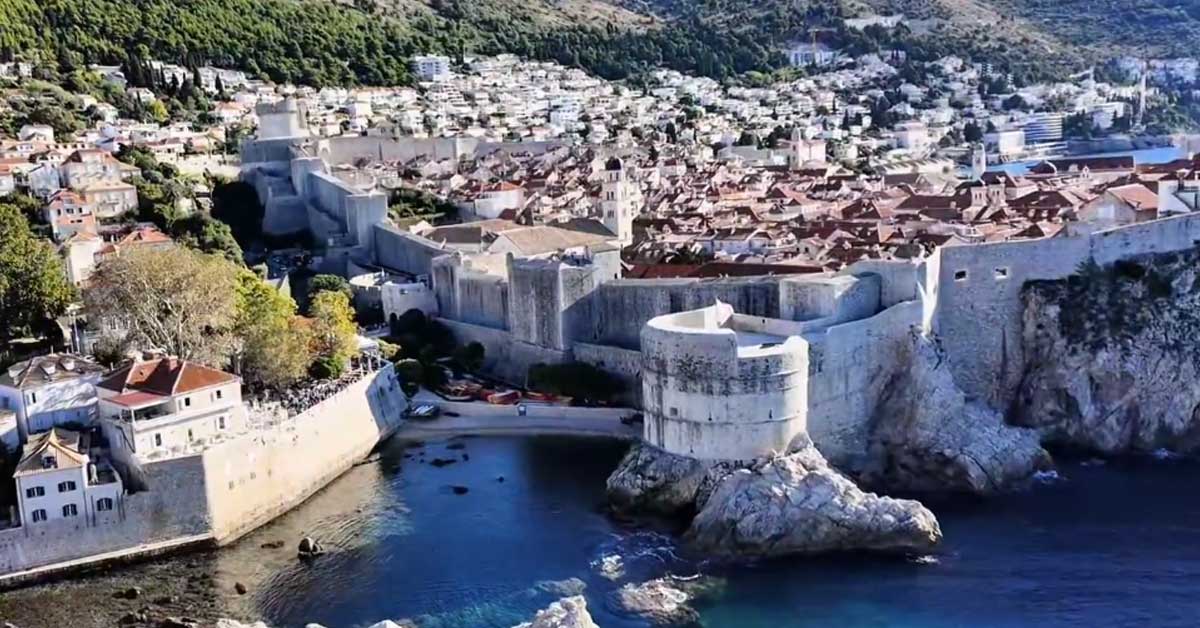
Standing on the western side of Dubrovnik’s Old Town, separated from the medieval walls by water and connected to the mainland by a narrow stone bridge, Lovrjenac Fortress rises like something out of a medieval fantasy. And as Lovrjenac stands on the western side, Revelin Fortress is on the eastern side. The fortress is massive, dramatically positioned on a rocky outcrop that seems to emerge directly from the sea, and its presence is so visually commanding that it literally steals your attention the moment you glimpse it from anywhere in the western Old Town. For medieval residents of Dubrovnik, Lovrjenac was an absolute necessity – a fortress positioned to defend the harbor entrance and protect the city from naval attack. For modern visitors, Lovrjenac is something more: a place where history, legend and imagination converge, where medieval reality and contemporary entertainment become difficult to distinguish.
Lovrjenac’s fame exploded globally when the fortress became the filming location for the Red Keep in the HBO series Game of Thrones. Suddenly, medieval military architecture became recognizable to millions of people who had never heard of Dubrovnik. But Lovrjenac’s significance extends far beyond television. This fortress represents five centuries of Dubrovnik’s commitment to protecting itself through strategic fortification, architectural innovation and political will. Walking through Lovrjenac is not simply visiting a tourist attraction. It is standing inside the physical embodiment of how medieval cities fought for survival.
This guide explores Lovrjenac’s history, its architectural sophistication, what you encounter when you visit and why spending time inside this fortress deepens understanding of medieval Dubrovnik in ways that studying the main city walls alone cannot accomplish.
Table of Contents
The History of Lovrjenac Fortress: Building Against Threat
Lovrjenac was constructed between 1018 and 1042, making it older than Dubrovnik’s main city walls. This early construction date reveals something crucial about medieval Dubrovnik’s understanding of threat and defense. The city recognized that its harbor entrance was its most vulnerable point. Ships entering the harbor had to navigate a narrow channel. If an enemy controlled this channel or positioned forces to attack ships as they entered or exited, Dubrovnik’s entire economy would be strangled.
The fortress was built not as part of the main city walls but as a separate, independent fortification positioned specifically to command the harbor entrance. This strategic positioning meant that enemies attacking Dubrovnik would have to deal with Lovrjenac before they could even reach the main city. The fortress could mount artillery and direct fire onto approaching vessels. It could prevent enemy ships from entering the harbor. It could serve as a fallback defensive position if the main city walls were breached.
Over the following centuries, Lovrjenac was repeatedly modified, rebuilt and strengthened as military technology evolved. The fortress that exists today is primarily a 16th-century reconstruction, built after earlier medieval structures were damaged or destroyed and redesigned to accommodate cannon artillery. The architectural style reflects the transition from medieval defensive thinking (high walls, towers with narrow defensive openings) to Renaissance military engineering (lower profiles, wider gun emplacements, bastions designed to mount heavy artillery).
The fortress was garrisoned continuously throughout its history. Soldiers were stationed there permanently to monitor the harbor, maintain the fortifications and stand ready to defend against attack. These were not elite knights but professional soldiers – men whose careers depended on understanding military technology and being prepared for combat at any moment.
Architectural Features of Lovrjenac Fortress: Engineering for Defense
Examining Lovrjenac’s physical structure reveals how medieval and Renaissance military engineers understood defense. The fortress sits on a rocky outcrop, providing natural height advantage. The height meant that defenders could see approaching enemies from great distances and could fire down on attackers, giving defenders significant tactical advantage.
The fortress’s outer walls are massive – approximately 12 meters thick in places – built from local limestone cut into large blocks and fitted together with minimal mortar. This construction method created walls that could withstand artillery bombardment better than earlier medieval walls built from smaller stones. The thickness also provided space for garrison quarters, ammunition storage and other necessary facilities.
Gun emplacements and artillery bastions are visible throughout the fortress. These were specifically designed positions where cannons could be mounted on swivels that allowed gunners to aim and fire in different directions. The positioning of these gun emplacements shows sophisticated understanding of how to defend against threats approaching from sea or land.
The fortress’s shape is roughly triangular, with bastions at each corner. This design, typical of Renaissance military architecture, allowed defenders to control approaches from multiple angles. Every approach to the fortress came under fire from at least one gun emplacement. This created a “kill zone” concept where attackers could not find any safe approach.
Water surrounds the fortress on three sides, providing natural defense against land-based assault. The narrow stone bridge connecting the fortress to the mainland was easily defended and could be destroyed or blocked if the fortress needed to be sealed off. The well inside the fortress provided fresh water, allowing the garrison to withstand siege if necessary.
Strategic Importance of Lovrjenac Fortress: More Than Just a Fort
Lovrjenac’s strategic value extended beyond its physical defensive capability. The fortress represented Dubrovnik’s determination to defend itself. The mere presence of Lovrjenac with a permanent garrison of soldiers signaled to potential attackers that Dubrovnik took its defense seriously. The fortress could not have been built cheaply or easily. Its massive walls, professional garrison and continuous maintenance required significant resource investment.
The fortress also embodied Dubrovnik’s legal and political autonomy. By maintaining independent fortification and garrison, Dubrovnik demonstrated that it possessed the means to defend itself without relying on external powers. This was not merely military statement but political one. It meant Dubrovnik was not simply a town that required protection from Venice, the Ottoman Empire or other regional powers but was an independent entity capable of self-defense. This perception of strength and independence was crucial to Dubrovnik’s diplomatic negotiations with larger powers.
Throughout its history, Lovrjenac never fell to military assault despite numerous wars and conflicts affecting the region. This is remarkable. The fortress was attacked multiple times, yet its walls proved impenetrable. This record of never being conquered contributed enormously to Dubrovnik’s reputation for military capability, even though Dubrovnik’s true strength lay in diplomacy and commerce rather than military force.
The Game of Thrones Connection to Lovrjenac Fortress: Medieval Reality Meets Entertainment
In 2011, the HBO series Game of Thrones began filming scenes at Lovrjenac, using the fortress as the exterior location for the Red Keep, the royal castle in the fictional kingdom of Westeros. The fortress’s dramatic positioning above water, its imposing stone walls and its historically authentic military architecture made it perfect for television production.
The casting of Lovrjenac as the Red Keep transformed the fortress’s cultural significance. Suddenly millions of people worldwide recognized Dubrovnik’s skyline through Game of Thrones imagery. Visitors who had never heard of medieval Dubrovnik came specifically to see the fortress that appeared on their screens. Tourism to Lovrjenac increased exponentially.
This intersection of history and entertainment raises interesting questions about how popular culture shapes historical understanding. People recognize Lovrjenac because of fictional drama but then learn about actual medieval history. The Game of Thrones connection, while fundamentally altering Lovrjenac’s fame and visitor numbers, has not diminished the fortress’s historical significance. Instead, it has created bridge between entertainment and education, allowing people to encounter medieval history through dramatic imagery they recognize.
The fortress remains marked by this dual identity. Medieval history and contemporary entertainment coexist. Visitors often arrive expecting to see the Red Keep and discover instead an actual fortress with real history. Many find that the actual medieval fortress is more interesting than the fictional version, precisely because the real history is more complex and grounded in genuine human concerns about defense and survival.
Interior Spaces of Lovrjenac Fortress: Living and Fighting
Walking into Lovrjenac, you encounter spaces designed for military function, not comfort. Garrison quarters were modest – soldiers slept in simple conditions with minimal privacy. The rooms were compact, built into the thick fortress walls where stone provided natural insulation from temperature extremes.
The command center, positioned at the highest point of the fortress, provided commanding view of the harbor and surrounding sea. From this position, commanders could monitor approaches and direct defensive response. This elevated position combined practical defensive advantage with psychological authority – the commander literally stood above everyone else in the fortress hierarchy.
Ammunition storage was built into protected chambers within the fortress walls, sheltered from direct enemy fire. These chambers held the cannons’ ammunition, gunpowder supplies and other materials necessary for sustained defense. The positioning of these storage areas shows careful planning – ammunition was stored where it could be quickly accessed by gunners without requiring long transport distances.
The well inside the fortress provided fresh water, essential for any garrison expected to withstand siege. The positioning and construction of the well shows that fortress designers understood that defenders needed to be self-sufficient, capable of maintaining garrison function for extended periods without resupply from the city.
Visiting Lovrjenac Fortress: What to Expect
Lovrjenac is located on the western side of Dubrovnik’s Old Town, outside the main city walls. Access is via a narrow stone bridge connecting the fortress to the mainland near the Pile Gate. The walk from the main Old Town through the Pile Gate to the bridge takes approximately five minutes.
Admission: Approximately 5–10 euros for adult tickets. The Dubrovnik Pass often includes access or provides discounts.
Hours: Lovrjenac’s opening hours vary seasonally. Summer hours are typically 8 AM – 7 PM, while winter hours are shorter. Confirm current hours before visiting.
Time Required: 30–45 minutes for thorough exploration.
Physical Considerations: Climbing steep stone staircases and navigating uneven surfaces requires reasonable physical fitness. The fortress has no elevator. Comfortable walking shoes with good grip are essential as stone surfaces can be slippery.
What to Bring: Bring water – there is minimal shade inside the fortress and Mediterranean sun can be intense. A camera is essential for photography given the dramatic views.
Views and Photography: The views from Lovrjenac are spectacular, encompassing the Adriatic Sea, Dubrovnik’s city walls and surrounding islands. The fortress is popular for photography because of these views and because of Game of Thrones recognition. Go early in the morning or late in the afternoon to avoid crowds and achieve better photography lighting.
Nearby Attractions and Combination Visits with Lovrjenac Fortress
Lovrjenac sits in close proximity to several other major Dubrovnik attractions. The city walls begin at the nearby Pile Gate. Fort St. John (Maritime Museum) is visible from Lovrjenac’s position. The Franciscan Monastery and Cathedral are short walks away. Combining a Lovrjenac visit with walks along the western portions of the city walls and visits to nearby monuments creates an efficient exploration of Dubrovnik’s western defensive zone. For those who want to escape the summer crowds and explore beyond the city walls, a short ferry ride from the Old Harbour takes you to Lokrum Island, where you can swim in the Dead Sea lake, walk among wild peacocks, and visit the monastery ruins that inspired countless legends.
You can also combine Lovrjenac with a half day inland escape to the mountain stronghold of Sokol Grad in Konavle, where you trade harbour views for raw Dalmatian wilderness and learn how Dubrovnik defended its land approaches as well as its sea gates.
FAQ – Lovrjenac Fortress
Why was Lovrjenac built outside the main city walls instead of being integrated into them?
Lovrjenac’s separate position outside the main walls provided dedicated defense of the harbor entrance, the city’s most strategically critical point. This separation allowed Lovrjenac to function independently if necessary and prevented attackers from using the fortress against the city proper if they managed to capture it. The fortress protected access to Dubrovnik’s economic lifeblood – the harbor.
How significant was Lovrjenac to Dubrovnik’s overall defense strategy?
Extremely significant. The fortress represented Dubrovnik’s commitment to maintaining independent military capability and diplomatic leverage as a city‑state. Lovrjenac’s successful defense throughout history strengthened Dubrovnik’s military reputation far beyond its actual military capacity, contributing to diplomatic negotiations with larger powers.
Did Lovrjenac ever actually come under siege or sustained attack?
Yes, multiple times throughout history. Yet the fortress never fell to military assault, remarkable testimony to its construction quality and defensive design. This record of never being conquered contributed enormously to Dubrovnik’s reputation for military strength and independence.
How does Game of Thrones filming affect visiting the fortress today?
Game of Thrones dramatically increased Lovrjenac’s fame and visitor numbers worldwide. While the fortress retains its authentic medieval structure, it now hosts visitors who arrive because of television recognition. Many discover that actual medieval history is more complex and interesting than fictional drama, enriching their experience beyond entertainment expectations.
What physical condition is necessary to visit Lovrjenac?
Visitors should be comfortable climbing steep stone staircases and navigating uneven surfaces. The fortress has no elevator and requires reasonable physical fitness to explore comprehensively. Senior visitors or those with mobility limitations should assess whether their condition permits climbing before purchasing admission.
Is there food or water available inside Lovrjenac?
No. Visitors should bring water, particularly during warm months. There are minimal facilities inside the fortress beyond restrooms. Refreshments are available in the nearby Old Town after exiting the fortress.
Our Most Popular Tours To Sarajevo
We offer many tours that include a visit to Sarajevo and its most popular locations:
- Full Day tour from Sarajevo to Belgrade (Most Popular)
- Full Day tour from Sarajevo to Međugorije & Mostar
- Full Day Tour from Sarajevo to Travnik and Jajce
- Full-Day 5 Cities Tour from Sarajevo to Herzegovina (Mostar)
- Full day Tour from Sarajevo to Dubrovnik (Kotor or Split)
Don’t Hesitate To Say Hi!
Got any questions about our tours or the city? Don’t hesitate to contact us anytime for more info and booking.
Use the following phone number and email: