
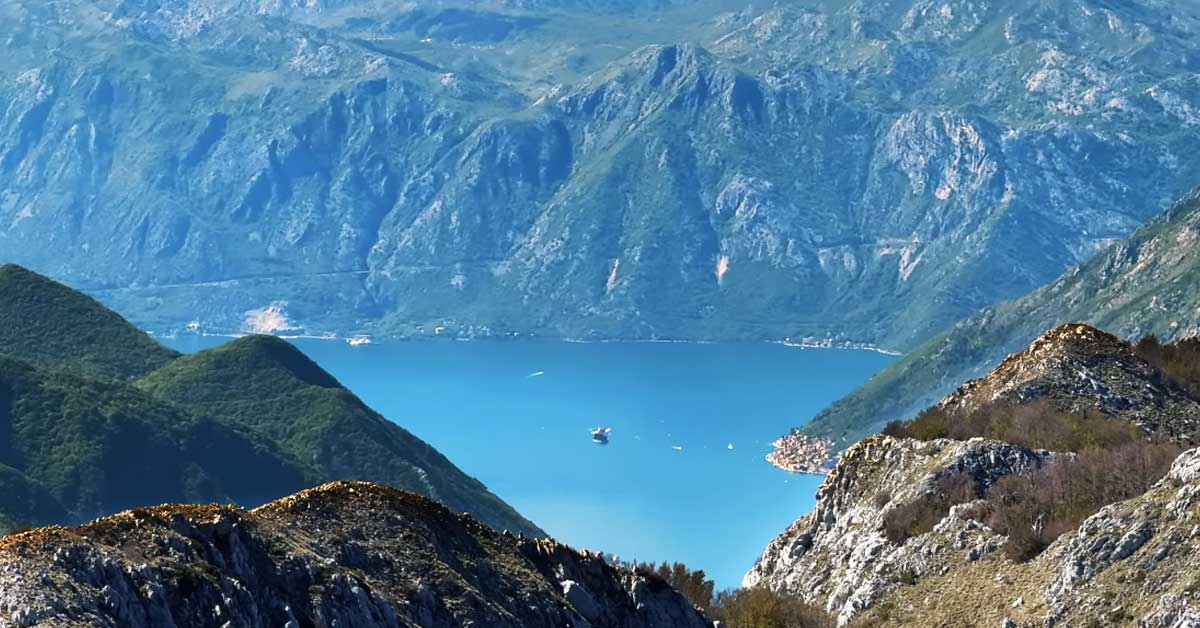
There are places in the world that define a nation. For Greece, it might be the Acropolis. For France, perhaps the vineyards of Bordeaux. But for Montenegro, that place is undoubtedly Lovćen National Park. It is not just a mountain; it is the spiritual and historical core of the country. Locals do not just look at it; they look up to it, quite literally.
Lovćen National Park is a place where two worlds collide. On one side, you have the Mediterranean: hot, dry, and smelling of salt and sage. On the other side, just a few kilometers away, you have the continental Balkans: harsh, snowy in winter, and smelling of deep beech forests. This clash of climates creates a unique ecosystem that is unlike anywhere else in Europe.
Table of Contents
The Road of 25 Serpentines to Lovćen National Park
The adventure to Lovćen National Park begins long before you reach the entrance gate. It starts with the drive. If you are coming from Kotor, you will take the famous “Kotor Serpentine Road.”
Constructed in 1884 by the Austro-Hungarians, this engineering marvel connects the coast with the interior. But “marvel” might not be the word you use when you are on it. You might use other, more colorful words. The road features 25 sharp, hairpin turns (serpentines) that climb steeply up the face of the mountain.
As you ascend towards Lovćen National Park, the view changes with every turn. First, you see the roofs of Kotor. Then, you see the bay. Then, you see the open sea. By the time you reach the 25th turn, the cruise ships in the harbor look like bath toys.
It is a thrilling drive, but it requires focus. The road is narrow, and you will often have to reverse to let a bus pass. But do not let that scare you. The locals drive it every day in old Golfs. Just take your time, honk around the corners, and enjoy the most spectacular drive of your life.
Njeguši: The Birthplace of Kings in Lovćen National Park
Before you enter the deep wilderness of Lovćen National Park, the road flattens out into a high mountain plateau. You have arrived in Njeguši. This is not just any village; this is the royal cradle of Montenegro.
This tiny stone settlement was the birthplace of the Petrović-Njegoš dynasty, the family that ruled Montenegro for over 200 years. You can still visit the humble stone house where Petar II Petrović-Njegoš, the country’s greatest poet and ruler, was born. It is a stark reminder of how tough life was in these mountains, even for kings.
But let’s be honest, most people stop in Njeguši for one reason: the food. This village is world-famous for “Njeguški pršut” (prosciutto) and cheese. The unique climate of the area, where the sea air meets the mountain air, is perfect for drying meat.
You must stop at one of the roadside smokehouses. The locals will welcome you, probably offer you a shot of rakija (at 10 AM), and slice the prosciutto right in front of you. It is dark, salty, and smoky, and when paired with the local cheese and a glass of red wine, it is the best meal you will have in Montenegro.
The Mausoleum on the Roof of the World in Lovćen National Park
The crown jewel of Lovćen National Park is the Mausoleum of Petar II Petrović-Njegoš. But visiting it is not a walk in the park; it is a pilgrimage.
The mausoleum sits on top of Jezerski Vrh (Lake Peak), the second-highest peak in the park at 1,657 meters. Why the second highest? Because Njegoš himself chose this spot. He was a modest man and said that the highest peak (Štirovnik) should be left for God.
To reach the mausoleum, you have to drive up a narrow road from Ivanova Korita to the foot of the peak. Then, the real work begins. You have to climb 461 stone steps. Most of these steps are inside a long, cool tunnel carved straight through the mountain rock. It feels like you are ascending into the sky.
When you emerge into the sunlight at the top, the view will take your breath away (if the stairs haven’t already). The mausoleum itself is a massive structure built of grey marble, designed by the famous sculptor Ivan Meštrović. Inside, under a golden mosaic canopy, sits a giant 28-ton statue of Njegoš, resting his head in his hand, eternally thinking about the fate of his people.
Behind the mausoleum is a stone viewing platform. This is the spot. From here, you have a 360-degree view of Montenegro. To the south, the shimmering Adriatic Sea. To the north, the jagged, snow-capped peaks of the Durmitor mountain range. To the east, the vast Skadar Lake. It is said that on a perfect day, you can see the coast of Italy across the water. Whether that is true or just a legend, the view is indisputably one of the best in Europe.
Ivanova Korita: The Green Heart of Lovćen National Park
If the Mausoleum is the head of the park, Ivanova Korita is its heart. Located at an altitude of around 1,200 meters, this vast grassy plateau is where the locals come to relax.
The name “Ivanova Korita” means “Ivan’s Troughs.” It is named after Ivan Crnojević, a medieval ruler who brought water to this area through wooden troughs. Today, it is a lush, green oasis surrounded by dense beech and pine forests.
This is the perfect base for exploring Lovćen National Park if you are not into extreme hiking. The meadows are flat and perfect for picnics, frisbee, or just napping in the sun. There is a visitor center here where you can get maps and information about the park’s wildlife.
For families, there is also an Adventure Park nestled in the trees. It has ropes courses and zip lines for all ages, allowing you to swing through the canopy of the famous Lovćen forests. It is a great way to burn off the energy from that prosciutto sandwich you ate in Njeguši.
Hiking the Wolf Trail in Lovćen National Park
For those who want to get some dirt on their boots, Lovćen National Park offers some incredible hiking trails. The most popular and rewarding one is the “Wolf Trail” (Staza vukova).
Do not worry about the name; you are very unlikely to see a wolf, although they do live in the deeper parts of the forest. The trail starts at Ivanova Korita and loops around the peak of Babina Glava (Grandma’s Head).
It is a moderate hike that takes about 3 to 4 hours. The path takes you through ancient beech forests that look like something out of a fairy tale; tall, grey trunks and a carpet of green leaves. Then, it opens up onto rocky ridges with spectacular views of the Budva Riviera.
Hiking here is different from the Alps or the Rockies. The terrain is “karst”; sharp, white limestone rocks that have been eroded by water into strange shapes. It is rugged and beautiful, but you need good shoes. The contrast between the white rock and the deep blue sea below is a photographer’s dream.
The Flora and Fauna of Lovćen National Park
Because of its unique position between the sea and the continent, Lovćen National Park is a biological hotspot. It is home to over 1,300 plant species, many of which are endemic, meaning they grow here and nowhere else on earth.
As you hike, look for the “Lovćen Bellflower,” a delicate purple flower that grows in the cracks of the rocks. The park is also famous for its medicinal herbs. If you hike in the summer, the air is thick with the scent of wild thyme, mint, and sage.
The animal life is just as diverse. While bears and wolves are rare and shy, you have a good chance of seeing smaller mammals. Foxes are common, as are wild boars (be careful if you see piglets!).
Birdwatchers will be in heaven. Lovćen National Park is a major migration route for birds of prey. Keep your eyes on the sky, and you might spot a Golden Eagle or a Peregrine Falcon hunting on the thermal currents rising from the warm rocks. The park is also home to over 200 species of birds, making it one of the most important ornithological sites in the Balkans.
The Austro-Hungarian Fortresses of Lovćen National Park
Lovćen National Park is not just about nature; it is also a military history museum. During the 19th and early 20th centuries, this mountain was the frontline between the Montenegrin Kingdom and the Austro-Hungarian Empire, which controlled the Bay of Kotor.
The Austrians built a massive network of roads and fortresses to secure their border. Many of these structures are still standing today, abandoned and reclaimed by nature.
One of the most impressive is Fort Goražda, located on the lower slopes of the park near the serpentine road. It is a massive stone and concrete bunker that was armed with huge rotating turrets. You can explore the dark tunnels and climb onto the roof for a view that explains exactly why they built it there, you can see every ship entering the bay.
Hiking to these forts adds a layer of Indiana Jones-style exploration to your visit. Just be careful, as these are unmaintained ruins. Bring a flashlight if you plan to explore the interiors.
Zip Line Njeguši: Adrenaline in Lovćen National Park
If the drive up the serpentines wasn’t exciting enough for you, Lovćen National Park has one more thrill to offer: the Zip Line in Njeguši.
Located near the top of the serpentine road, just before you enter the village of Njeguši, this zip line stretches across a deep valley. It is not the longest in the world, but the location is unbeatable. You are hanging 1000 meters above sea level, with the Bay of Kotor spread out below you like a map.
The ride is fast and exhilarating. For a few seconds, you are flying like one of the eagles that call this park home. It is a quick adrenaline shot that breaks up the sightseeing and gives you a story to tell. Plus, the guys running it are usually hilarious locals who will joke with you to calm your nerves before pushing you off the edge.
Practical Guide to Visiting Lovćen National Park
Visiting Lovćen National Park requires a bit of planning, especially regarding transport and weather.
The best way to visit is by car. Public transport does not go all the way up to the Mausoleum or Ivanova Korita. You can rent a car in Kotor or Budva, or hire a taxi for the day. If you are not confident driving on narrow mountain roads, hiring a driver is a smart investment.
The park is open year-round, but access depends on the snow. In winter (December to April), the road to the Mausoleum is often blocked by deep snowdrifts. The lower parts like Ivanova Korita might be accessible, but check the local conditions before you go.
The best time to visit is from May to October. However, remember that even in summer, the temperature at the top is much cooler than on the coast. It can be 35°C in Kotor and a pleasant 22°C on Lovćen. Always bring a jacket or a sweater, even if you are sweating at the beach.
There is a small entrance fee for the national park (around 3 Euros) and a separate ticket for the Mausoleum (around 8 Euros). Bring cash, as the card machines do not always work at high altitudes.
Also, bring plenty of water. While there are restaurants in Njeguši and Ivanova Korita, there are no shops on the hiking trails or at the Mausoleum itself (other than a small souvenir shop).
If you are spending several days in the Bay of Kotor area, you can combine your visit to Lovćen with a boat excursion to the Blue Cave, offering a perfect contrast between mountain peaks and underwater wonders.
For travelers who love mixing dramatic viewpoints with quiet highland escapes, Blidinje Nature Park in Bosnia offers a similar blend of rugged karst peaks, wide open plateaus and a mirror‑like alpine lake just a short drive from Mostar.
Frequently Asked Questions About Lovćen National Park
How much is the entrance fee to Lovćen National Park?
The entrance fee to the national park itself is typically 3 Euros per person, which is collected at the entrance gates on the roads leading into the park.
Is the road to Lovćen National Park dangerous?
The road from Kotor is famous for its 25 hairpin turns and can be narrow, but it is paved and safe if you drive slowly and carefully; however, it might be intimidating for nervous drivers.
Can I visit Lovćen National Park in winter?
The park is technically open, but the road to the Mausoleum and higher peaks is frequently closed due to heavy snow from December to April, so check conditions before driving.
Is there food available in Lovćen National Park?
Yes, there are excellent traditional restaurants in the village of Njeguši and at Ivanova Korita, serving local specialties like prosciutto, cheese, and roast lamb.
Can I hike in Lovćen National Park without a guide?
Yes, the trails are generally well-marked with red and white circles, especially the popular Wolf Trail, so experienced hikers can navigate them on their own.
Our Most Popular Tours To Sarajevo
We offer many tours that include a visit to Sarajevo and its most popular locations:
- Full Day tour from Sarajevo to Belgrade (Most Popular)
- Full Day tour from Sarajevo to Međugorije & Mostar
- Full Day Tour from Sarajevo to Travnik and Jajce
- Full-Day 5 Cities Tour from Sarajevo to Herzegovina (Mostar)
- Full day Tour from Sarajevo to Dubrovnik (Kotor or Split)
Don’t Hesitate To Say Hi!
Got any questions about our tours or the city? Don’t hesitate to contact us anytime for more info and booking.
Use the following phone number and email: