
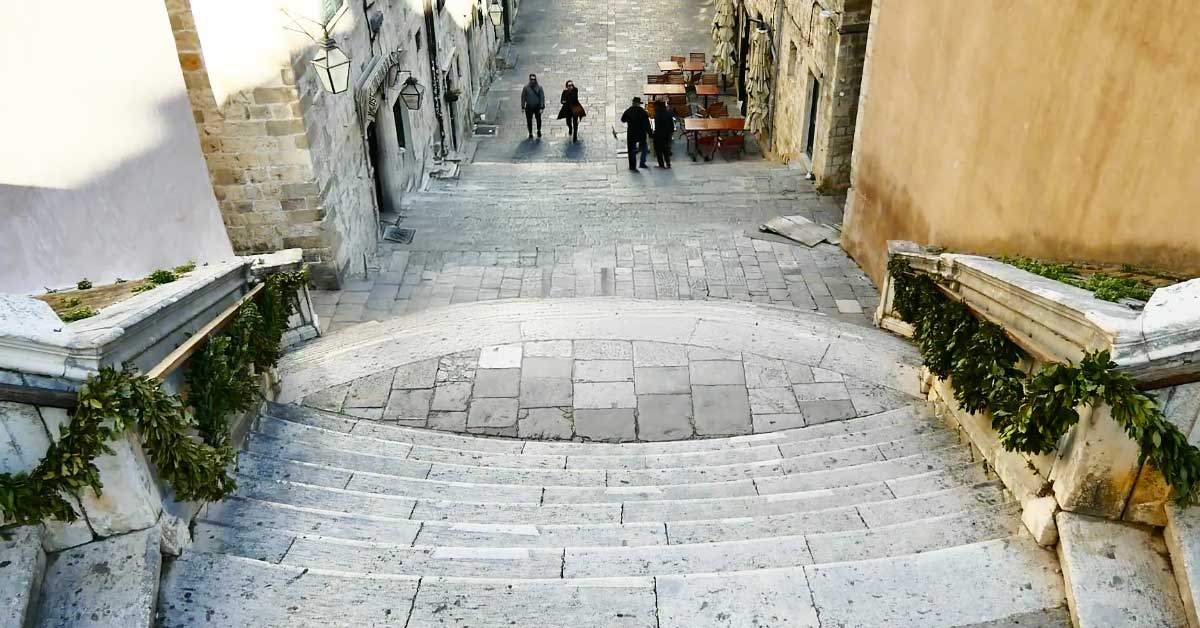
Jesuit Stairs Dubrovnik are one of those places where real history and pop culture collide so perfectly that you almost feel like you have slipped through a crack in time. Rising gracefully from the bustle of Gundulić Square up to the quiet terrace of St. Ignatius Church, these grand Baroque steps form one of the most beautiful corners of the Old Town – and one of the most recognisable, thanks to Game of Thrones. In Season 5, this is where Cersei Lannister begins her infamous Walk of Shame, standing at the top as the High Sparrow condemns her before she descends into the chaos of King’s Landing.
In reality, Jesuit Stairs Dubrovnik are a masterpiece of 18th-century urban design, built in 1738 to connect the everyday life of the market below with the spiritual world of the Jesuit college and church above. Their sweeping curves and split flights were inspired by Rome’s Spanish Steps, but here the Adriatic light, limestone glow and tight medieval streets give them their own distinctive character. Climb them slowly and you feel the mood shift: the chatter of vendors fades, the air cools in the shade of stone walls, and suddenly you arrive at Bošković Square with the monumental façade of St. Ignatius rising before you like a theatre backdrop. Whether you come as a Game of Thrones fan, a lover of Baroque architecture, or just someone chasing a good city view, Jesuit Stairs Dubrovnik make you stop, look around and think: “Yes, this is exactly why I came to Dubrovnik.”
Table of Contents
History of Jesuit Stairs Dubrovnik: a 100-year Baroque project
The story of Jesuit Stairs Dubrovnik begins not with the stairs themselves, but with the ambitious plan to build a full Jesuit complex – college, church and access – in the southern part of the Old Town. In 1653, Jesuit rector Gianbattista Canauli drew the first plans for a large college and church complex in an area of small medieval houses and narrow lanes. Over the next decades, properties were purchased, houses demolished, and an entire neighbourhood reshaped to make space for this new centre of learning and faith.
The catastrophic earthquake of 1667, which destroyed much of Dubrovnik, temporarily halted construction but also created new open space on the hill, making it possible to build a more ambitious church than first imagined. In 1699, the Jesuits invited Andrea Pozzo – one of Europe’s leading Baroque architects and painters, famous for his illusionistic frescoes in Rome – to design the Church of St. Ignatius of Loyola and refine the complex. He based the church on Il Gesù in Rome, the mother church of the Jesuit order, with a powerful façade, longitudinal nave and rich interior decoration. The church was completed in 1725, giving Dubrovnik one of the most impressive Baroque interiors on the Adriatic.
The final step in this century-long project was the construction of Jesuit Stairs Dubrovnik in 1738, designed by Roman architect Pietro Passalacqua of Sicilian origin. His monumental stone staircase linked the square in front of the college and church down to the heart of the town, creating a dramatic urban composition where architecture and topography work together. With this, the Jesuit complex – college, church and stairs – became a unique Baroque ensemble in Croatia, combining early, high and late Baroque elements in a single, carefully staged sequence. Today, when you walk up Jesuit Stairs Dubrovnik, you retrace this 18th-century vision: city, staircase, and church woven into one continuous experience.
Architecture of Jesuit Stairs Dubrovnik: Dubrovnik’s Spanish Steps
Architecturally, Jesuit Stairs Dubrovnik are widely compared to Rome’s Spanish Steps, and with good reason. Built in 1738, they are one of the most refined examples of late Baroque stair design along the Adriatic coast, crafted to be both practical and theatrical. The staircase consists of 136 broad limestone steps that rise from Gundulić Square to the plateau in front of St. Ignatius, split into multiple flights that curve and widen like stone waves as they climb.
Pietro Passalacqua shaped Jesuit Stairs Dubrovnik with flowing, almost sculptural lines: the lower steps fan out generously onto the market square, inviting people to pause, sit and observe, while the middle section narrows and bends, pulling you upward and framing glimpses of the church above. The upper flights open out again into a small, elevated square (Boškovićeva poljana), where the façade of St. Ignatius fills your view like a stage set. This dynamic, scenic conception – a hallmark of late Baroque – turns the simple act of walking up stairs into a kind of urban performance.
Details matter here: the stone balustrades curve gracefully, the proportions of each step are comfortable underfoot, and the gentle slope allows processions to move easily without feeling too steep. While there is no elevator or ramp, and the stairs are challenging for those with reduced mobility, their design still reflects a deep concern for both aesthetics and function. Jesuit Stairs Dubrovnik are not just a staircase; they are a piece of urban theatre, designed to lead your eye and your feet from the everyday world of Gundulić Square up to the spiritual and intellectual world of the Jesuit church and college.
Jesuit Stairs Dubrovnik and the Jesuit complex of St. Ignatius
Jesuit Stairs Dubrovnik are inseparable from the Jesuit complex they serve. At the top of the stairs lies Bošković Square, named after Dubrovnik’s famous polymath Ruđer Bošković, and dominated by the magnificent Church of St. Ignatius of Loyola. This church, completed in 1725 to Andrea Pozzo’s design, has a powerful Baroque façade with pilasters, niches and a central doorway that immediately command attention when you reach the top of the staircase.
Inside, the church continues the Baroque drama with a single nave, side chapels and a richly painted ceiling fresco cycle depicting the life of St. Ignatius, executed in the early 18th century. The church once formed part of the Collegium Ragusinum, a Jesuit college that educated Dubrovnik’s elite and connected the city to a wider European intellectual network. The college buildings form a four-winged cloister-like structure around the church, with classrooms, living spaces and internal courtyards, creating a self-contained world of study and prayer.
Jesuit Stairs Dubrovnik, then, are the ceremonial approach to this world: they physically and symbolically link the commercial life of Gundulić Square – with its daily market and open-air cafés – to the spiritual and academic realm above. Walking up them, you can almost imagine 18th-century students in black robes heading to lectures, priests preparing for mass, and processions snaking down into the city on feast days. In modern times, the church of St. Ignatius still functions as an active parish church with regular masses, and both locals and visitors use the stairs daily, sometimes for worship, sometimes simply to cut across town or to find a quieter viewpoint over the Old Town.
Jesuit Stairs Dubrovnik and Game of Thrones: the Walk of Shame
For many visitors, Jesuit Stairs Dubrovnik came to life not in a history book, but on a TV screen. In Game of Thrones Season 5, these steps became the setting for one of the show’s most powerful scenes: Cersei Lannister’s Walk of Shame. In the episode “Mother’s Mercy”, Cersei stands at the top of Jesuit Stairs, in front of a digitally altered version of St. Ignatius, which doubles as the Great Sept of Baelor. After the High Sparrow delivers his speech, she is stripped and forced to walk down the staircase and through the streets of King’s Landing as a form of penance and humiliation.
In reality, the Jesuit Stairs Dubrovnik sequence is just the beginning of Cersei’s route: from the top of the stairs, she descends into Gundulić Square, then continues through several other Old Town locations including Od Margarite Street, St. Dominic Street and out towards Ploče Gate. The production team chose Jesuit Stairs because their Baroque drama and open perspective made them the perfect stage for such a symbolic moment. The stone steps, the rising church façade, and the tight crowd-filled square all contributed to the feeling of being exposed before an unforgiving city.
Today, Jesuit Stairs Dubrovnik is one of the most popular Game of Thrones locations in the city. Fans pose at the top where Cersei stood, recreate shots on the steps, and sometimes jokingly mutter “Shame!” among friends – though locals appreciate it when visitors keep the theatrics respectful and brief. Even if you are not a fan, it is hard to deny that the show captured something real about this place: the idea of a city watching from every window and balcony, the weight of history pressing on each step, and the thin line between glory and humiliation in a public space. Standing there, you are in the same spot as both Baroque processions and HBO crews – a rare double claim to fame.
Practical guide to Jesuit Stairs Dubrovnik: how to visit
Visiting Jesuit Stairs Dubrovnik is straightforward and completely free, since the stairs are part of the public street network inside the Old Town. There are no tickets, no opening hours and no barriers – you can walk them at any time of day or night. The staircase begins at Gundulić Square (Gundulićeva poljana), the lively market square just south of Stradun, and rises up along Ulica Uz Jezuite to Bošković Square in front of St. Ignatius Church.
If you are staying inside the Old Town, simply head towards Gundulić Square – in the morning you will find it full of fruit, vegetables, spices and souvenirs – and look for the broad stone steps at the square’s southern side. From Pile Gate (the main entrance), it is about 8 minutes’ walk along Stradun and then up a side street; from Ploče Gate (the eastern entrance), it is about 7 minutes. The stairs are not accessible by car or taxi; vehicles must stop outside the walls, and you must enter on foot.
The Jesuit Stairs Dubrovnik consist of 136 steps, and there are no ramps or lifts, so they can be challenging for visitors with mobility issues. If stairs are a problem, you can still see the staircase from the bottom in Gundulić Square or from nearby alleys without climbing. For most visitors, the ascent is moderate: take your time, use the side walls for support if needed, and pause at the landings to enjoy the changing views over the square and rooftops. In high season, the stairs can be busy during late morning and early afternoon, especially when cruise ships are in port, so early morning or evening visits are more peaceful.
Best times and photo tips for Jesuit Stairs Dubrovnik
Choosing the right time to experience Jesuit Stairs Dubrovnik makes a big difference. Early morning, between about 7:00 and 9:00, is ideal if you want to see the stairs with soft light and minimal crowds. The market in Gundulić Square is just getting going, locals are doing their shopping, and the steps are largely free of tour groups and Game of Thrones fans. This is the perfect time for architectural photos, wide shots and quiet appreciation of the Baroque design.
Late afternoon and early evening, between around 17:00 and sunset, also work well, especially in summer when the sun is lower and the stone glows warm without being overly harsh. At this time, Jesuit Stairs Dubrovnik can still be busy, but the atmosphere is more relaxed, with people lingering on the steps, musicians sometimes playing in the square below, and the façade of St. Ignatius catching the last light. Midday, especially during peak cruise hours, is the worst time for both crowds and lighting: the sun is strong, shadows are hard, and the staircase can feel like a conveyor belt of groups.
For photos, there are a few classic angles at Jesuit Stairs Dubrovnik. From the bottom in Gundulić Square, stand back and frame the entire staircase with the church at the top – this shows the full Spanish Steps-like effect. Midway, turn around and shoot down towards the square, capturing the market stalls and the sea of terracotta roofs beyond. At the top, near St. Ignatius, you can look back down the stairs for a more intimate shot with converging lines drawing the eye into the Old Town. Game of Thrones fans often pose at the very top with the church behind them, recreating the opening moment of Cersei’s Walk of Shame. Tripods are best used early morning to avoid blocking others; during busy hours, quick handheld shots are more considerate.
Tips to enjoy Jesuit Stairs Dubrovnik like a local
To really enjoy Jesuit Stairs Dubrovnik, treat them as more than just a quick photo stop. Start your visit in Gundulić Square in the morning, wander through the market, buy some fresh figs or cherries in season, and watch how locals interact in this open-air living room. Then take the steps slowly, imagining students and Jesuit priests doing the same three centuries ago. At the top, step into St. Ignatius Church if it is open – admission is free, and the frescoed ceiling is one of the Old Town’s most overlooked treasures.
After exploring the church, sit for a few minutes on the edge of Bošković Square and look back at the view down the stairs into the city. From here, the Old Town feels like a theatre set, with people entering and exiting Gundulić Square as if on stage. If you are a Game of Thrones fan, you can quietly revisit the scene in your mind without shouting “Shame” or blocking the steps for others – locals appreciate fans who keep things low-key and respectful.
Footwear matters: the limestone on Jesuit Stairs Dubrovnik can be smooth and slippery, especially after rain, so wear shoes with some grip, not flip-flops or heels. In summer, bring water and sunscreen; there is little shade on the staircase itself, though the square below and church area above offer some cool spots. Combine your visit with nearby attractions: Ruđer Bošković’s birthplace plaque, the Collegium Ragusinum building, and narrow side streets like Ulica od Teatra or Ulica od Margarite, which offer quieter, photogenic slices of Dubrovnik life just steps away from the main routes. For those seeking a quieter retreat after climbing the stairs, head to Park Gradac, a shaded forest park that offers panoramic views of the Old Town and a peaceful atmosphere away from tourist crowds.
FAQ about Jesuit Stairs Dubrovnik
What are Jesuit Stairs Dubrovnik?
Jesuit Stairs Dubrovnik are a grand 18th-century Baroque stone staircase with 136 steps that connect Gundulić Square to Bošković Square and the Jesuit Church of St. Ignatius in Dubrovnik’s Old Town, often compared to the Spanish Steps in Rome.
Where are Jesuit Stairs Dubrovnik located?
Jesuit Stairs Dubrovnik begin at Gundulić Square in the Old Town and rise along Ulica Uz Jezuite to the plateau in front of St. Ignatius Church; they are about an 8-minute walk from Pile Gate and 7 minutes from Ploče Gate.
When were Jesuit Stairs Dubrovnik built?
Jesuit Stairs Dubrovnik were built in 1738 as the final phase of the Jesuit complex, designed by Roman architect Pietro Passalacqua to link the Jesuit college and church of St. Ignatius with the town centre below.
Why are Jesuit Stairs Dubrovnik famous in Game of Thrones?
Jesuit Stairs Dubrovnik gained worldwide fame as the filming location for Cersei Lannister’s Walk of Shame in Game of Thrones Season 5, serving as the steps of the Great Sept of Baelor where her atonement begins.
Do I need a ticket to visit Jesuit Stairs Dubrovnik?
No, Jesuit Stairs Dubrovnik are part of the public street network and completely free to visit at any time; there are no tickets, opening hours or reservations required to walk or photograph them.
Are Jesuit Stairs Dubrovnik difficult to climb?
Jesuit Stairs Dubrovnik involve 136 stone steps and no ramps, so they can be challenging for visitors with reduced mobility, but most reasonably fit people manage the climb in a few minutes with occasional pauses on the landings.
Our Most Popular Tours To Sarajevo
We offer many tours that include a visit to Sarajevo and its most popular locations:
- Full Day tour from Sarajevo to Belgrade (Most Popular)
- Full Day tour from Sarajevo to Međugorije & Mostar
- Full Day Tour from Sarajevo to Travnik and Jajce
- Full-Day 5 Cities Tour from Sarajevo to Herzegovina (Mostar)
- Full day Tour from Sarajevo to Dubrovnik (Kotor or Split)
Don’t Hesitate To Say Hi!
Got any questions about our tours or the city? Don’t hesitate to contact us anytime for more info and booking.
Use the following phone number and email: