
When you climb the steep narrow staircase to reach Dubrovnik Synagogue in the Old Town, you are not simply ascending to another tourist attraction or museum. You are entering one of the most historically significant religious spaces in Europe, a place where faith has been practiced continuously for nearly seven centuries through prosperity and persecution, earthquakes and wars, exile and displacement. The Dubrovnik Synagogue is the oldest Sephardic synagogue in the world still in active use and the second oldest functioning synagogue in all of Europe.
This is not a grand structure that announces itself loudly. It is a small, intimate space squeezed into an upper floor of a building on Žudioska Street in Dubrovnik’s Old Town. The understatement is profound. From the street, you might pass it without noticing the narrow doorway and steep stairs that lead upward. But once you enter, you encounter a space whose historical weight and spiritual presence are almost overwhelming. The synagogue contains within its modest walls the entire story of Dubrovnik’s Jewish community, a narrative of intellectual achievement, commercial success, cultural contribution and then devastating loss during the Holocaust.
This guide explores the history of Dubrovnik Synagogue, explains why it matters in the broader context of European Jewish history and tells you what to expect when you visit. You will learn about the Sephardic Jews who built this sanctuary, understand the challenges they faced living in medieval and early modern times, see how the space functions today and understand why this small building holds significance far beyond its physical dimensions.
Table of Contents
The Origins of Dubrovnik Synagogue: Exile, Commerce and Sanctuary
The story of Dubrovnik Synagogue begins not in Dubrovnik but in Spain. In 1492, the Spanish Inquisition expelled Jews from Spain in one of the defining traumatic events of medieval Jewish history. Approximately 200,000 Jews were forced to leave the Iberian Peninsula, dispersing across the Mediterranean and beyond. Many fled to Ottoman territories where they expected greater religious tolerance. Others settled in port cities with established merchant networks where they could rebuild their commercial activities.
Dubrovnik received some of these Sephardic refugees because it was an active port city with sophisticated merchant infrastructure. The Republic of Ragusa, as Dubrovnik was officially known, had extensive trade networks reaching Spain, Italy and the Ottoman Empire. Jewish merchants from Spain and Portugal with existing commercial connections found Dubrovnik attractive. The city’s leadership, pragmatic and economically minded, recognized that Jewish merchants brought valuable skills, international connections and capital. While religious prejudice existed, economic interest often overrode it.
The government of Dubrovnik, however, was cautious. Instead of immediately granting full integration into the city, the Senate initially confined Jews to a specific district. A decree in 1546 officially established the Jewish Ghetto on what became known as Žudioska ulica, meaning Jewish Street. This street was essentially cordoned off from the rest of the city with gates that could be closed. Jews were required to live within this confined area and could only move through the city during daylight hours. These restrictions seem harsh from a modern perspective, but they were actually relatively liberal compared to Jewish ghettos in other European cities. The Dubrovnik Ghetto was smaller and less restrictive than the Venice Ghetto or the Rome Ghetto, and Jews in Dubrovnik maintained significant commercial and professional freedoms despite living within boundaries.
The legal establishment of the Jewish community in 1546 marked the beginning of organized Jewish institutional life in Dubrovnik. Before this, Jews had lived in the city but without formal recognition or institutional structures. After 1546, the community began to establish institutions. The most important was the Synagogue, officially established in 1652 when one of the houses within the ghetto was converted into a place of worship.
Architecture of the Dubrovnik Synagogue: Intimacy and History
The Dubrovnik Synagogue occupies an upper floor of a building on Žudioska Street, accessible by a narrow staircase that requires visitors to climb steep steps to reach the entrance. This verticality was intentional. By placing the synagogue on an upper floor rather than at street level, the community made a statement. The synagogue was separated from the mundane activities of the street. It occupied a more elevated and spiritually significant position. This was common in European synagogues where space constraints meant synagogues were often placed on upper floors of residential or commercial buildings.
The interior measures approximately 480 square meters and is divided into a women’s gallery above and a main prayer hall below. The architectural style is Baroque, reflecting the period when the space was converted into a synagogue. The interior decoration was completed in 1652 and has been preserved to this day with only minor modifications. This means the space you encounter today is almost identical to what worshippers have experienced for nearly 400 years.
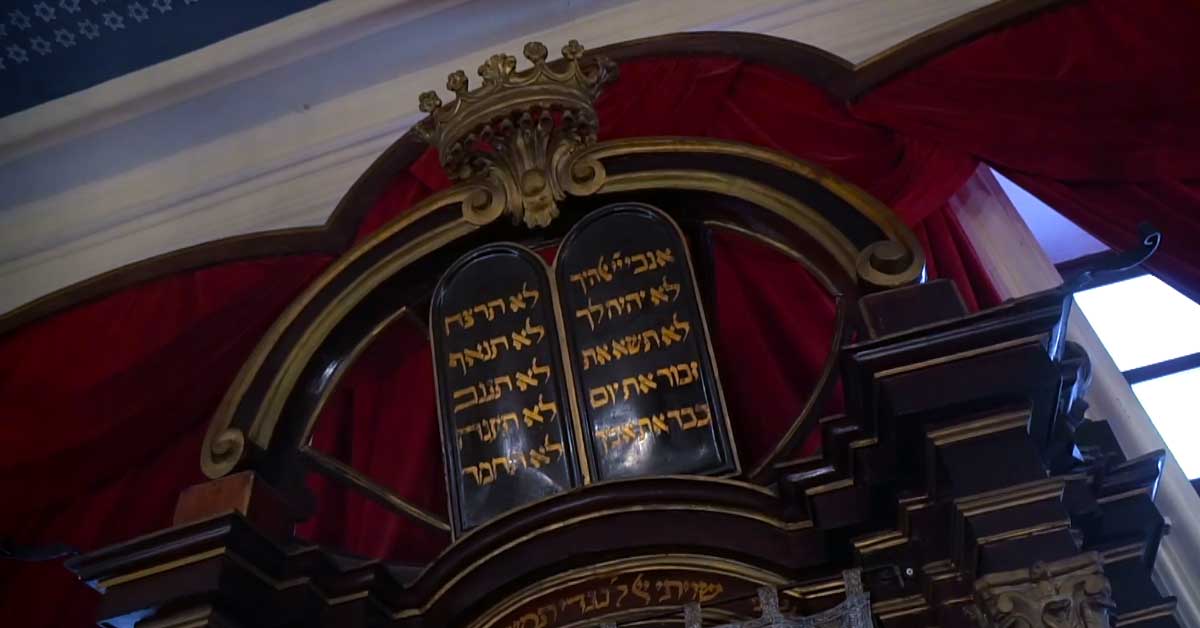
The most spiritually significant feature is the Holy Ark, called the Aron Kodesh in Hebrew. This is the cabinet that holds the Torah scrolls. The Dubrovnik Synagogue’s ark is a masterpiece of Baroque religious art, ornately carved and decorated. Inside it holds several Torah scrolls, including at least one brought by Sephardic exiles from Spain before 1492. These scrolls, written on parchment and hand-lettered by scribes over centuries ago, are among the most precious objects in the synagogue. They represent continuity with a vanished world, the Spanish Jewish community that was destroyed by exile and displacement.
Opposite the ark stands the Bimah, the pulpit from which the Torah is read during services. The Bimah is surrounded by a wooden fence and contains intricate carvings. During traditional Sephardic services, the congregation sits around the Bimah, creating an intimate atmosphere where everyone can hear and see the reader. This differs from other Jewish traditions where the Bimah is positioned at the front of the congregation.
One of the most remarkable objects in the synagogue is a 13th-century Moorish carpet displayed on the steps leading to the Holy Ark. According to local tradition, this carpet was a gift to a Jewish doctor given by Queen Isabella of Spain. While the historical accuracy of this specific attribution is impossible to verify, the carpet itself is undeniably ancient and beautiful, its patterns and colors preserved despite centuries of exposure to sunlight and air.
The ceiling is decorated with stucco reliefs painted sky blue with golden stars. This celestial imagery transforms the ceiling into a representation of the heavens, connecting the earthly space of worship to the divine realm above. Florentine-style chandeliers from the 19th century hang from this decorated ceiling, providing light and contributing to the refined atmosphere of the interior.
History of the Dubrovnik Synagogue Community: Prosperity to Persecution
For roughly two centuries after the synagogue’s establishment in 1652, Dubrovnik’s Jewish community experienced remarkable prosperity. Jewish merchants became integral to the city’s commercial operations. They handled textiles, spices and other goods, profiting from Dubrovnik’s position as a middleman in Mediterranean trade between the Ottoman Empire and Europe. Jewish doctors, physicians and intellectuals contributed to Dubrovnik’s cultural life. The community was small, never numbering more than a few thousand people even at its peak, but its influence and importance far exceeded its size.
This prosperity and integration was punctuated by disasters. The great earthquake of 1667 caused severe damage to the synagogue. The building had to be restored and its interior decoration rebuilt. Again in the 18th century, when the synagogue underwent expansion to add a women’s gallery, significant modifications were made to accommodate the growing community’s needs.
The catastrophic transformation came in the 20th century. During World War II, the Nazi occupation of Yugoslavia and the Holocaust profoundly affected Dubrovnik’s Jewish community. While Dubrovnik was not the site of a major concentration camp or ghetto like Warsaw or Theresienstadt, local Jews faced persecution, deportation and death. Many were sent to camps in Europe or killed locally. The community that had numbered in the hundreds was decimated. Families that had lived in Dubrovnik for generations were destroyed.
The synagogue itself was damaged during World War II. More significantly, the Jewish religious objects and Torah scrolls were hidden to preserve them from Nazi confiscation and destruction. After the war, these precious items were gradually recovered and returned. The story of their preservation and return became part of the synagogue’s narrative of survival.
The Holocaust legacy is difficult. Of the approximately 250 Jewish residents of Dubrovnik before World War II, most did not survive. The contemporary Jewish community in Dubrovnik numbers between 30 and 40 people, a fraction of what it was. Many of those who survived left Dubrovnik, seeking new lives elsewhere. The loss is immeasurable and visible in the demographics of today’s community.
The Museum within Dubrovnik Synagogue: Preserving Memory
Today, the Dubrovnik Synagogue functions both as an active place of worship and as a museum dedicated to preserving the history of the Jewish community. The first floor, occupied by the museum, contains religious artifacts, documents and personal items that chronicle centuries of Jewish life in Dubrovnik.
The collection includes Torah scrolls dating from the 13th to 17th centuries, objects of extraordinary rarity and value. Each scroll represents generations of religious devotion and commitment to preserving Jewish law and tradition. Some scrolls originated in Spain before the 1492 expulsion and were brought to Dubrovnik by Sephardic refugees. Others were created by scribes in Dubrovnik over the following centuries. Together, they form a library of handwritten Jewish law that has survived war, earthquakes and persecution.
The museum displays religious ceremonial objects including menorahs, prayer books in multiple languages and ritual garments worn by rabbis and community leaders. These items reveal the sophistication and refinement of Dubrovnik’s Jewish community. They were not crude or simplistic but carefully crafted objects reflecting knowledge of Jewish law and tradition.
Documents displayed include legal agreements, tax records and permits that chronicle the Jewish community’s relationship with the Dubrovnik government. These papers make clear that the community was not simply tolerated but actively engaged in negotiating its place within the city. Contracts show Jewish merchants conducting business with Catholic and Orthodox partners. Tax records show the community paid specific taxes and received certain exemptions. Legal documents clarify rights and restrictions. Together, these items reveal a community that was simultaneously integrated and separate, economically important and religiously distinct.
Perhaps most poignantly, the museum dedicates significant space to Holocaust memorials. Photographs display names and faces of community members who were deported or killed. Personal belongings, letters and documents from this period are preserved. A section contains information about specific families whose histories illustrate the tragedy that befell the community. This is not presented as distant history but as recent personal loss. The oldest Holocaust victims would have lived into the 21st century if they had survived.
Dubrovnik Synagogue Today: Living Faith and Preservation
The Dubrovnik Synagogue is not simply a museum frozen in time. It is an active religious space where services continue to be held. The High Holy Days, Rosh Hashanah and Yom Kippur, see services that draw the small contemporary Jewish community of Dubrovnik plus visitors from diaspora communities and interested non-Jewish visitors. Marriages continue to be performed within the synagogue, creating new memories and new links to the past. Bar and bat mitzvahs, the religious coming-of-age ceremonies, still take place within these walls, marking young people’s transition to adulthood according to Jewish tradition.
This living continuity is theologically and historically significant. Many historic synagogues have been converted into museums or cultural centers, preserving the building but ending the religious practice. The Dubrovnik Synagogue remains a place of worship. The prayer books are used. The Torah scrolls are read. The community may be small, but it is active. This continuity means the synagogue is not a museum of dead history but a living link to centuries of Jewish practice and belief.
The restoration of the synagogue after damage sustained during the 1991 war demonstrated the community’s commitment to maintaining this living space. The shell damage was repaired. The interior was carefully restored to match historical records. The building reopened in 1997, transformed from wounded victim back into active sanctuary. The very act of restoring the synagogue became a statement. The Jewish community of Dubrovnik refused to let the building be conquered or transformed by violence.
Visiting Dubrovnik Synagogue: Practical Information
The synagogue is located on Žudioska Street in Dubrovnik’s Old Town, accessible by walking through the narrow alleys that branch off from the main Stradun. The street itself is narrow and somewhat hidden, which contributes to the synagogue’s character as an intimate, somewhat secret space within the larger city. Once you reach the building housing the synagogue, you will see a narrow doorway with stairs ascending upward. The climb is steep but not long, requiring perhaps thirty seconds of effort to reach the entrance.
Admission is approximately five to seven euros, which is modest compared to other attractions in Dubrovnik. A visit typically takes thirty to forty-five minutes if you examine the museum carefully and reflect on the history. You can move more quickly if time is limited, but the space rewards slow contemplation and careful attention.
The synagogue is open year-round, though hours vary seasonally. It is generally open from morning through early evening, with reduced hours in winter months. It is closed on Saturdays during winter, following Jewish tradition of Sabbath observance. Contact the Dubrovnik Tourism Office or check online for current hours before visiting.
Respectful behavior is essential. While the space functions as a museum for tourists, it remains a sacred religious site for the active community. Dress modestly, speak quietly and approach the objects with reverence. Photography is usually permitted but without flash, which protects the ancient objects from light damage.
FAQ – Dubrovnik Synagogue Frequently Asked Questions
Is Dubrovnik Synagogue the oldest synagogue in Europe?
No. It is the oldest Sephardic synagogue in the world and the second oldest synagogue in all of Europe. The oldest synagogue in continuous use is the Old Synagogue in Erfurt, Germany, though its current usage dates to different periods.
When was the Dubrovnik Synagogue established?
The Jewish community gained legal status in Dubrovnik in 1407. The synagogue itself was officially established in 1652 when a building was converted into a place of worship. The interior Baroque decoration was completed by 1652.
Where did the Sephardic Jews who built the synagogue come from?
Many came directly from Spain after the 1492 expulsion by the Spanish Inquisition. Others came from Portugal after the 1496 expulsion. Some arrived via the Ottoman Empire or settled over time through commercial connections.
What is the most precious object in the synagogue?
The Torah scrolls are the most precious. Several date to the 13th to 17th centuries and some originated in Spain before the 1492 expulsion. These handwritten scrolls represent irreplaceable links to medieval Jewish life.
How did the Jewish community experience the earthquake of 1667?
The synagogue was severely damaged in the 1667 earthquake but was restored. The community rebuilt and continued worshipping in the space.
What happened to the Jewish community during World War II?
Approximately 250 Jews lived in Dubrovnik before World War II. Most were deported or killed during the Holocaust. Only about 30-40 survived, primarily those who had left the city before Nazi occupation.
Our Most Popular Tours To Sarajevo
We offer many tours that include a visit to Sarajevo and its most popular locations:
- Full Day tour from Sarajevo to Belgrade (Most Popular)
- Full Day tour from Sarajevo to Međugorije & Mostar
- Full Day Tour from Sarajevo to Travnik and Jajce
- Full-Day 5 Cities Tour from Sarajevo to Herzegovina (Mostar)
- Full day Tour from Sarajevo to Dubrovnik (Kotor or Split)
Don’t Hesitate To Say Hi!
Got any questions about our tours or the city? Don’t hesitate to contact us anytime for more info and booking.
Use the following phone number and email: