
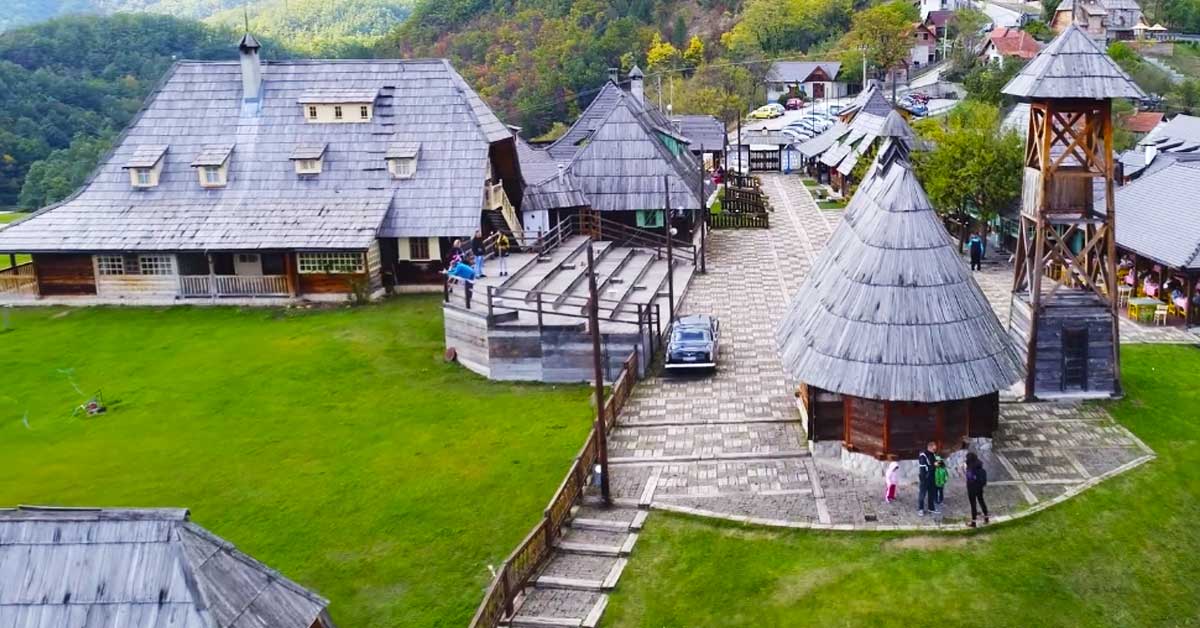
Drvengrad, also known as Mećavnik or Küstendorf, looks like someone took a movie set, added homemade soup, a bit of ideology, and left it on a hill above Mokra Gora. It is not a classic village and not really a town either, but it behaves perfectly like a small, closed planet where different rules apply.
It was created during the filming of the movie Life Is a Miracle. Instead of building a cardboard set and tearing it down after filming, Emir Kusturica decided to build a real wooden town where he could stay even after the end credits. Today it is the place where the Küstendorf festival is held, but also where completely ordinary people come for a day or two to escape asphalt and glass, with stable internet and good food.
Table of Contents
Is Drvengrad the right place for you
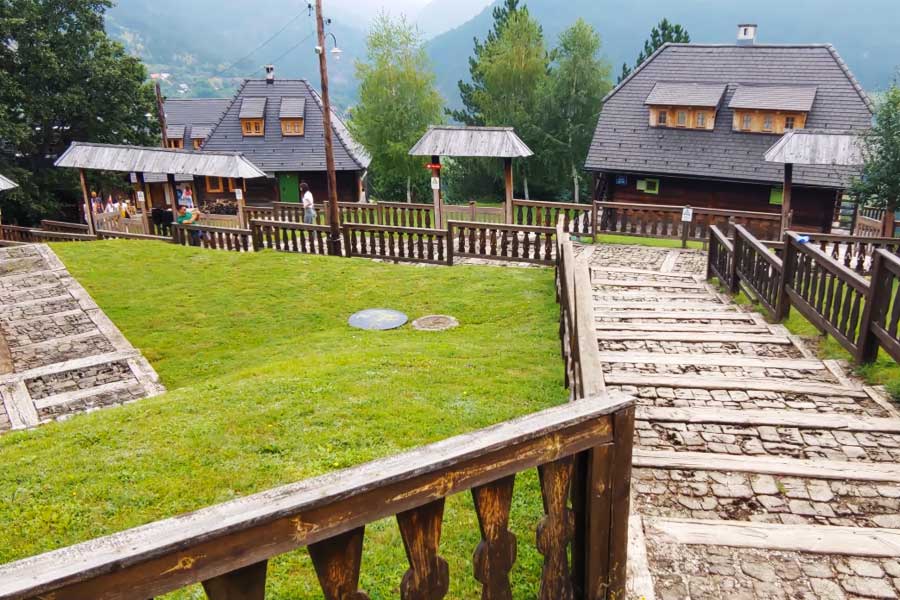
Drvengrad is ideal for someone who wants to escape the city, but not into a concrete “mountain hotel” with the same reception as in downtown Belgrade or Sarajevo. This Drvengrad travel guide is for people who want to wake up in a room that smells of wood, to look at the Mokra Gora valley instead of traffic, and to spend the whole day walking on cobblestones instead of in a shopping mall.
If it sounds appealing to walk around a place that looks like a mix of an old Serbian village and a European art film, Drvengrad makes sense. If your idea of a holiday is outlets, several clubs, and shopping, this is probably not the destination for you.
Where Drvengrad is and how to get there
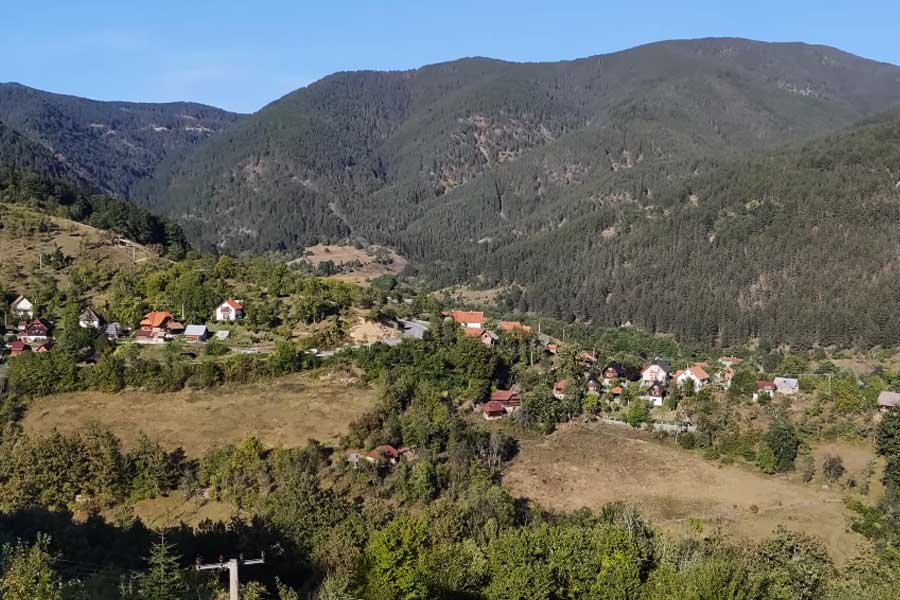
Drvengrad is located above Mokra Gora, between Tara and Zlatibor, roughly halfway between Serbia and Republika Srpska. It is a mountain spot, not a city crossroads, so you get there deliberately, not by accident.
From Belgrade you usually drive towards Užice, then Zlatibor, and from there turn towards Mokra Gora. From Mokra Gora the road becomes uphill hairpins, and after about ten minutes of climbing you arrive at Mećavnik. Expect about four and a half to five hours of normal driving by car. From Sarajevo and Višegrad you go via Višegrad and the Kotroman border crossing to Mokra Gora, then uphill again to Drvengrad. Many trip plans combine Višegrad, Andrićgrad, Šargan Eight and Drvengrad into one weekend.
If you come by bus, your target is Mokra Gora. From there a taxi will take you up to Drvengrad. There is no city bus that drops you at the gate, which fits the idea that you are coming to a hilltop, not to a mall.d as the “heart” of the city – a place for gathering, events, and coffee breaks with a view of stone facades.
First impression: Drvengrad travel guide through streets named after idols
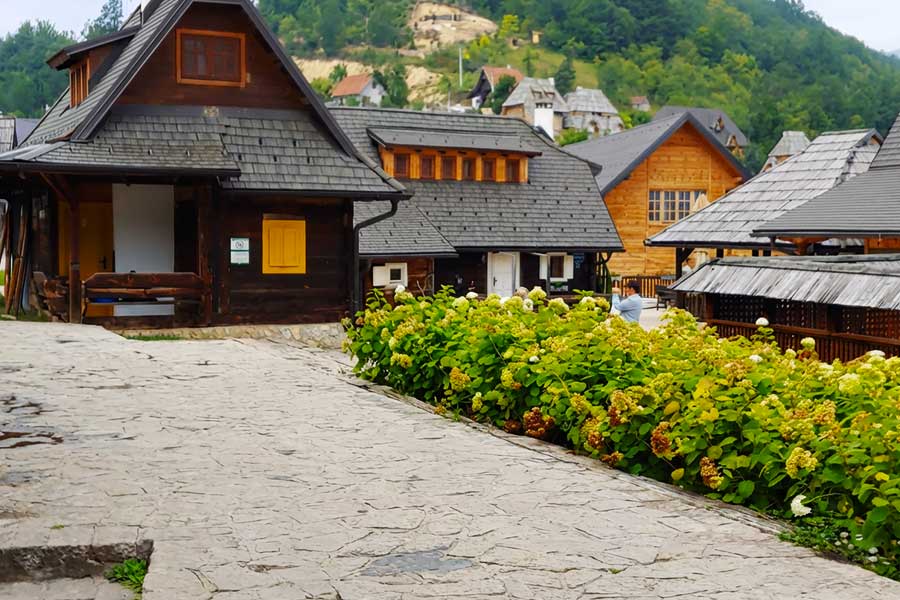
As soon as you pass through the Drvengrad gate, it becomes clear this is not a template-built ethno village. Streets carry the names of people Kusturica personally considers important. You will find Nikola Tesla and Ivo Andrić, but also Diego Maradona, Che Guevara and Federico Fellini. It is a very direct list of personal idols turned into names on wooden signs.
The town is small, everything is wooden, cobblestones creak under your feet, roofs are low, and every house looks like a detail from a film. The central area is a square with a church, restaurant, cinema, gallery and guest rooms. There are no modern glass-and-aluminum buildings. Everything looks as if someone intentionally froze time at a different frequency.more of a living scenography: people eat, drink, watch movies, perform plays, and host festivals here.
What to actually do in Drvengrad
The Drvengrad travel guide is not a checklist of “must-see attractions” you need to tick off under pressure. The point is to slow down.
The most natural first step is a simple walk. You enter, make a loop around the square, climb up to the wooden church of Saint Sava at the top of the hill, stop at the viewpoint railing and look down at the valley. The view over Mokra Gora and the surrounding forests is hard to capture in a photo, but very easy to collect likes with when you eventually post it.
Inside Drvengrad there is a small but serious cinema used for screenings during the Küstendorf festival and for occasional events during the rest of the year. The space feels more like a miniature art center than a local community hall. If it happens that there is a film, concert, or talk that day, that is a bonus that turns a simple walk into a proper cultural outing.
Food is a story of its own. The restaurant in Drvengrad leans heavily into home-style cuisine with more attention paid to how it looks and feels. On the menu you will find soups, stuffed cabbage, lamb, veal baked under a clay bell, trout, local cheeses, pies and proper cakes. Prices are higher than in a basic village tavern at the foot of the hill, but still lower than in a typical mountain resort. You are not paying only for the plate, but for the wood around you, the view through the window, and the fact you are sitting somewhere that looks like a movie set.
If you do not want or cannot afford a full meal, just having a coffee and dessert is enough to get a feel for Drvengrad. That is a perfectly valid way to experience the place without feeling like you must order half the menu to “earn” your seat.
Staying overnight: what the Drvengrad travel guide really recommends
You can “do” Drvengrad in passing within two or three hours. Walk, photos, coffee, and you move on. But if you want to understand why people come back, staying the night changes everything.
When you sleep in Drvengrad, you get a morning with no crowds, no buses and no day-trip groups. Fog still sits in the valley while you are on a wooden terrace with your first coffee. At night, when lights go down and the wind hits the wooden roofs, Drvengrad gains an atmosphere you simply cannot feel in the daytime.
The number of rooms is limited, because this is not a mass hotel but a small wooden complex. If you plan a weekend, holiday or festival period, booking ahead is not a suggestion, it is a requirement. On this point the Drvengrad travel guide is very clear: if you show up without a reservation, you risk ending up in some completely different accommodation option.
Drvengrad travel guide and Šargan Eight as a natural combo
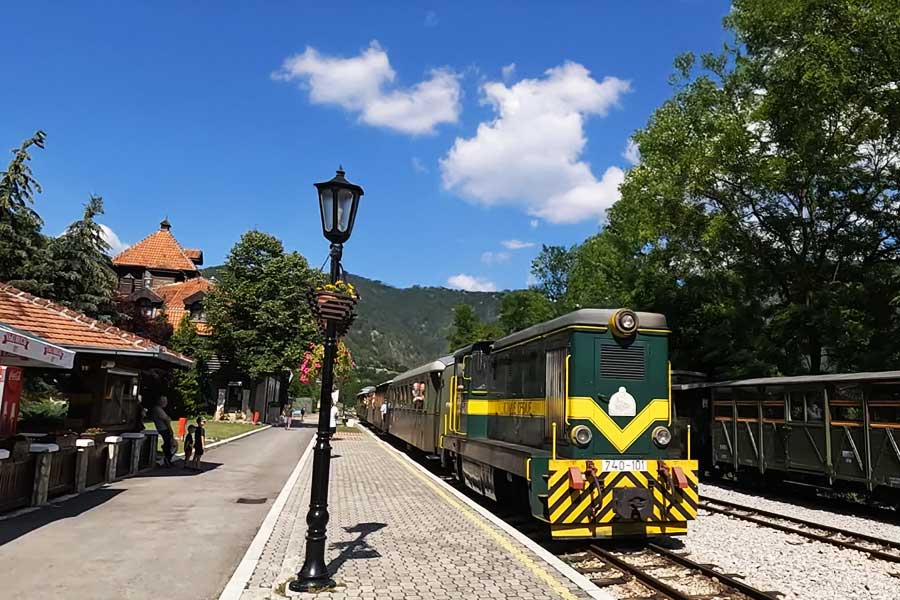
Honestly, the Drvengrad travel guide does not make much sense if you ignore the Šargan Eight railway. The two are made for each other.
Šargan Eight is an old narrow-gauge railway turned into a tourist ride, with tunnels, bridges and steep sections that draw a figure-eight on the map. The train ride through the forest, with many photo stops, lasts just long enough to understand why people talk about it for days afterwards.
The most logical itinerary looks like this: in the morning you arrive in Mokra Gora and take the Šargan Eight train ride. After the ride, you drive or take a taxi up to Drvengrad, have lunch, walk around, take photos and then decide whether you head back home or stay the night. Checking the train timetable in advance is essential, because Šargan Eight does not run like a city line.
Practical tips before you head to Drvengrad
It is smart to have some cash with you, because entry to Drvengrad is usually charged as a small fee per person, and although most restaurants and cafés now accept cards, a mountain is not the best place to test your luck with payment terminals.
Footwear matters more than it sounds. Cobblestones, wooden stairs and gradients call for trainers or shoes with decent grip. In winter it can be slippery but visually spectacular. In summer it is pleasantly cool, especially if you are escaping from a city that is melting at thirty-plus degrees.
If you come with children, expect that Drvengrad will feel like a natural playground to them. There are dogs walking around freely, there are steps, railings and viewpoints. All those elements are fun, but they also mean adults need to keep an eye on where the running stops.
Mobile signal and internet generally work, which means you can post stories and complain about civilization at the same time. The Drvengrad travel guide is not selling a total digital detox, but a balance.
FAQ: Drvengrad travel guide questions you actually care about
Is Drvengrad travel guide relevant only for Kusturica fans?
You do not need to know a single one of his films to enjoy Drvengrad. If you like mountains, wood, quiet and slightly unusual architecture, the Drvengrad travel guide has plenty to offer even without any film references.
How many days are ideal according to the Drvengrad travel guide?
One day is the minimum if you combine the Šargan Eight and Drvengrad. If you want a slower pace, morning fog, evening silence and breakfast without rushing, the Drvengrad travel guide realistically nudges you towards at least one overnight stay.
What is the price to value ratio based on Drvengrad travel guide experiences?
Entry is usually a small fee, food is more expensive than in a basic local tavern, but the setting is incomparable. Overall, the Drvengrad travel guide treats it as a destination with a solid balance between cost and experience, especially if you do not expect “all inclusive” but a specific concept.
Is Drvengrad travel guide a good option for a trip with children?
Yes, kids usually love the wooden houses, steps, dogs and the nearby train. The Drvengrad travel guide is family friendly, with the caveat that you need a bit more attention because of slopes, stairs and railings that are real terrain, not padded playground equipment.
Our Most Popular Tours To Sarajevo
We offer many tours that include a visit to Sarajevo and its most popular locations:
- Full Day tour from Sarajevo to Belgrade (Most Popular)
- Full Day tour from Sarajevo to Međugorije & Mostar
- Full Day Tour from Sarajevo to Travnik and Jajce
- Full-Day 5 Cities Tour from Sarajevo to Herzegovina (Mostar)
- Full day Tour from Sarajevo to Dubrovnik (Kotor or Split)
Don’t Hesitate To Say Hi!
Got any questions about our tours or the city? Don’t hesitate to contact us anytime for more info and booking.
Use the following phone number and email: