
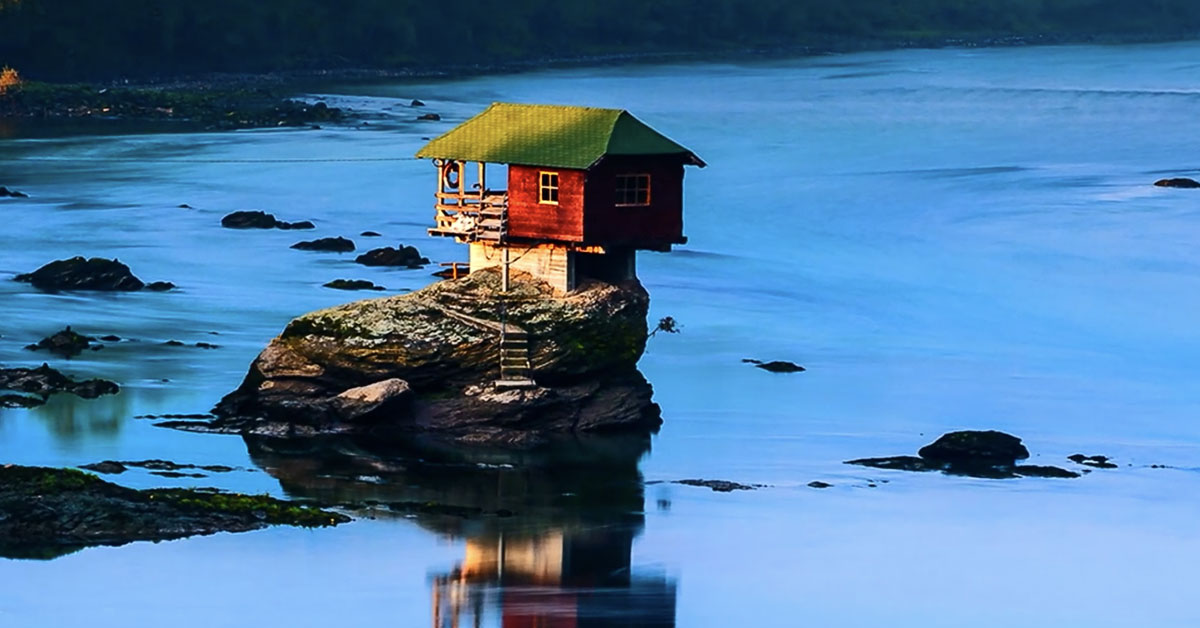
When you hear about Drina River House, the first image that probably comes to mind is a small house on the water, like from a fairy tale, standing unshakably in the middle of the Drina River. This isn’t just an Instagram photo that conquers social media – it’s a story about a man who built a dream at the place where two worlds, two nations, two lives collide.
Drina River House is not just a tourist attraction. It is a symbol of persistence, love for nature, and proof that sometimes the most important things in life are not those you can buy or sell. Located at the crossroads of Bosnia and Serbia, this small house has become an icon of the region, attracting thousands of visitors who want to see it, photograph it, and understand what makes it so special.
This is not an ordinary text about a location. This is a story about a man who literally and metaphorically built a bridge between two worlds.
Table of Contents
What is Drina River House and where is it located
Drina River House is a wooden house with a surface area of about 5 square meters, built on a metal structure in the middle of the Drina River, on the border between Serbia and Bosnia and Herzegovina. It is located near the village of Trnoba by Bajina Bašta, at a place where the Drina widens and creates a natural pool surrounded by forest and cliffs.
Geographically, the house is positioned on the Serbian side of the Drina, but it is so close to the border that it is often considered a shared symbol of both countries. You reach it via a path from the village of Trnoba or the Perućac viewpoint, and the nearest parking spot is at nearby restaurants or weekend houses. There is no bridge to the house – it stands lonely on the water, connected to the shore only by thin cables that prevent the current from carrying it away.
The house was built by Milivoje “Mićo” Popadić in the early 21st century as a weekend cottage for himself and his friends. What began as a personal project turned into a tourist icon thanks to social media and media attention. Today, Drina River House is protected as cultural heritage and a symbol of peace between neighbors.
The story of Mićo Popadić creator of Drina River House
Milivoje Popadić, better known as “Mićo of the Drina,” was a man born for the river. Connected to the Drina since childhood, he spent his life fishing, rowing, and observing its humorous and dramatic sides. The idea for the house on the water was born from a simple desire: he wanted a place where he could sleep to the sound of waves, fish from the window, and be closer to nature than anyone else.
He built the house in 2006, using concrete barrels filled with gravel as foundations, a metal frame for stability, and wood for the walls. He had no architectural plans, permits, or big investors – just hands, tools, and persistence. Initially, the house served as a fishing shack for Mićo and his friends, but when photos of the house started circulating online, visitors began arriving on their own.
In 2019, after Mićo’s death, the local community and authorities organized the house’s status as cultural heritage. Today it is maintained through volunteer work and donations, and every year a memorial gathering is held in Mićo’s honor.
Mićo often said: “The Drina is alive. It gives, but it also takes. The house is my way of saying thank you to it.” That quote now stands on a memorial plaque at the viewpoint.
Architecture and construction of Drina River House how it survived floods
The construction of Drina River House itself is an engineering marvel of simplicity. The 5 square meters of space contains:
- wooden walls coated with resin for waterproofing
- metal frame for stability
- 4 concrete barrels as foundations (each 1m in diameter, filled with gravel)
- anchoring cables to the shore
- small terrace for fishing and drying fish
The key to flood resistance is the “floating” construction – the house is not fixed to the riverbed but floats above it. When the water rises, the house lifts along with the cables, and when it falls, it returns to its position. This was proven during the 2014 major flood, when the Drina flooded the banks, but the house remained untouched.
Inside there is no electricity, water, or modern comforts – just a table, bed, pictures, and the feeling that you’re in a world that has forgotten concrete and asphalt. The walls are decorated with old fishing rods, pictures of the Drina, and messages from visitors.
How to visit Drina River House best viewpoints and approaches
Drina River House cannot be physically visited – it remains as Mićo’s private space, symbol, and photographic icon. A visit means access to viewpoints from both sides:
Serbian side (Trnoba/Bajina Bašta)
- parking at Drinska bašta restaurant or weekend houses
- 10–15 minute footpath to the main viewpoint
- best angle: panorama of the house with terrace and dammed Drina
- parking: 200–300 dinars (around €1.70 to €2.50)
Bosnian side (Perućac)
- Perućac Lake and viewpoint
- slightly farther, but wider shot with more river
- access via Bajina Bašta–Lubardža border crossing
Best time to visit:
- dawn – mist over the Drina, golden light
- dusk – reflections on the water
- spring/autumn – moderate water level, calm river
Photography is allowed from both viewpoints. Drone use is restricted due to nature protection and privacy.
Drina River House and surroundings attractions for a full day
Drina River House is always combined with other attractions:
If you want to expand this into a full day trip, a very natural add-on in the same wider region is Mokra Gora and the wooden hilltop film village; use this guide for what to see and whether staying overnight is worth it: Drvengrad travel guide: wooden hilltop village.
1. Ćira (5 km from viewpoint)
Mićo’s restaurant-fishing base. House on the water, where it all began. Traditional food, Drina view.
2. Perućac Lake and viewpoints (15 min by car)
Artificial lake, HEP power plant, Drina panorama. Perfect contrast: house on river vs. lake.
3. Mračaj Waterfalls (30 min from Bajina Bašta)
Series of waterfalls in the forest. Nature in full splendor.
4. Tara National Park (45 min)
Lake, forests, viewpoints. Mountain and river combination.
Ideal one-day route: Trnoba (Drina River House viewpoint) → Ćira → Perućac → Mračaj.
Just upstream from this tiny house, the Mehmed Paša Sokolović Bridge in Višegrad is the Drina’s most famous landmark, a UNESCO protected Ottoman masterpiece built by Mimar Sinan in the 16th century and made famous by Ivo Andrić’s Nobel Prize winning novel.
Legend and symbolism of Drina River House the bigger story
Drina River House is not just a photograph. It is a symbol:
1. Love for nature
Mićo built a house where the river was home. No electricity, WiFi, or modern comforts there – just river, forest, and sky.
2. Borders that don’t divide
At the crossroads of Serbia and Bosnia and Herzegovina, the house connects two worlds. Visitors come from both sides, take photos together.
3. Human persistence
The house survived floods, storms, snow. Proof that dreams, if sincere, can withstand more than concrete.
4. Nostalgia for simplicity
In the Instagram age, the house reminds us of a time when river, rod, and friends were enough.
Today, messages from visitors appear on viewpoint walls: “Thank you Mićo for leaving us a wonder”, “The river is home, the home is river”.
Why Drina River House became a world icon
House photos started circulating in the 2010s via Facebook and forums. In 2016, CNN published “World’s coolest tiny houses,” with Drina River House at the top. National Geographic, Lonely Planet, and Instagram did the rest.
The numbers speak for themselves:
- over 1 million annual visits to viewpoints
- #DrinaRiverHouse – over 50,000 posts
- 100+ annual media mentions
Yet what makes it special is not the number of likes, but the story behind it: a man who built a dream on the river and left it to the world.
Practical tips for photographing Drina River House
1. Time of day
- Dawn: misty effects, golden light
- 11–14h: strongest contrast, but crowded
- dusk: water reflections
2. Equipment
- wide angle lens (16–35mm) for full shot
- telephoto (70–200mm) for house details
- tripod for dusk
3. Seasonal tips
- spring: water in full flow
- summer: greenery, but crowded
- autumn: leaf colors
- winter: rare, but spectacular with snow
4. Rules
- no drones (prohibited)
- no entering the house
- respect locals and neighbors
Drina River House today status and future
After Mićo’s death, the community organized the “Friends of the Drina” association which maintains viewpoints, paths, and organizes events. Every year on June 25 (day the house was built), a memorial gathering is held with fish, music, and stories.
Future plans:
- info centers on both sides
- eco-paths along the river
- photography exhibition in Bajina Bašta
The house remains untouched – a symbol, not a hotel.
FAQ about visiting Drina River House
Can you enter Drina River House?
No. The house remains as a symbol and photographic attraction. Entry is not allowed.
Where to park for the best view?
Serbian side (Trnoba): parking at Drinska bašta restaurant. Bosnian side: Perućac Lake.
How long does a visit take?
30–60 minutes for both viewpoints + photography.
Is there an entrance fee?
No. Viewpoint visits are free. Parking may be charged.
Best time of year?
Spring and autumn – moderate water level, less crowds.
Our Most Popular Tours To Sarajevo
We offer many tours that include a visit to Sarajevo and its most popular locations:
- Full Day tour from Sarajevo to Belgrade (Most Popular)
- Full Day tour from Sarajevo to Međugorije & Mostar
- Full Day Tour from Sarajevo to Travnik and Jajce
- Full-Day 5 Cities Tour from Sarajevo to Herzegovina (Mostar)
- Full day Tour from Sarajevo to Dubrovnik (Kotor or Split)
Don’t Hesitate To Say Hi!
Got any questions about our tours or the city? Don’t hesitate to contact us anytime for more info and booking.
Use the following phone number and email: