
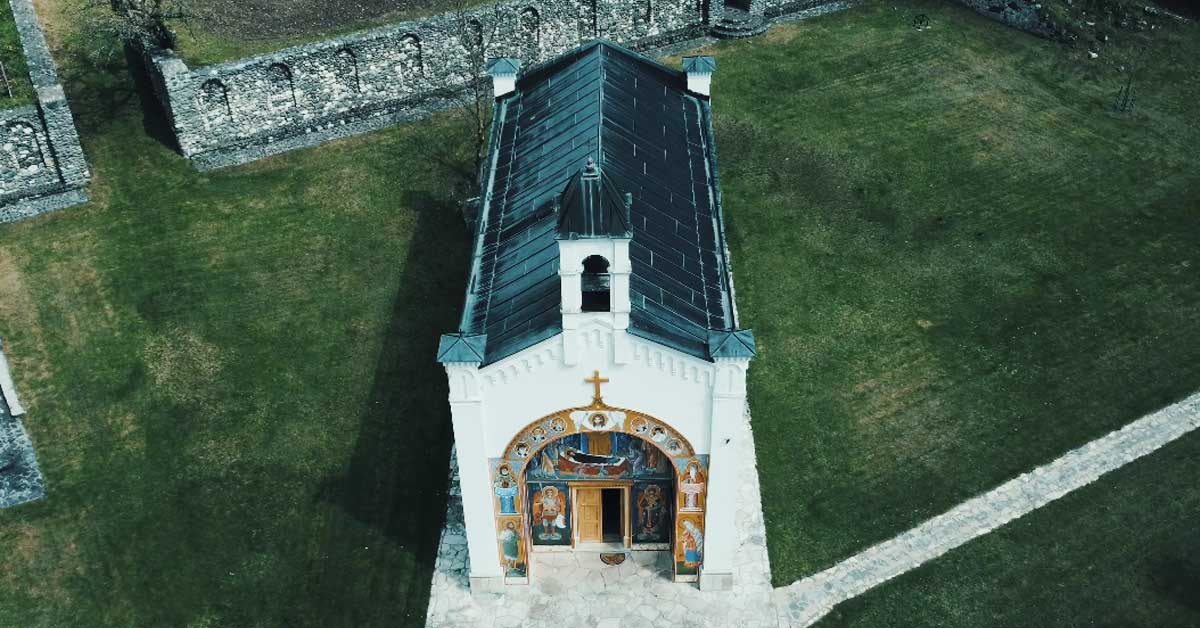
Imagine a place where history isn’t read from books but felt under your fingertips as you touch the cold stone of ancient walls. Where Emperor Dušan the Mighty, in his full power, looks straight at you from frescoes nearly seven centuries old, and steep cliffs above the monastery guard the secrets of a long forgotten, powerful city. Dobrun Monastery, or as old historical sources often call it, Kruševo, is not just an ordinary spiritual sanctuary. It is a stone witness to turbulent Serbian history, situated in the dramatic, wild gorge of the Rzav River, right on the border between Serbia and the Republic of Srpska. This is the story of a holy place that was destroyed, burned, turned to dust and ashes, but never conquered because its spirit lives in every stone and prayer.
Table of Contents
History of Dobrun Monastery: The Founder, The Emperor, and The Great Betrayal
The story of Dobrun Monastery begins back in 1343, at a time when Serbia was at the peak of its medieval power. It was built by the prominent Župan Pribil with his sons, Stefan and Petar. But Dobrun was not conceived as just a lonely endowment in the wilderness. It was the heart and soul of a mighty medieval city, a strategically important fortification. The golden age of the monastery occurred during the time of Župan Petar, who later took monastic vows himself and received the name Jovan. During that period, Dobrun was a true hive of spirituality where historical records state that over 700 monks lived and served here! Can you imagine that image: hundreds of monks in the silence of the Rzav gorge, incense smoke rising to the sky, and chanting echoing among the rocks?
However, like every great epic story in the Balkans, the history of Dobrun has its tragic turn. In 1462, the city of Dobrun fell under ruthless Ottoman rule. Folk tradition and legends say the city did not fall in battle, but by betrayal. It is said that a Serbian servant, Jovan Kalajdžić, revealed to the Turks that the city’s defenders and most of the population had gone to a wedding in distant Kruševac. The city remained almost undefended. The Turks broke through the gates, looted the city, and burned it to the ground, devastating the monastery. Yet, neither fire nor sword could extinguish the faith. Monks returned, rebuilding the sanctuary stone by stone, and for centuries kept the flame of Orthodoxy alive, even in the hardest times when they had to live in hidden hermitages carved into the surrounding cliffs.
Frescoes of Dobrun Monastery: A Unique Meeting with Emperor Dušan
What makes Dobrun Monastery a true gem of world cultural heritage are its frescoes. Although the monastery suffered many times over the centuries, parts of the original 14th century painting miraculously survived. The most important and famous among them is the fresco depicting Emperor Dušan with his wife Jelena and son Uroš.
Why is this so important? Because this is one of the rare surviving portraits of the most powerful Serbian ruler created during his lifetime, at the time when he was at the very peak of his power. To look into that face is to look into the eyes of the Serbian Empire. Beside the imperial family, the donor’s composition is exceptionally valuable, showing Župan Pribil, with a model of the church in his hands, standing before Christ as holy angels lead him into the Kingdom of Heaven. Those colors, those figures, that artistic power make it a direct, unbroken link to medieval Serbia that you won’t find in any history textbook.
Dobrun Monastery Complex: Karađorđe, Metropolitans, and the Treasury
Today, visiting Dobrun is not just visiting the church dedicated to the Dormition of the Most Holy Theotokos. It is a tour of an entire complex that bridges centuries and different epochs of the Serbian struggle for freedom.
Monument to Karađorđe: High on an inaccessible cliff above the monastery, next to a large white cross that dominates the surroundings, watches a monumental statue of Vožd Karađorđe. He stands as an eternal sentinel, reminding every traveler that freedom in these lands was always the most expensive word, paid for with blood and sacrifice.
Karađorđe’s Konak (Lodging): In 2004, to mark the 200th anniversary of the First Serbian Uprising, a magnificent lodging was built within the complex. Today, it houses the Museum of the First Serbian Uprising, a place that preserves the memory of the Vožd and insurgents who fought fierce battles right in these regions.
Museum of the Metropolitans: Within the same complex is the Museum of the Dabar Bosnia Metropolitans. This is a true treasury of the history of the Serbian Orthodox Church in Bosnia and Herzegovina, with valuable icons, books, and objects testifying to the church’s endurance in these lands.
How to Get There and What to See Around Dobrun Monastery
Dobrun Monastery is located in an extremely accessible location, just 12 kilometers from Višegrad, directly next to the main road leading to Užice and the Vardište border crossing. This makes it an ideal stop if you are traveling between Serbia and Bosnia.
Višegrad: A visit to Dobrun is perfectly complemented by a trip to nearby Višegrad. Drink coffee on the famous Mehmed Paša Sokolović Bridge on the Drina and walk through Andrićgrad, a stone town dedicated to our Nobel laureate.
Old City of Dobrun: Above the monastery itself, high in the rocks, are the remains of the medieval city of Dobrun. For those with an adventurous spirit and good fitness, the climb to the caves and old walls is a must. From there, an incredible view of the Rzav valley unfolds.
Šargan Eight and Mokra Gora: Just a few kilometers further, as soon as you cross the border into Serbia, the famous narrow gauge railway Šargan Eight and the ethno village Drvengrad (Mećavnik), a masterpiece by Emir Kusturica, await you.
Useful Information for Visiting Dobrun Monastery
To make your visit as pleasant as possible, here are a few practical tips:
Entry and Dress Code: Entry to the monastery complex and church is free. As in any holy place, modest dress is implied with covered shoulders and knees, regardless of the heat. Women often cover their heads with a scarf out of respect, though it is not strictly mandatory.
Visiting Museums: For visiting the Museum of the First Serbian Uprising and the Museum of the Metropolitans, it is desirable to leave a voluntary donation used for the maintenance of the monastery and museum exhibits.
Liturgy: Holy Liturgies are served on Sundays and holidays in the morning hours (usually starting around 9:00 AM). Attending the liturgy in such an ambiance is a special spiritual experience due to the acoustics of the old church and the peace that reigns here.
Monastery Products: Be sure to stop by the monastery shop. Here you can buy real domestic honey, monastery brandy (rakija), healing balms, and prayer ropes made with love and prayer by the monks. It is the most beautiful souvenir you can take home.
Frequently Asked Questions (FAQ) about Dobrun Monastery
Are there relics of a saint in Dobrun Monastery?
Although the monastery does not possess the entire body of a saint, particles of the relics of several saints are kept with great respect, giving the church great graceful power. The Church of the Dormition of the Most Holy Theotokos itself is a great sanctuary due to its centuries old prayer history.
Can one stay overnight at Dobrun Monastery?
The monastery has a konak (lodging), but overnight stays are primarily intended and reserved for larger, organized groups of pilgrims, with prior announcement and the abbot’s blessing. For individual visits and tourists, nearby Višegrad and Mokra Gora offer a large selection of hotels and private accommodation.
How far is Dobrun Monastery from Zlatibor?
The distance is about 45 to 50 kilometers, which takes less than an hour on a good road. This makes Dobrun a perfect destination for a day trip if you are staying on Zlatibor or Tara.
Is the road to the monastery good and passable in winter?
Yes, the monastery is located directly next to the busy Višegrad Užice main road. The road is regularly maintained and cleared, so access to the monastery is excellent and safe for all types of vehicles throughout the year, even in winter months.
Our Most Popular Tours To Sarajevo
We offer many tours that include a visit to Sarajevo and its most popular locations:
- Full Day tour from Sarajevo to Belgrade (Most Popular)
- Full Day tour from Sarajevo to Međugorije & Mostar
- Full Day Tour from Sarajevo to Travnik and Jajce
- Full-Day 5 Cities Tour from Sarajevo to Herzegovina (Mostar)
- Full day Tour from Sarajevo to Dubrovnik (Kotor or Split)
Don’t Hesitate To Say Hi!
Got any questions about our tours or the city? Don’t hesitate to contact us anytime for more info and booking.
Use the following phone number and email: