
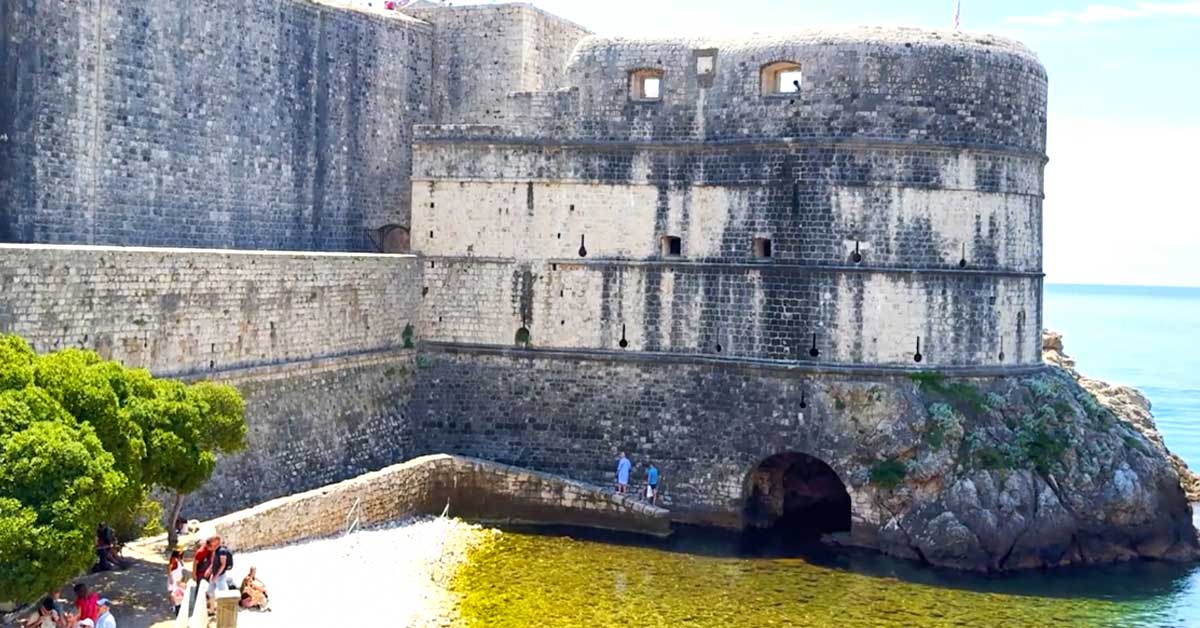
While tourists crowd Lovrjenac and photograph themselves at major city wall gates, Bokar Fortress sits quietly on Dubrovnik’s southwestern corner, a structure so seamlessly integrated into the city walls that many visitors walk past it without realizing they are looking at one of the region’s most interesting medieval fortifications. Yet those who take time to explore Bokar discover a fortress that tells a unique story about medieval military thinking, architectural evolution and how defensive structures adapted to changing technology across centuries. Bokar is not separated from the city like Lovrjenac or Revelin. Instead, it is literally built into the city wall itself, functioning as both defensive tower and integrated part of Dubrovnik’s perimeter defense system.
Bokar Fortress represents an earlier stage of fortification development than Revelin, predating comprehensive Renaissance redesign yet still incorporating medieval adaptations for artillery defense. The fortress’s distinctive circular tower, visible from Dubrovnik’s western approach, has dominated the southwestern corner of the city for nearly 500 years. Walking along the city walls toward Bokar, you encounter a structure that seems to grow organically from the medieval walls themselves, a visual embodiment of how medieval cities integrated defensive architecture into urban planning.
This guide explores Bokar’s history, its architectural significance, what makes it different from other Dubrovnik fortifications and why this lesser-known fortress deserves place on any serious exploration of Dubrovnik’s medieval defense system.
If fortress-hunting is your thing beyond the Adriatic, Serbia’s Danube has a heavyweight too: Smederevo Fortress, a massive riverside complex that feels like a whole medieval city.
Table of Contents
The History of Bokar: Medieval Foundation and Renaissance Adaptation
Bokar Fortress was constructed in 1461, during the same period when other major Dubrovnik fortifications were being rebuilt or significantly modified to accommodate artillery technology. The fortress replaced earlier medieval defensive structures that had proven inadequate against emerging cannon warfare. The decision to rebuild at this location reflects understanding that the southwestern corner was strategically crucial – this is where attackers approaching from the sea or from Dubrovnik’s hinterland would most likely attempt to breach the city’s defenses.
The fortress was built by the Dubrovnik government at substantial expense, with materials sourced from local stone quarries and skilled masons hired for construction. The investment reflects the city leadership’s commitment to maintaining defensive viability at a moment when military technology was evolving rapidly and Dubrovnik’s political circumstances were increasingly uncertain. Ottoman military pressure was intensifying, and while Dubrovnik managed through diplomacy to maintain independence longer than most Adriatic cities, the city still needed to maintain appearance of military strength and defensive readiness.
Over the following centuries, Bokar was modified and maintained as military technology continued to evolve. The fortress was never destroyed or abandoned, remaining continuously garrisoned throughout its history. This continuity distinguishes Bokar from some other Mediterranean fortifications that were damaged during wars or fell into disrepair during periods of peace. Bokar remained militarily functional and relevant, adapted to each new military challenge that emerged.
The fortress was eventually decommissioned as active military installation sometime during the 19th or 20th century, though the exact timing is unclear. By the time Dubrovnik became major tourist destination in the late 20th century, Bokar was already incorporated into the city wall walking route, accessible to visitors who explored the fortifications. Unlike Lovrjenac and Revelin, which were restored as standalone attractions with admission fees, Bokar remained accessible as part of the city wall experience.
Architectural Features of Bokar Fortress: Circular Innovation and Defensive Design
Bokar’s most distinctive feature is its circular tower, a design choice that reveals important evolution in medieval military thinking. Circular towers provided several advantages over the rectangular towers that dominated earlier medieval fortifications. Circular design meant that defenders could see around the tower without blind spots. The circular shape presented smaller target profile to artillery fire. Projectiles striking circular walls glanced off rather than striking flat surfaces perpendicularly, reducing penetration.
The tower is massive, rising approximately 20 meters above the surrounding walls with thick stone walls built to withstand cannon bombardment. The walls are composed of large limestone blocks precisely fitted together, demonstrating quality of construction and investment of skilled labor. The scale and solidity of the tower communicate military competence and commitment to defense in physical form.
Gun emplacements are visible on multiple levels of the fortress, showing where artillery was mounted for harbor defense and protection of the southwestern approaches. These positions were carefully calculated to provide maximum coverage of potential attack approaches. Casemates – enclosed gun positions within walls – provided protection for artillery crews from enemy return fire. The positioning and number of gun emplacements show that Bokar was designed as serious military installation, not symbolic fortress.
The fortress is directly connected to the city wall system, functioning as integral component rather than independent structure. Defenders moving along the walls could enter Bokar for reinforced defensive positions. Supplies and ammunition stored within Bokar could be distributed to defenders along adjacent walls. This integration meant that Bokar was not isolated garrison but part of unified defensive system where each fortification supported others.
The entrance to Bokar is narrow and defensible, reflecting medieval understanding of how to control access to fortified structures. An attacking force would have to approach the narrow entrance under fire from defenders positioned on walls above. There were no convenient assault approaches – every angle was defended. The entrance design demonstrates that Bokar was built to withstand serious assault, not merely serve symbolic function.
Bokar Fortress and Its Integration with Dubrovnik City Walls: A Unified Defensive System
What distinguishes Bokar from Lovrjenac and Revelin is its integration into the city wall system. Rather than being separate fortress on island or promontory, Bokar is built into the wall itself, functioning as both tower and wall segment simultaneously. This integration was not accidental but deliberate design choice reflecting understanding that fortifications work more effectively when they function as unified system rather than isolated components.
Walking along the city walls, you experience this integration directly. You move along the wall, pass through various defensive positions and eventually encounter Bokar as natural part of wall progression rather than separate attraction requiring special entrance fee or separate visit. The fortress seems to grow organically from the wall system, a visual demonstration of integrated defensive thinking.
This integration means that Bokar controlled not just harbor approaches but also land approaches along the southwestern perimeter. Attackers attempting to climb the city walls would come under fire from Bokar positions. Defenders on the walls could retreat into Bokar’s more heavily fortified interior if walls were breached. The fortress functioned as combination of offensive and defensive position, active artillery platform and strategic reserve location.
The positioning of Bokar where the wall system changes direction (along the southwestern corner) shows sophisticated understanding of defensive geometry. Corner positions are strategically critical – attackers can approach from two directions simultaneously at corners, making corner defense extremely difficult. Bokar’s reinforced position at this corner meant that attackers would face concentrated defensive fire if they attempted assault at this vulnerable point.
Strategic Importance of Bokar Fortress: Defending Dubrovnik’s Most Vulnerable Approaches
The southwestern approaches to Dubrovnik represented genuine strategic vulnerability. Unlike other sides of the city that were protected by sea or steep terrain, the southwestern side faced relatively flat terrain where attackers could assemble forces and mount coordinated assault. Bokar was designed specifically to defend this vulnerable approach.
The fortress also controlled the bay approaches from the southwest. Ships attempting to enter Dubrovnik’s harbor from the southwestern approach would come under fire from Bokar’s gun emplacements. This meant that no hostile naval force could conduct unopposed approach to the harbor from this direction. Bokar functioned as maritime defense as effectively as land defense.
The fortress’s position on the wall system meant that it could concentrate defensive fire from multiple levels and multiple gun positions. Attackers approaching the southwestern corner would face overlapping fire from Bokar’s positions, from adjacent wall segments and from other fortifications positioned to support this sector. The multiplicity of fire sources meant that attackers could not suppress all defenders simultaneously.
Architectural Materials and Construction Quality of Bokar Fortress
Examining Bokar’s construction reveals investment of significant resources and employment of highly skilled craftspeople. The stone walls are built from precisely cut limestone blocks fitted together with minimal mortar. This dry-fit construction allowed walls to settle and shift without developing structural failure. The walls have survived nearly 600 years with minimal deterioration, testament to both material quality and construction technique.
The circular tower is built with extraordinary precision. The stones are cut to precise angles that curve to follow the circular form. This curvature cutting is more difficult than cutting stones for rectangular walls, requiring skilled masons with sophisticated geometric understanding. The precision of stone-fitting means that the tower functions as unified structural whole, distributing weight and forces efficiently across the curved surface.
Interior spaces show sophisticated design. Arched ceilings made from carefully cut stone distribute structural loads, allowing interior spaces to remain open without requiring support columns. The proportions and geometry of these arches demonstrate mathematical knowledge and architectural sophistication. These are spaces designed by people with professional training and considerable experience in military architecture.
Bokar Today: Integrated Into City Wall Experience
Unlike Lovrjenac and Revelin, which are standalone attractions with separate admission fees, Bokar is incorporated into the city wall walking experience. Visitors exploring Dubrovnik’s fortifications encounter Bokar as natural part of wall progression, accessible without additional fee. This accessibility means that Bokar receives fewer deliberate visitor pilgrimage but attracts those exploring the broader city wall system.
This integration into the broader wall experience actually provides advantage for visitor understanding. Walking along the walls approaching Bokar, you experience how the fortress functions as integrated component of larger defensive system. You understand not just Bokar in isolation but Bokar in context of complete fortification network. This provides more comprehensive understanding than visiting isolated fortifications.
The fortress remains in good condition, having been preserved and maintained even as its military function became obsolete. The interior spaces remain accessible to visitors exploring the walls, allowing direct examination of construction techniques and defensive design. The structure has not been heavily restored or reconstructed but allowed to retain patina of centuries while maintaining structural integrity.
Visiting Bokar: Integration with City Walls
Bokar Fortress is located on the southwestern corner of Dubrovnik’s city walls. Access is via the city wall system – either by starting from the Pile Gate and walking counterclockwise or from the Ploče Gate and walking clockwise. The walk from Pile Gate to Bokar requires approximately 20–30 minutes along the walls.
Admission: Entry to Bokar is included in city wall admission. The city walls cost approximately 30–35 euros for unlimited access with re-entry privileges, though price varies seasonally. You do not need separate admission for Bokar if you already have city wall access.
Hours: City wall hours typically run from 8 AM to sunset, with exact closing time varying seasonally. Summer hours extend to 7 PM, while winter hours close by 4–5 PM.
Time Required: 15–20 minutes to explore Bokar specifically, or longer if you intend to walk substantial portions of the wall system.
Physical Considerations: City walls feature numerous stairs and uneven surfaces. Walking the full wall circumference requires reasonable physical fitness. Bokar specifically involves stairs and climbing to access higher positions. Comfortable walking shoes with good grip are essential.
What to Bring: Bring substantial water – the wall system has minimal shade and Mediterranean sun can be intense. Sunscreen and hat are essential. Walking the walls requires 2–4 hours for complete circumference, so plan water and rest stops accordingly. A camera is essential given the dramatic views throughout the walk.
Best Time to Visit: Early morning or late afternoon provide better light and avoid midday heat and crowds. Views are spectacular throughout the day but dramatic during golden hour light near sunrise and sunset.
Exploring Bokar Fortress: Nearby Attractions and Integration with Broader Dubrovnik Exploration
Bokar’s position on the city walls means it connects directly to the broader fortification system. Walking east along the walls from Bokar, you encounter additional towers and defensive positions. Walking west and then north, you reach Lovrjenac Fortress. The western walls provide views toward the Elaphiti Islands and the Adriatic beyond the city. The southwestern corner where Bokar sits offers exceptional views of the city from exterior, one of the most photographic perspectives of Dubrovnik’s silhouette.
Combining Bokar exploration with broader city wall walking creates comprehensive understanding of medieval defensive thinking. Different fortifications serve complementary functions. Walking the full wall circuit (approximately 2 kilometers) provides perspective on how Dubrovnik’s defense system functioned as integrated whole.
For a completely different perspective on Dubrovnik’s defenses away from the sea cliffs of Bokar, you can also visit Sokol Grad, a remote mountain fortress in Konavle that once guarded the inland approaches to the city.
FAQ – Bokar Fortress
Why is Bokar less famous than Lovrjenac or Revelin despite being equally significant militarily?
Bokar’s integration into the city wall system means it lacks separate tourism infrastructure and distinct visual separation from surrounding fortifications. Lovrjenac and Revelin are dramatic standalone structures immediately recognizable as separate fortifications. Bokar’s integration into walls actually provides more authentic experience of how medieval cities functioned but generates less tourist awareness.
How does Bokar’s circular tower design represent military innovation?
Circular towers provided advantages over rectangular medieval towers: no defensive blind spots, smaller artillery target profile, and projectile glancing rather than perpendicular impact. The circular design demonstrates evolution of medieval military thinking specifically responding to artillery threat.
What was Bokar’s primary military function?
Bokar served dual function as active artillery platform defending harbor approaches and land approaches, and as integrated defensive position supporting adjacent wall segments. The fortress was not secondary position but primary defense point for the southwestern approaches, the most vulnerable part of city’s perimeter.
Can I visit Bokar without walking the entire city wall circuit?
Yes, though it requires approximately 20–30 minutes of wall walking from nearest entrance to reach Bokar. You cannot access Bokar directly without city wall admission and cannot reach it by alternative routes. The fortress is intentionally integrated into the wall system.
How does integration into city walls make Bokar militarily superior to isolated fortifications?
Integrated position means Bokar functions as part of unified defensive system rather than isolated garrison. Defenders can reinforce wall positions from Bokar interior. Supply lines are shorter and less vulnerable. Attackers cannot isolate and assault Bokar without attacking entire wall system.
Is it worth walking the city walls specifically to visit Bokar, or should I visit Lovrjenac and Revelin instead?
Both experiences are valuable but different. Lovrjenac and Revelin provide dramatic isolated fortification experience. Bokar provides integrated system understanding available only through wall walking. Comprehensive Dubrovnik exploration includes both isolated fortifications and integrated wall system walking.
Our Most Popular Tours To Sarajevo
We offer many tours that include a visit to Sarajevo and its most popular locations:
- Full Day tour from Sarajevo to Belgrade (Most Popular)
- Full Day tour from Sarajevo to Međugorije & Mostar
- Full Day Tour from Sarajevo to Travnik and Jajce
- Full-Day 5 Cities Tour from Sarajevo to Herzegovina (Mostar)
- Full day Tour from Sarajevo to Dubrovnik (Kotor or Split)
Don’t Hesitate To Say Hi!
Got any questions about our tours or the city? Don’t hesitate to contact us anytime for more info and booking.
Use the following phone number and email: