
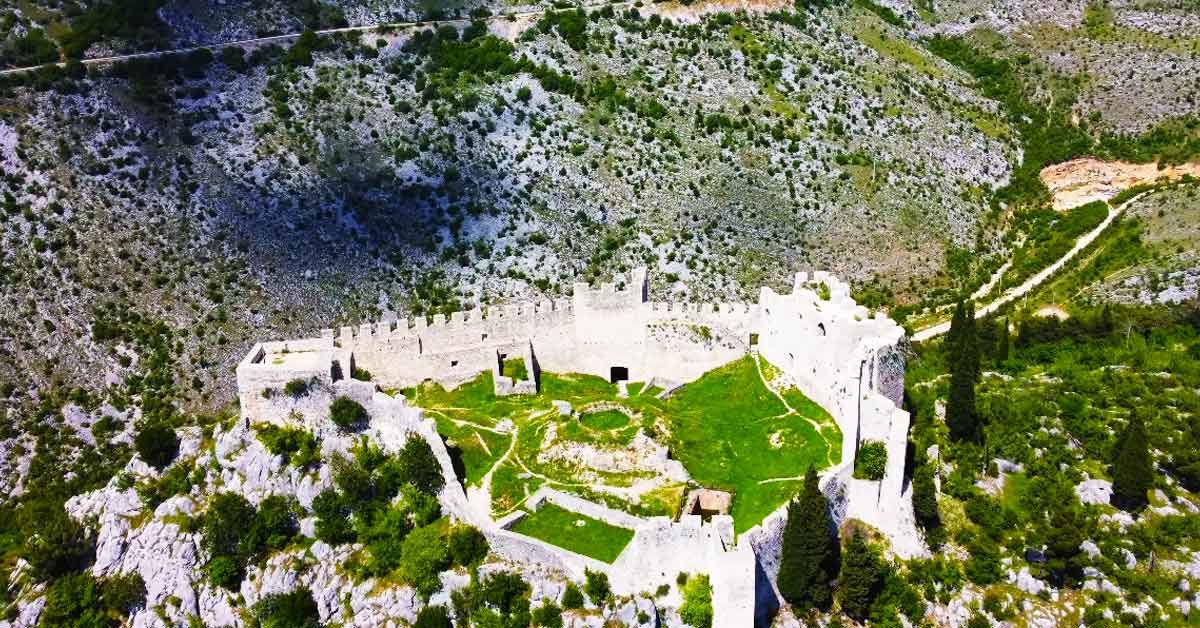
Perched dramatically on an inaccessible karst hilltop at 310 meters elevation, commanding sweeping views of the emerald Buna River valley and the distant Herzegovina plateau, stands Blagaj Fortress – known locally as Stjepangrad or simply “The Old Town.” Located just 10 kilometers south of Mostar in central Bosnia and Herzegovina, this remarkable medieval fortification represents one of the Balkans’ most significant yet undervisited historical complexes. The fortress has witnessed six centuries of continuous occupation, strategic regional importance, and dramatic historical transformations, from its origins as an Illyrian settlement through Roman, Byzantine, medieval Bosnian, and Ottoman periods, finally abandoning permanent military function in 1835.
Unlike Mostar’s celebrated Stari Most bridge – which dominates contemporary photography and tourist consciousness – Blagaj Fortress embodies deeper historical strata, archaeological continuity spanning millennia, and architectural genius adapted to one of Europe’s most strategically complex landscapes. The fortress complex covers more than two hectares, featuring walls reaching 12-14 meters in height, towers, internal structures, and defensive systems reflecting multiple centuries of construction, modification, and adaptation. Archaeological excavations during the 1960s revealed that human settlement at this location extends back at least 3,000 years, with uninterrupted occupation documented from the Iron Age through the 19th century.
What renders Blagaj extraordinary is not merely its historical importance or architectural achievement, but rather its relationship to place – the fortress appears as organic expression of landscape rather than imposed structure. The rocky plateau’s triangular configuration, surrounded on three sides by the Rakitnica River’s historic canyon course, provided natural defenses requiring minimal supplementary fortification. The fortress builders understood landscape intimately, positioning their walls and towers to harmonize with geological realities rather than fighting against them. This integration of human construction with natural topography characterizes medieval military engineering at its finest.
Table of Contents
Historical Evolution of Blagaj Fortress – From Illyrian Stronghold to Ottoman Garrison
The earliest evidence of human settlement at Blagaj extends back through prehistoric Illyrian occupation, demonstrating that the defensive advantages of this karst hilltop were recognized millennia before medieval fortification. Remnants of prehistoric hillforts visible on the southeastern peak confirm settlement spanning at least 3,000 years. The Romans, following their conquest of Illyrian territories, built their own fortification at Blagaj – not as primary administrative center, as was typical Roman practice, but rather as supporting installation complementing the earlier Illyrian settlement. Byzantine occupation during the 6th century under Emperor Justinian I (535-600 CE) left architectural signatures identifiable in construction techniques and brick-laying patterns. This layering of civilizations – Illyrian foundation, Roman reinforcement, Byzantine enhancement – establishes Blagaj as palimpsest of Mediterranean and Balkan history.
The earliest written documentation of Blagaj appears in the “Treatise on Peoples” of Byzantine Emperor Constantine Porphyrogenitus (948-952 CE), which mentions two separate fortifications in the region – Bona and Hum. This reference establishes that Blagaj had achieved sufficient territorial and military importance to warrant mention in imperial administrative records. The settlement’s economic foundation derived from its position controlling major trade routes connecting the Adriatic coastal regions with Bosnia’s interior and the Danube valley beyond. Merchants transporting Mediterranean goods inland and Balkan products seaward passed through this strategic corridor, generating taxation revenue, toll collection, and commercial opportunity that enriched fortress residents.
During the medieval period, Blagaj achieved particular prominence as a royal and noble seat. The Bosnian ban (roughly equivalent to viceroy) and later Croatian-Bosnian kings established Blagaj as one of their residences, with historical charters and official documents dated from the fortress as evidence of administrative functions conducted there. In 1404, the fortress became one of the primary seats of Voivode Sandalj Hranić, one of medieval Bosnia’s most powerful nobles, whose territory extended across southeastern Bosnia and Herzegovina. Sandalj’s successor, Count Stjepan Vukčić Kosača, enhanced the fortress substantially, implementing defensive improvements and architectural embellishments that still constitute the visible structure. The fortress subsequently became known as “Stjepangrad” (Stjepan’s Town) in his honor. This period represents Blagaj’s apogee as political and military center, when noble families maintained permanent courts and substantial garrisons ensured security and territorial control.
The Ottoman conquest in 1465 transformed Blagaj’s strategic role fundamentally. Initial Ottoman reconstruction and garrison establishment maintained the fortress as military installation, with documented repairs in 1699 (when the western tower was restored) and again in 1827. However, the fortress’s military significance declined as Ottoman power consolidated and Mostar – positioned lower in the valley with better access to commerce and fortification possibilities – emerged as the region’s primary administrative and military center. The 1664 travel account by Ottoman explorer Evlija Çelebi describes Blagaj as essentially abandoned – mentioning only an iron gate, 15 empty houses, a small mosque, two cisterns, and two cannons. The fortress garrison finally withdrew in 1835, marking the definitive end of military occupation spanning over 1,400 years.
The fortress suffered significant damage during the 1990s Bosnian War, with bombardment and decay threatening its survival. However, conservation efforts beginning in the early 21st century have stabilized structures and prevented further deterioration. In 2009, the Bosnian government officially recognized Blagaj Fortress as a National Monument – specifically designated as a Cultural Landscape – making it the only such designation in Bosnia and Herzegovina for a location with continuous human habitation throughout its protected period. Additionally, Blagaj was included on UNESCO’s tentative World Heritage List, acknowledging international recognition of its cultural significance and archaeological importance.
Architecture and Fortification of Blagaj Fortress – Medieval Military Genius Adapted to Landscape
Blagaj Fortress’s most striking characteristic is its architectural response to the challenging landscape. The triangular plateau configuration with vertical cliffs on the north, west, and south sides eliminated the need for fortifications on these naturally defended approaches. The fortress builders focused their formidable engineering efforts on the single accessible side – the eastern approach – where massive walls, bastions, towers, and complex defensive systems created formidable barriers to any attempted assault.
The fortification walls, constructed from locally quarried limestone blocks fitted without mortar in the characteristic medieval technique, reach heights of 12-14 meters and width of 3-5 meters depending on location and construction period. The base of walls deliberately slopes outward – a sophisticated medieval defensive innovation that causes projectiles launched from attackers’ siege equipment to ricochet unpredictably rather than striking walls perpendicularly. This technique, known as “scarping,” reflects knowledge of ballistics accumulated through centuries of medieval siege warfare.
Archaeological investigation has revealed multiple construction phases spanning several centuries. The earliest medieval phase (late 14th-early 15th centuries) employed distinctive construction techniques characteristic of Bosnian royal fortifications. Subsequent Ottoman-period modifications added rounded bastions and gun platforms – evidence of fortification adaptation to evolving artillery technology. Unlike medieval fortresses whose high, thin walls proved vulnerab to cannon bombardment, Ottoman military engineers modified Blagaj to accommodate artillery, indicating recognition that medieval defensive strategies required transformation in response to technological change.
Within the fortress complex, archaeological excavation revealed remnants of internal structures including a palace (kula), administrative buildings, and residential quarters. The palace, constructed in late medieval period, featured sophisticated architectural elements including a central courtyard and underground cistern for water collection – critical for besieged garrisons. The presence of ceramic fragments, metalwork, and domestic refuse scattered throughout the excavation site confirms sustained occupancy with substantial permanent population rather than minimal garrison settlement.
The fortress’s overall ground plan forms an irregular polygon adapted to the plateau’s natural configuration rather than conforming to standard geometric fortress designs. This adaptation to landscape – rather than imposing artificial geometric order – distinguishes Blagaj from many contemporary European fortifications. Medieval architects understood that flexibility in layout reflecting topography often provided superior defensive advantages compared to rigid adherence to fortification geometric ideals. The result is fortress that appears almost organic to the landscape, emerging naturally from the hilltop rather than dominating it through obvious human imposition.
Blagaj Fortress in Relation to Mostar and the Region
Blagaj’s relationship to nearby Mostar illuminates important medieval and Ottoman regional dynamics. When Ottoman forces consolidated their Balkan conquests in the 15th-16th centuries, Blagaj’s elevated position, limited water supply, and distance from major commerce routes became strategic liabilities rather than advantages. Mostar, situated in the valley alongside the Neretva River with better water access, improved communication routes, and riverside commercial opportunities, proved more suitable for regional administrative headquarters and commercial center. The fortress garrison increasingly found Mostar’s lower town preferable for daily habitation, leaving Blagaj as primarily ceremonial and military installation occupying a diminishing niche.
This transition – from fortress as primary settlement to secondary military installation – characterizes broader patterns observed across the Ottoman Empire as military technology evolved and administrative structures adapted to new realities. The conquest of Constantinople in 1453 and subsequent Ottoman military successes demonstrated that artillery-resistant fortifications required different configurations than medieval fortress designs. Large, sprawling complexes like Blagaj became harder to defend adequately against concentrated cannon bombardment compared to compact, heavily bastioned modern fortifications. Ottoman military engineers, learning from experience, developed new fortification principles that Blagaj’s medieval layout could only partially accommodate.
The proximity of the Blagaj Tekija (Dervish monastery) – constructed around 1520 directly below the fortress at the Buna River source – represents cultural and spiritual complement to the military fortress. While Blagaj Fortress embodied temporal power, military organization, and political control, the Tekija represented spiritual authority, mystical tradition, and alternative authority systems. The juxtaposition of these two institutions – fortress and monastery, temporal and spiritual power, military might and peaceful contemplation – encapsulates broader tensions within Ottoman society between expansion and consolidation, military ambition and religious devotion.
The Blagaj Tekija Below Blagaj Fortress: Spiritual Sanctuary
At the foot of Blagaj Fortress, beside the extraordinary spring where the Buna River emerges from limestone karst – creating one of Europe’s most dramatic water features – stands the Blagaj Tekija, a Dervish monastery constructed around 1520. This monastery embodies Ottoman-Mediterranean architectural fusion, combining Islamic spiritual traditions with Mediterranean building principles in a setting of unparalleled natural beauty.
The Buna spring represents a hydrogeological phenomenon of international significance – classified among Europe’s five most important karst springs. The river emerges directly from limestone bedrock after traveling 19.5 kilometers underground through subterranean channels, appearing with such force that its water volume rivals rivers formed from surface watershed collection. The spring’s emerald-green coloration results from mineral composition and water clarity, creating visual effect reminiscent of gemstones. Local tradition attributes mystical properties to the spring water, though scientific analysis reveals simply exceptional purity reflecting underground passage through limestone substrates.
The Tekija building itself occupies a narrow terrace between the vertical cliff rising 180 meters above and the Buna River flowing below, a location simultaneously dramatic and constrained. The modest structure – approximately 15 meters by 8 meters – features whitewashed walls, traditional Ottoman windows, and a prayer hall oriented toward Mecca. The interior contains few furnishings, reflecting Dervish emphasis on spiritual practice over material comfort. The building functions simultaneously as religious institution (tekija or tekke in Ottoman terminology) – a gathering place for Sufi mystical practices – and as comfortable refuge where spiritual seekers could retreat for extended meditation and devotional activity.
The Dervish order represented in Blagaj embraced Sufi Islam, the Islamic faith’s mystical dimension emphasizing direct spiritual experience, ecstatic devotional practices including whirling rituals (the famous “whirling dervishes” of Ottoman culture), and alternative authority structures challenging orthodox Islamic hierarchy. The Blagaj Tekija hosted initiates undergoing spiritual training, pilgrims seeking blessings and healing, and wandering holy men receiving shelter and sustenance. The spring water played spiritual role – considered blessing, source of healing, symbol of divine presence manifesting through nature.
The Tekija endured the 1990s Bosnian War with damage but survived largely intact. It now functions as museum and pilgrimage destination, with modest entrance fee (approximately 2-3 euros) permitting interior access. Visitors must remove shoes and dress modestly – women may be offered headscarves and long skirts if attire seems inappropriate. The spiritual atmosphere remains palpable despite transformation to tourist destination. Morning visits, before day-tripping crowds arrive, capture the sanctuary’s essential character most authentically.
Activities and Experiences at Blagaj Fortress
Visiting Blagaj involves multiple experiences combining historical exploration, natural landscape appreciation, water-based recreation, and culinary enjoyment.
Fortress exploration constitutes the primary activity. The climb from parking area to fortress entrance involves ascending steep serpentine path approximately 900 meters long and 2 meters wide – historically designed for horse passage but now accommodating tourist foot traffic. The ascent requires 20-30 minutes depending on fitness level and pace. The effort proves worthwhile: views from fortress ramparts encompassing the Buna Valley, surrounding mountains, and distant Mostar create memorable perspective on landscape scale and medieval strategic positioning. Exploration of the fortress interior – walking the perimeter walls, examining tower structures, investigating internal layouts – typically requires 45-60 minutes.
Tekija visitation involves walk through village streets to the monastery entrance, modest entry fee payment, and approximately 30-45 minutes inside the building and surrounding grounds. The spring water is potable – many visitors fill containers with the renowned pure water. Photography opportunities abound, though interior photography may require permission from caretakers.
Kayaking and canoeing on the Buna River represents increasingly popular activity. Several operators offer guided excursions, typically 2-3 hours duration, paddling downstream from launch points and returning by vehicle. Costs approximately 20-30 euros per person, with equipment provided. The river’s calm flow makes paddling accessible to participants without prior kayaking experience. Some tours extend to the Bunica River (smaller tributary), visiting the source spring – though reaching this requires short portage over rocks.
Boat rides to the Buna spring offer alternative to kayaking – motorized boats navigating the narrow canyon to the spring source, entering the cave opening where water emerges. Approximately 1-2 hours duration, costs around 15-25 euros per person depending on group size.
Hiking trails extend throughout the surrounding landscape. The Stjepangrad trail connects Blagaj to neighboring medieval town of Počitelj (approximately 4-5 hours), offering panoramic views and passing additional historical sites. Shorter 1-2 hour trails loop through local villages and along river valley.
Photography opportunities prove exceptional, particularly during golden hours (early morning and late afternoon) when light angles create dramatic shadows and color saturation intensifies. The fortress silhouetted against sunset, the emerald water reflecting canyon walls, the old stone buildings of the village – all create compelling photographic subjects.
Where to Eat and Drink Near Blagaj Fortress
Blagaj’s dining scene emphasizes traditional Bosnian cuisine, freshwater fish specialties reflecting the Buna’s importance, and river-facing ambiance that enhances culinary experience.
Restoran Vrelo represents the most prominent dining establishment, located beside the Buna spring with spectacular views of the water and cliff face. The restaurant specializes in freshwater fish – particularly trout (pastrmka) from the Buna – prepared through traditional grilling, baking, or stewing methods. Traditional dishes include Brodeta (fish stew with Mediterranean herbs), grilled whole fish served with seasonal vegetables, and Čorba (traditional meat and vegetable soup). Main courses range from 12-20 euros, with generous portions reflecting Balkan hospitality traditions. The establishment operates daily from 8:00 AM to 11:00 PM. The riverside location and spring-water views create romantic dining ambiance, particularly during evening hours.
Phone: +387 36 551 230
Restoran Fajić specializes in grilled meat and fish, featuring traditional Herzegovina preparations. The menu emphasizes local ingredients – river fish, lamb, beef – prepared according to family recipes spanning generations. Ćevapi (grilled meat sausages) cost approximately 8-10 euros, mixed grilled platters 15-20 euros, and fish preparations 12-18 euros. The casual atmosphere and reasonable pricing attract both tourists and local visitors. Opening hours typically 9:00 AM – 10:00 PM daily.
Mlinica Restaurant operates from converted historic mill building, offering unique atmosphere blending heritage architecture with contemporary comfort. The kitchen emphasizes traditional Bosnian pastries and meat preparations, with prices moderate – appetizers 5-8 euros, main courses 12-18 euros, desserts 3-5 euros.
Café establishments throughout the village serve traditional Bosnian coffee (kahva), prepared meticulously in small copper pots with specific ritual and technique – approximately 1.50-2 euros per cup. Tea, fresh juices, and soft beverages typically cost 2-3 euros.
Picnic supplies available from small village shops allow self-catered dining with fortress views, an option many budget-conscious travelers prefer. Locally produced cheese, bread, cured meats, and fresh fruit provide satisfying meals at minimal cost.
Dining in Blagaj emphasizes quality over elaboration – simple, honest food reflecting local traditions rather than sophisticated presentation or complex preparations. Water quality is exceptional throughout the village, fed by the pure Buna source, ensuring that even basic refreshments prove satisfying and safe.
Getting to Blagaj Fortress from Mostar
Blagaj lies approximately 10 kilometers south of Mostar, accessible by car in roughly 15-20 minutes from Mostar’s city center. The journey follows the M17 highway initially before transitioning to smaller roads toward the Buna Valley. Clear road signage directs travelers toward Blagaj Village (Blagaj Selo) and the fortress/Tekija sites.
Parking facilities exist near the village and fortress base, typically free or minimal cost. Most travelers drive independently or arrange private transfers through accommodations. Organized day tours from Mostar frequently include Blagaj alongside other attractions (Kravica Waterfall, Počitelj fortress), typically costing 40-80 euros per person depending on inclusions and group size.
Public transportation via local buses connects Mostar and Blagaj, though schedules prove irregular and journey time extends to 30-45 minutes including stops. Cycling enthusiasts often undertake the pleasant Mostar-to-Blagaj journey through scenic valley terrain.
Natural Environment and Seasonal Considerations at Blagaj Fortress
The Buna River valley creates distinctive microclimate – cooler than surrounding Herzegovina plateau due to water presence and canyon walls providing afternoon shade. Summer temperatures typically reach 25-28 degrees Celsius (versus 30-35 in Mostar and elevated areas). Spring (April-May) and autumn (September-October) provide ideal visiting conditions with stable weather and moderate temperatures. Summer brings maximum tourist crowds and occasional extreme heat. Winter (December-February) features occasional precipitation and cool temperatures, though conditions rarely prevent visitation.
The Buna spring operates year-round, with winter water volume higher due to rainfall and snowmelt from surrounding mountains. The river’s pristine water quality reflects minimal development within its watershed – a rarity in contemporary Europe. Wildlife includes indigenous fish species, abundant bird populations (particularly raptors utilizing canyon thermals), and insects reflecting Mediterranean-influenced climate at valley floor elevation.
FAQ – Frequently Asked Questions about Blagaj Fortress
What is the best time to visit Blagaj?
Spring (April-May) and autumn (September-October) offer ideal conditions – pleasant temperatures, stable weather, manageable tourist crowds, and scenic landscape conditions. Summer (June-August) brings maximum heat and tourist density. Winter is accessible but less comfortable.
How long should I plan for a Blagaj visit?
Yes, absolutely. Most visitors undertake day trips lasting 6-10 hours including transportation. Alternatively, overnight accommodation enables deeper village immersion and early morning experiences before day visitors arrive.
Is the fortress climb difficult?
The 900-meter serpentine path climbs steeply but is well-maintained. Most reasonably fit visitors complete ascent in 20-30 minutes. Those with mobility limitations may find the climb challenging.
Can I visit Blagaj as day trip from Mostar?
Absolutely. Most visitors undertake same-day excursions from Mostar, combining Blagaj with other attractions. The 15-20 minute drive from Mostar makes this easily feasible.
What should I wear when visiting the Tekija?
Modest dress is requested – shoulders covered, knees covered. Remove shoes before entering prayer space. Women may be offered headscarves if needed.
Are there facilities for visitors with disabilities?
Limited accessibility exists. The fortress climb involves steep paths and stairs. The Tekija is ground-level and reasonably accessible. Inquire regarding specific limitations.
Our Most Popular Tours To Sarajevo
We offer many tours that include a visit to Sarajevo and its most popular locations:
- Full Day tour from Sarajevo to Belgrade (Most Popular)
- Full Day tour from Sarajevo to Međugorije & Mostar
- Full Day Tour from Sarajevo to Travnik and Jajce
- Full-Day 5 Cities Tour from Sarajevo to Herzegovina (Mostar)
- Full day Tour from Sarajevo to Dubrovnik (Kotor or Split)
Don’t Hesitate To Say Hi!
Got any questions about our tours or the city? Don’t hesitate to contact us anytime for more info and booking.
Use the following phone number and email: