
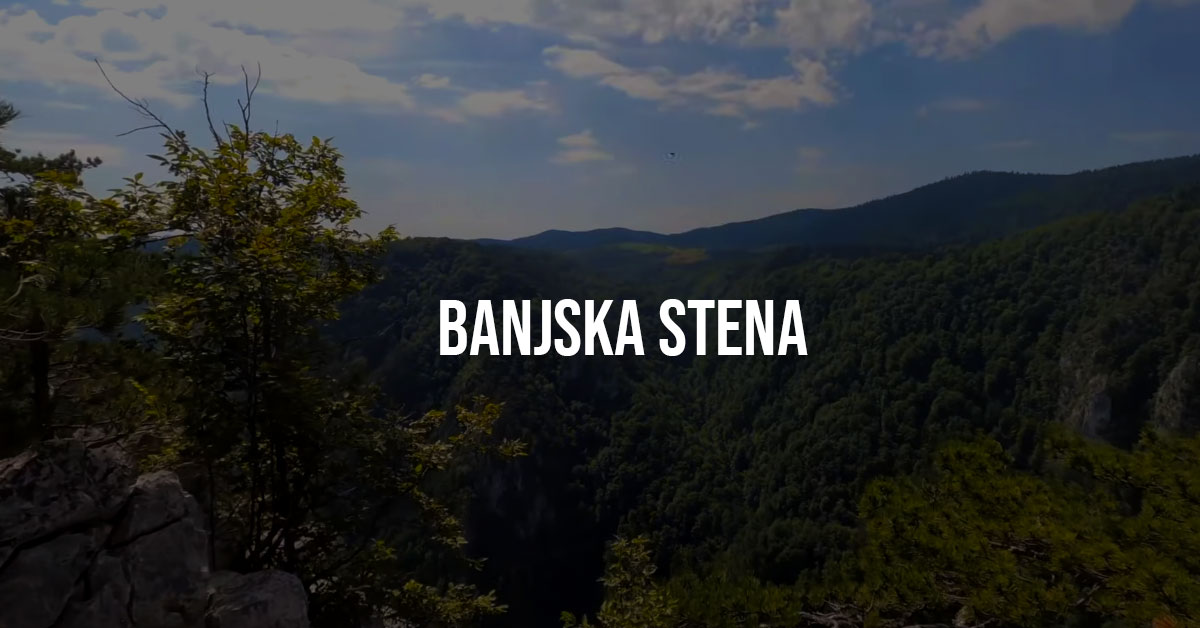
When you travel through Tara National Park or climb from Bajina Bašta towards the mountain, you will surely hear about Banjska Stena – that steep crevice in the stone that looks as if someone cut the mountain with a giant knife from top to bottom. Banjska Stena is a viewpoint at an altitude of 821 meters on Mount Tara in Serbia, a place where nature showed itself as an artist – where it carved, drilled, and shaped stone into something that looks as if it was deliberately made for people to come and be amazed.
This is not an ordinary geological formation. Banjska Stena is a geological crevice about 300 meters long, about 100 meters deep, and with a view that extends over 30 kilometers in all directions. When you stand on the edge and look down, you feel as if you are on top of the entire world – the Drina River glitters below like a silver ribbon, forests cover everything that is not stone, and mountains extend to the horizon where sky and earth become one.
Banjska Stena is a place where history, geology, and beauty meet at their simplest form. No architecture is needed, no museum, no tourist center – only nature and your ability to understand what you see. This is why Banjska Stena has become one of the most visited attractions in Tara National Park, where millions of strangers come every year to feel small before the magnitude of nature.
Table of Contents
What is Banjska Stena and Where is it Located
Banjska Stena is a geological formation known as a natural crevice or ravine in a limestone mountain, located on Mount Tara in Serbia, at a place where the Drina River carves through a canyon more than 1000 meters deep. The crevice was formed through millions of years of erosion – water, wind, and ice worked as a sculptor to cut away pieces of stone and transform it into something that looks as if it was deliberately designed.
Geographically, Banjska Stena is located at an altitude of 821 meters, at a place where the Drina canyon is deepest and where Mount Tara rises as a natural wall. Near Banjska Stena is Lake Zaovine – an artificial lake created by the construction of a hydroelectric dam, which provides contrast between the natural and the modern. Banjska Stena is 800 meters to 2 kilometers away from the main path, depending on which entrance you start from and how you explore.
Access to Banjska Stena is through Tara National Park, usually from the village of Bajina Bašta (15 km from Banjska Stena) or from the village of Raska (20 km). The road is paved or macadam, accessible for cars, although the last sections of the road are steep and require careful driving. Parking is available near Banjska Stena, free (2024/2025). From the parking to the viewpoint is a hiking trail about 800 meters to 1 kilometer long, which requires 15–30 minutes of easy walking without major climbs.
Banjska Stena is protected as part of Tara National Park by Serbia and is on the IUCN list as an important place for nature conservation. Although it is not on the UNESCO list as national heritage, its ecological and geomorphological significance is invaluable – it is one of the cleanest examples of how water and time can transform stone.
Geology of Banjska Stena – Millions of Years in Stone
Banjska Stena is the result of long-term erosion of limestone which is characteristic of mountains in this part of the Balkans. Limestone is calcium carbonate – a stone that water easily dissolves. When rain falls on the mountain, water filters through the pores of the stone, and then flows downward and begins to attack limestone where it is closest to the path of water.
The process is simple but long-lasting:
- Water falls on stone – rain is slightly acidic, making it an agent of erosion
- Water flows downward – it follows natural sequences in the stone and begins to dissolve it
- Over millions of years – water creates deep ravines and crevices in the stone
- The result is Banjska Stena – a crevice 300 meters long and 100 meters deep
What is special about Banjska Stena is that erosion was so uniform that it created almost ideally symmetrical sides of the crevice. If you stand on top of the viewpoint and look down, the left and right sides of the crevice look as if they were cut with a knife – the natural knife of time.
Type of stone: Banjska Stena is built from Jurassic limestone – stone that dates from a period 180–200 million years ago, when this area was under the sea. Fossils and minerals visible in the stone show that ancient sea world – shells, corals, and other remains.
Drina River: The Drina River is the main erosive agent that caused the creation of Banjska Stena. The river collected water from the entire mountain and channeled it through one sequence, creating so much pressure that it cut through stone like water cuts through soft soil. The Drina canyon below Banjska Stena is more than 1000 meters deep – showing how deep water managed to carve.
History of Banjska Stena from Geological Times to Today
Banjska Stena as a geological formation was created over millennia – no one knows exactly when erosion began or when the crevice was “finished,” because erosion is a process that continues even today. However, we can say that the crevice has existed for at least 5–10 million years, and its current depth and shape were reached several million years ago.
During the Ottoman period (16th–19th centuries), Banjska Stena was known to the local population – hunters, shepherds, and travelers knew about it. However, there was no official documentation or name until the 19th century when new cartography of the region began.
During the Austro-Hungarian period (1878–1918), Banjska Stena became known to European geologists and travelers who wrote about it as one of the “wonders of the Balkans.” The name “Banjska Stena” appears in books from that time, although it was not as well known as other places.
After World War II, Banjska Stena was included in Tara National Park, which was founded in 1981. The park was an important decision because it protected Banjska Stena from erasure – before the establishment of the park, there was a danger that roads or other structures could be built near it.
During the 1992–1995 war, Banjska Stena was not seriously damaged because it is located far from military action. However, the park was abandoned during the war and the road deteriorated. In the early 2000s, the park was reactivated and Banjska Stena began to be systematically promoted as a tourist attraction.
Today, Banjska Stena is one of the most visited attractions in Tara National Park, with an estimated 100,000 to 200,000 visitors annually – a significant number for a small park in Serbia.
Viewpoints from Banjska Stena – A View That Takes Your Breath Away
When you stand on the Banjska Stena viewpoint, you see probably the best viewpoint from Mount Tara. The view extends over 30 kilometers in all directions:
- Towards the Drina River: The river is seen as a silver ribbon that winds through the canyon – you see how the river catches light and how it glitters. A classic “next stop” down in the valley is the iconic Drina River House, one of the most photographed spots in the Bajina Bašta area.
- Towards Mount Mokra Gora: Another mountain that is known as the location for the Šargan Eight Railway – you can see the railway line from a distance
- Towards Bajina Bašta: A small town is visible if the day is clear – small houses look like Lego blocks from a height of 800 meters
- Towards Lake Zaovine: An artificial lake created by a dam – contrast between the modern and the natural
What is special is that the viewpoint is not just a view – it is a synergy of geology, nature, and man. You see how water drilled through stone, how it produced energy at the dam below, and how nature continues to exist around human development.h a temporary exhibition and a workshop, two hours will pass very quickly.
Tourism at Banjska Stena – How to Visit
Banjska Stena is accessible to tourists throughout the year, although it is easiest to visit during April to October when the weather is mild and visibility is good.
Location:
- From Užice: 60–70 km towards Bajina Bašta, then towards Tara National Park. On the same Užice–Bajina Bašta road through the Drina canyon, add a quick photo-and-history detour to Gate of Podrinje.
- From Bajina Bašta: 15 km towards Mount Tara
- From Belgrade: 200–250 km – the drive is 4–5 hours
Access:
- Car to parking: free parking (2024/2025)
- Hiking trail from parking to viewpoint: 800 meters to 2 kilometers, 15–30 minutes of walking
- The trail is clearly marked and accessible for most people, although the final section may be slightly steep
Price: Admission to Tara National Park is usually 3–5 EUR for adults, 1–2 EUR for children – prices should be verified at local information centers.
Best time to visit:
- Spring (April–May): nature is in full color, temperatures are mild, water in the river is clear
- Autumn (September–October): leaves change colors, view is crystal clear
- Summer: warm and dry, but can be hot and crowded
- Winter: possible, but can be slippery from ice and snow on the trail
What to see:
- Banjska Stena itself – the crevice in the stone
- Viewpoint with a view of the Drina
- The Drina River far below
- Lake Zaovine on the other side
- Mountains extending to the horizon
- The forest around the viewpoint
How to prepare:
Sunscreen – sun reflects from the stone
Bring hiking boots – the trail can be wet or slippery
Water and light food – there is no place for food near the viewpoint
Jacket or hoodie – it is colder at the top than at the bottom
Camera or phone – the viewpoint is photographically spectacular
Surroundings of Banjska Stena – Other Attractions in Tara
Lake Zaovine is located near Banjska Stena (3–5 km) – an artificial lake perfect for camping, fishing, or simply walking along the shore.
Mokra Gora is a mountain village where the starting station of the Šargan Eight Railway is located – if you go from Banjska Stena, you can visit the railway line on the way. If you’re already stopping in Mokra Gora for the Šargan Eight, it’s a perfect moment to add the nearby wooden film village too: Drvengrad travel guide: wooden hilltop village.
For a more remote, hike-only viewpoint on Tara (higher, wilder, and far less visited), continue to Kozja Stena.
Rajačke Caves are caves with stalactites and stalagmites – 20 km from Banjska Stena, accessible to tourists with guides.
Perućac Lake is located 30 km further along the Drina – another section of the canyon where nature is spectacular.
One-day route: Morning – Banjska Stena and viewpoint (2–3 hours). Afternoon – lunch in Bajina Bašta or near Tara. Afternoon – Lake Zaovine or walk through Tara forest. Evening – return home or camping near the park.
Symbolism of Banjska Stena – Time and Nature as Artists
Banjska Stena is a symbol of how time transforms nature into art. There is no human hand here – just water, wind, and millions of years. The result is something that looks as if it was deliberately made – but it is the result of only blind natural processes.
For people who come, Banjska Stena is an experience of humility. When you stand on top and look down, you feel small – small before the magnitude of geological time, small before the magnitude of nature, but also significant because you can experience and understand what you see.
For Tara National Park, Banjska Stena is a symbol – it is the image used in brochures, on websites, and in promotional materials. It is what Tara is known to the world for – not as a park where you can camp, but as a park where you can see something that is probably older than any city you know.
Practical Tips for Visiting Banjska Stena
Photography: The best angles are from the viewpoint where you can see all three dimensions of the crevice. Avoid standing with your back to the edge – the crevice is deep and there is a possibility of falling.
Weather: If it is raining, the trail can be slippery – consider postponing your visit if the weather is bad.
Physical fitness: The hiking trail is easy for most people, but the final section can be slightly steep for older people or people with mobility problems.
Time: Average visit lasts 2–3 hours (including travel from parking, hiking, and time on the viewpoint).
Respect for nature: Do not leave trash, do not write names on stone, and respect signs that prohibit entry into certain parts of the park.
Guides: If you want more detailed information, local guides are available at the park information center.
FAQ About Banjska Stena
Where is Banjska Stena?
Mount Tara in Serbia, near Bajina Bašta, in Tara National Park.
How deep is the crevice?
About 100 meters deep and about 300 meters long.
Is it accessible to tourists?
Yes, completely accessible with clear trails and viewpoints.
How much time do I need?
2–3 hours for a complete visit.
Is it safe?
Yes, but be careful on the edge because it is deep.
When is the best time to visit?
Spring or autumn for the best weather and visibility.
Our Most Popular Tours To Sarajevo
We offer many tours that include a visit to Sarajevo and its most popular locations:
- Full Day tour from Sarajevo to Belgrade (Most Popular)
- Full Day tour from Sarajevo to Međugorije & Mostar
- Full Day Tour from Sarajevo to Travnik and Jajce
- Full-Day 5 Cities Tour from Sarajevo to Herzegovina (Mostar)
- Full day Tour from Sarajevo to Dubrovnik (Kotor or Split)
Don’t Hesitate To Say Hi!
Got any questions about our tours or the city? Don’t hesitate to contact us anytime for more info and booking.
Use the following phone number and email: