
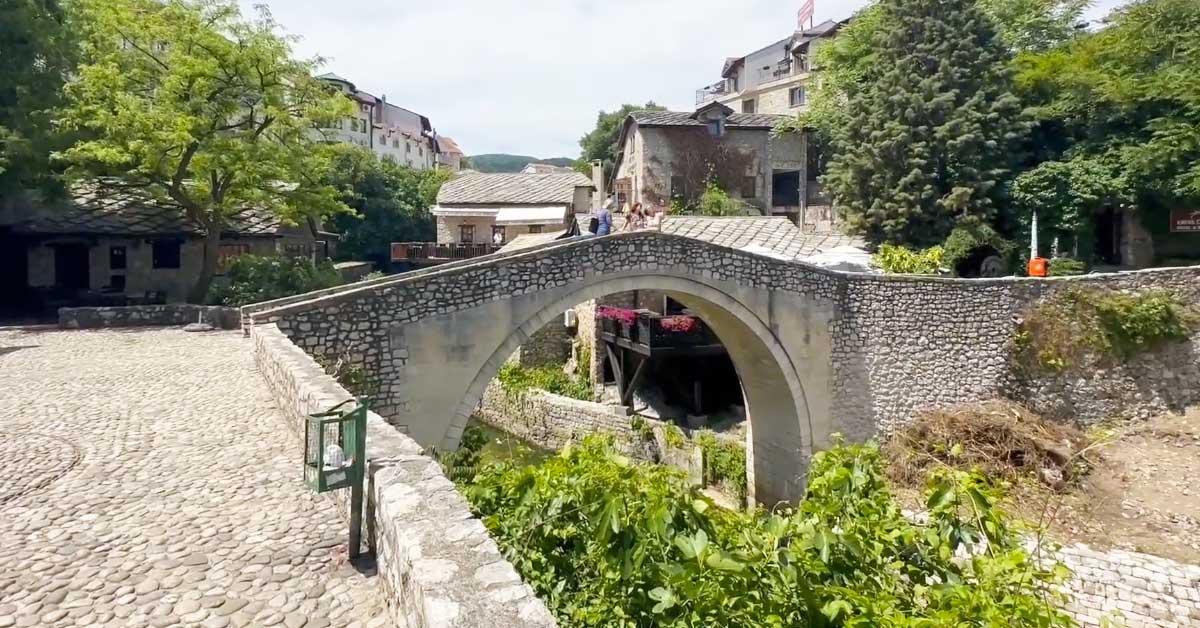
Nestled on a quiet cobblestone lane just 30 meters from the world-famous Stari Most, Crooked Bridge Mostar – or Kriva Ćuprija – waits patiently as Mostar’s most charming hidden treasure, a petite stone archway that carries 465 years of Ottoman engineering genius and local legend without ever demanding the spotlight. Built in 1558 as the prototype for the iconic Old Bridge, this single-arch beauty spanning the Radobolja stream offers everything Stari Most delivers in miniature form: perfect stonework, flowing drinking water, romantic benches, and postcard reflections, all minus the diver crowds and selfie-stick chaos.
Crooked Bridge Mostar feels like stepping into a fairy tale. Picture a flawless semicircular arch rising 4.15 meters high and stretching 8 meters across sparkling stream water, flanked by smooth stone steps worn by generations of feet, framed by cascading weeping willows and the slender minaret of the Nezir Agina Mosque piercing the sky behind it. Local women fill water jugs from its decorative spouts each morning, children splash in the shallow Radobolja below, couples share quiet moments on weathered benches – this intimate corner captures Mostar’s authentic soul while the main bridge across the Neretva buzzes two streets away.
What makes Crooked Bridge Mostar irresistible is its dual personality: architectural marvel by day, lovers’ legend by night. Ottoman architect Ćejvan Kethoda built it to prove his single-arch mastery to Sultan Suleiman before getting the green light for the grander Stari Most project. War-ravaged, flood-tested, and lovingly restored, Kriva Ćuprija stands today as resilient symbol – Mostar’s “little sister bridge” that survived where even her famous sibling fell.
Table of Contents
History of Crooked Bridge Mostar: Ottoman engineering test
Crooked Bridge Mostar’s story begins in 1558 during Sultan Suleiman the Magnificent’s transformation of Mostar from riverside village to regional Ottoman hub. Architect Ćejvan Kethoda, protégé of imperial master Mimar Sinan, received commission for Mostar’s first permanent stone crossing over Radobolja stream – eight years before unveiling Stari Most across mighty Neretva. Local legend claims Suleiman demanded “prototype proof” before funding grander project; Ćejvan delivered perfect miniature showcasing innovative mortarless construction.
The bridge’s 4.15m-high, 8m-wide single arch used precisely cut limestone blocks interlocked via wooden tenon-mortise joints – revolutionary technique harnessing river pressure for self-stabilization without mortar or metal. Decorative spouts once gushed drinking water (still functional today), frontal stone walls filled gaps with crushed aggregate, creating watertight seal enduring centuries. For 435 years, Kriva Ćuprija reliably connected mahalas (neighborhoods), proving Ottoman engineering genius predating Stari Most triumph.
1993 Croat-Bosniak war shelling severely damaged both bridges – Crooked Bridge Mostar cracked but smaller size prevented total Stari Most-style collapse. 2000 catastrophic floods nearly swept remnants into Neretva, but UNESCO/Luxembourg-funded reconstruction salvaged original stones, rebuilt authentic joints by 2003. Today fully functional landmark symbolizes Mostar resilience – prototype survived where masterpiece temporarily fell.
Architecture of Crooked Bridge Mostar: Stari Most perfected
Crooked Bridge Mostar showcases 16th-century Ottoman engineering at intimate scale. Ćejvan Kethoda applied identical Stari Most techniques: precisely cut limestone blocks (average 1.5m long) interlocked via oak pegs forming tenon-mortise system harnessing Radobolja current for structural tension. Single semicircular arch spans 8m rising 4.15m center, flanked gently sloping stone steps ascending each bank, frontal parapet walls fitted smaller cubes plus crushed stone aggregate creating watertight barrier.
Subtle 1558 details reward close inspection: decorative spouts channeling spring water (still potable), weathered carving traces on keystones, perfect mathematical proportions defying gravity. War scars visible in repaired sections blend authentic patina with modern reinforcement beneath surface. Weeping willows frame east bank, Nezir Agina Mosque (1619) minaret silhouettes west approach, cobblestone Jusovina street completes fairy-tale setting. Crooked Bridge Mostar proves “small perfection” sometimes outshines grand gestures.
Location of Crooked Bridge Mostar: Old Town hidden gem
Crooked Bridge Mostar occupies prime yet peaceful Old Town position on pedestrian-only Jusovina street, exactly 30 meters west Stari Most spanning Radobolja tributary where it meets Neretva. From Old Bridge, follow riverbank path left past Restaurant Šadrvan (20 seconds); Nezir Agina Mosque slender minaret immediately signals arrival. Park Gojka Vukovića road offers free 15-minute drop-off, 1-minute downhill walk to bridge.
This strategic “streamside corner” contrasts Stari Most chaos perfectly – shallow Radobolja invites children splashing, stone benches host local gossip sessions, willow shade cools summer afternoons. Proximity unlocks Old Town triangle: 2min Svrzo House museum (16thC Turkish house), 3min Hamam Turkish baths, 4min Koski Mehmed Pasha Mosque minaret climb. Crooked Bridge Mostar transforms any Stari Most visit from 30-minute photo stop to proper 1-hour neighborhood immersion.
Legends of Crooked Bridge Mostar: love and architecture
Crooked Bridge Mostar legends weave romance through stone. Primary tale credits Ćejvan Kethoda building 1558 prototype proving single-arch mastery before Sultan Suleiman approved Stari Most Neretva commission – “little sister” validated “big brother” engineering. Another claims “crooked” name from slight arch curve mirroring Jusovina street bend, though surveyors confirm mathematical perfection.
Most romantic legend: young sailor carved sweetheart initials on parapet before Venetian warship departure; survived centuries as fidelity symbol. War folklore adds orphans sheltered beneath 1993 shelling, earning “guardian bridge” status. Modern divers claim Kriva Ćuprija inspired Stari Most jumping tradition (false – too shallow). These tales transform functional crossing into Mostar’s storytelling centerpiece.
Destruction and reconstruction of Crooked Bridge Mostar
Crooked Bridge Mostar endured centuries floods, earthquakes, Ottoman-Venetian tensions gracefully until 1990s war tested limits. 1993 Croat-Bosniak shelling shattered nearby Stari Most completely while shrapnel scarred Kriva Ćuprija’s smaller frame – cracks radiated through arch stones but single-arch design prevented total collapse. Bridge slumped hazardous but survived initial destruction.
1999-2000 catastrophic floods delivered near-fatal blow – Radobolja swelled violently washing tons debris across fractured structure, leaving skeletal remains. UNESCO Luxembourg-funded reconstruction (2001-2003) meticulously salvaged original limestone blocks identifiable via tooling marks, rebuilt authentic tenon-mortise oak joints, reinforced hidden modern concrete core ensuring seismic resistance. By 2003, fully functional Kriva Ćuprija flowed potable water again, symbolizing Mostar reconciliation – prototype outlived masterpiece through resilience.
Practical guide to visiting Crooked Bridge Mostar
Crooked Bridge Mostar welcomes visitors completely free 24/7 year-round – no tickets, opening hours, reservations, or entry fees required anywhere. Exact location sits mid-pedestrian Jusovina street spanning Radobolja stream, 30 meters west Stari Most (2-minute walk left from Old Bridge riverbank past Šadrvan restaurant). Parking available Gojka Vukovića road (free 15 minutes drop-off, €1/hour extended); Mostar bus station 15-minute downhill walk or €2 taxi ride delivers directly.
Access routes: From Stari Most, follow Neretva left bank 30 seconds reaching mosque minaret marker; from Spanish Bridge east side, climb Rondo stairs right 3 minutes. Wheelchair access exists via gentle bank ramps avoiding main steps. Duration: Allow 10-30 minutes typical visit (photos both angles, water refill, bench relaxation); extend 1 hour combining Nezir Agina Mosque interior (€1 donation), Svrzo House museum (€5 authentic Turkish home). Best combine: Morning Stari Most divers (€10 bridge museum optional), lunch nearby Ćevabdžinica Hodžić (€8 meat plates), afternoon Crooked Bridge Mostar golden hour photography.
Peak timing: Dawn (7-9AM) guarantees empty scene local authenticity; avoid cruise midday 11AM-3PM (Spanish Bridge traffic). Winter solitude, summer shade from willows. Bring reusable bottle – spouts flow cold potable spring water year-round.
Best photography spots at Crooked Bridge Mostar
Downstream classic (most Instagram-famous): Position 5 meters back Jusovina street capturing perfect semicircle arch reflection Radobolja shallow waters/puddle foreground – golden hour morning light weaves magic through weeping willow branches overhead. Wide-angle lens (24mm) includes mosque minaret right frame balance.
Upstream mosque frame: Shoot from east bank stone steps positioning Nezir Agina slender minaret piercing perfect blue sky directly behind curved stonework – midday sun illuminates frontal limestone blocks revealing intricate Ottoman tooling marks.
Side-angle willow drape: East bank low angle through willow branches draping parapet creates romantic fairy-tale composition – overcast days soften shadows perfectly. Include foreground water jug local woman filling adds authentic Mostar life.
Detail close-ups: Macro lens captures weathered tenon-mortise oak peg joints, decorative spout lion heads, 465-year-old step wear patterns – black-and-white post-processing emphasizes timeless stone texture.
Drone aerials: FAA-equivalent permits required but 20m altitude reveals Jusovina curve mirroring bridge arch, Radobolja thread weaving Old Town fabric – stunning Mostar map addition.
Pro timing: Dawn empty reflections, sunset warm glow minaret silhouettes. Off-season (Nov-Mar) zero photo bombers.
Essential tips for experiencing Crooked Bridge Mostar
Start dawn visits (7-9AM) capturing empty bridge local women filling morning jugs – authentic Mostar moment cruise crowds miss entirely. Refill reusable bottle from decorative spouts – ice-cold potable spring water flows year-round, saving plastic bottles while connecting to Ottoman engineering. Picnic benches under willows perfect shaded lunch spot – Mostar burek (€2) pairs beautifully.
Combine intelligently: 2-minute walk Svrzo House museum (€5 – 16thC Turkish family home perfectly preserved), 3-minute Hamam Turkish baths exterior photos, 4-minute Koski Mehmed Pasha Mosque minaret climb (€3 panoramic Mostar). Respect locals filling water jugs – never photograph without permission, yield benches to elders. Off-season magic (November-March) delivers complete solitude, misty Radobolja mornings rival fairy tales.
Photo etiquette: Tripod low-traffic dawn only, wide-angle respects scene scale, include human elements (water carriers) showing living heritage. War context: Shell damage scars visible close-up – touchstones of Mostar resilience. Diver connection: Friendly rivalry with Stari Most – “we’re prettier, safer jumps” locals tease.
Nearby hidden gems: 1-minute Rondo alley Ottoman fountain house, 2-minute Tabačica neighborhood authentic Bosniak life away tourists. Crooked Bridge Mostar transforms obligatory Stari Most photo stop into genuine neighborhood immersion revealing Mostar’s beating heart.
FAQ about Crooked Bridge Mostar
What exactly is Crooked Bridge Mostar?
Crooked Bridge Mostar, known as Kriva Ćuprija, is the 1558 Ottoman single-arch stone bridge spanning Radobolja stream that served as architect Ćejvan Kethoda’s prototype proving his mortarless construction technique before building the famous Stari Most across Neretva eight years later.
Where is Crooked Bridge Mostar located in Mostar?
Crooked Bridge Mostar sits on pedestrian Jusovina street exactly 30 meters west of Stari Most, spanning the Radobolja tributary opposite the Nezir Agina Mosque – follow the Old Bridge riverbank path left for 30 seconds from the main bridge.
When was Crooked Bridge Mostar originally constructed?
Crooked Bridge Mostar was built in 1558 by Ottoman architect Ćejvan Kethoda during Sultan Suleiman the Magnificent’s Mostar expansion, serving as engineering test model eight years before the grander Stari Most Neretva crossing opened to traffic.
Is the water flowing from Crooked Bridge Mostar safe to drink?
Yes, the decorative spouts of Crooked Bridge Mostar provide cold, fresh, potable spring water that local residents safely drink daily – bring your reusable bottle for authentic Mostar refreshment straight from 16th-century Ottoman engineering.
Why do they call it Crooked Bridge Mostar?
Crooked Bridge Mostar earned its nickname “Kriva Ćuprija” either from the slight natural curve in its mathematically perfect arch or from the bend in Jusovina street where it sits – romantic local legend claims young lovers carved crooked initials proving eternal devotion.
Was Crooked Bridge Mostar destroyed in the Bosnian War?
Crooked Bridge Mostar sustained serious shrapnel damage during 1993 Croat-Bosniak shelling that completely destroyed nearby Stari Most, but its smaller size prevented total collapse – UNESCO restored it by 2003 using many original stones and authentic techniques.
Our Most Popular Tours To Sarajevo
We offer many tours that include a visit to Sarajevo and its most popular locations:
- Full Day tour from Sarajevo to Belgrade (Most Popular)
- Full Day tour from Sarajevo to Međugorije & Mostar
- Full Day Tour from Sarajevo to Travnik and Jajce
- Full-Day 5 Cities Tour from Sarajevo to Herzegovina (Mostar)
- Full day Tour from Sarajevo to Dubrovnik (Kotor or Split)
Don’t Hesitate To Say Hi!
Got any questions about our tours or the city? Don’t hesitate to contact us anytime for more info and booking.
Use the following phone number and email: