
Before the selfie sticks and cruise ships, before café umbrellas and TV crews, Dubrovnik was a walled stone city with one simple, brutal problem: water. Large & Small Onofrio’s Fountain are the elegant answer to that problem – two stone masterpieces that don’t shout for attention, but without them, the city’s story would be much shorter and far thirstier. You pass them on the way to the walls or the harbour, maybe refill a bottle and move on, not realising you are touching the very system that allowed Ragusa to become a maritime power in a dry, rocky corner of the Adriatic.
Large & Small Onofrio’s Fountain are like two stone siblings at opposite ends of Stradun, the main street: one big and round by Pile Gate, impossible to miss; the other small and ornate near Luža Square, often overlooked but full of detail. Together, they are the visible tip of a 15th‑century engineering miracle: an aqueduct that dragged fresh water 12 kilometres from the hills above Rijeka Dubrovačka straight into the heart of the Old Town, using nothing but gravity, genius and a lot of stubborn stonework.
Table of Contents
The water story behind Large & Small Onofrio’s Fountain
For medieval Dubrovnik, rainwater alone was not enough. Cisterns under houses and squares collected what fell from the sky, but long, dry summers turned water into a constant worry, a weak point in a city that otherwise prided itself on being self-reliant and clever. The Ragusan government knew that a siege or drought could be catastrophic if wells ran dry, so the councillors decided it was time for the city to stop depending only on the clouds.
In 1436, the Great Council issued a decision: Dubrovnik would build a proper aqueduct from the spring at Knežica/Šumet, about 12 km away in Rijeka Dubrovačka. They turned to Naples and hired a specialist – Onofrio Giordano della Cava, an Italian architect and engineer – signing a detailed contract for a gravity-fed system that would bring water to the city in just a couple of years.
The result was astonishing. By 1438, water was already flowing along stone channels and underground pipes, snaking over hills and under fields, all calculated so gravity would do the work without pumps. At the two ends of Stradun, the flow emerged in public fountains designed by Onofrio himself: a Large Onofrio’s Fountain by the western entrance near Pile and a Small Onofrio’s Fountain by the eastern end near the market and Rector’s Palace, turning flowing water into civic art.
Onofrio della Cava: the man behind the fountains
Onofrio della Cava was not just “some Italian architect” passing through; he was the man Dubrovnik trusted with its survival. Coming from Naples, he had experience with hydraulic works and monumental architecture, exactly what a rich but cautious republic needed when planning a project that could bankrupt them if it went wrong.
Archival documents show that Onofrio’s contract covered the aqueduct itself and the urban fountains, with penalties for delay and precise expectations for water quantity and quality. The fact that the aqueduct reportedly took only about two years to complete – and remained the city’s main water source until the late 19th or even mid-20th century – says a lot about both his skill and Ragusa’s insistence on long-term solutions.
Large & Small Onofrio’s Fountain are, in many ways, his signature engraved in city stone: one massive, functional and robust; the other smaller, ornate and playful, both showcasing a mix of Gothic and early Renaissance forms that were cutting-edge for the time. Every time someone leans over to drink from them today, they unconsciously pay homage to the man who nearly 600 years ago solved a problem that seemed unsolvable.
Large Onofrio’s Fountain: Dubrovnik’s stone crown at Pile
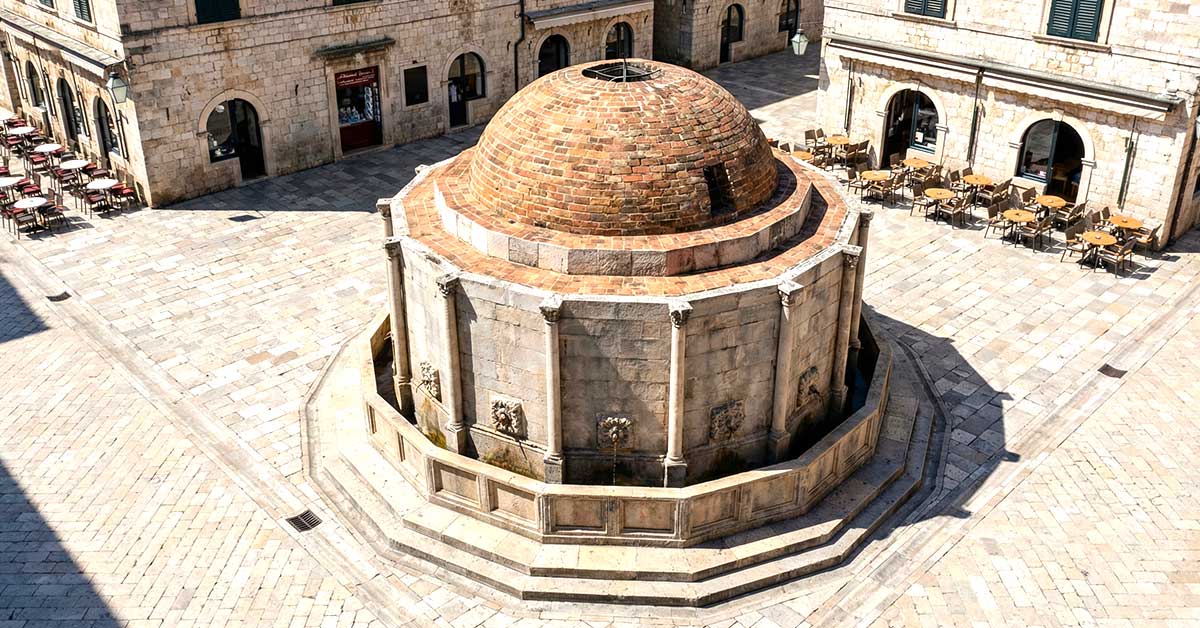
Large Onofrio’s Fountain sits at the western end of Stradun, just inside Pile Gate, like a stone crown marking the beginning of the Old Town. It is a massive, circular structure with a central dome and 16 sides, each decorated with a carved mask (maskeron) whose mouth once poured water into a basin below.
Built between 1438 and 1440 as the final point of the new aqueduct, it originally had even more elaborate Gothic sculpture and ornamentation. But the great earthquake of 1667 damaged the fountain heavily, stripping away much of the upper decoration; what you see today is partly simplified Baroque reconstruction with the original 16 stone faces surviving, slightly worn, still dripping fresh water.
For centuries, Large Onofrio’s Fountain was more than a landmark – it was the city’s main public tap, where citizens queued with clay jugs and wooden buckets, where gossip was exchanged and news spread faster than water itself. Today, it is a meeting point, a resting spot, a place where tour groups gather in its shade and travellers fill reusable bottles with cool water that is still famously clean and safe to drink.
Small Onofrio’s Fountain: the elegant twin at Luža Square
At the eastern end of Stradun, near Luža Square and the city bell tower, you find the quieter sibling: Small Onofrio’s Fountain, an elegant octagonal fountain tucked into a niche of the City Guard building. Many visitors walk past without a second glance, rushing toward the harbour or Rector’s Palace, but those who pause discover a true little work of art.
Built between 1440 and 1442, designed again by Onofrio della Cava, this fountain carries sculptural work by Pietro di Martino from Milan, a master who added a playful touch to Dubrovnik’s stone seriousness. The eight-sided basin is decorated with reliefs of nude baby boys, dolphins, shells and stylised masks, a mix of Gothic verticality and emerging Renaissance softness that feels almost Italian in delicacy.
Small Onofrio’s Fountain was strategically placed to supply water to the bustling market area around Luža Square, as well as nearby buildings like the Rector’s Palace and surrounding shops. Even today, it still provides drinking water – a discrete, ever-working piece of infrastructure hiding in plain sight, as much a part of daily routine as it was 500 years ago.
Large & Small Onofrio’s Fountain and the aqueduct: a hidden masterpiece
What makes Large & Small Onofrio’s Fountain special is not only how they look, but what they represent: the end points of a hidden backbone of the city – the early Renaissance aqueduct. This system ran roughly 12 km from the Šumet/Knežica spring in Rijeka Dubrovačka, across uneven terrain and down into the city, calculated precisely so gravity alone kept the flow steady.
Sources describe a channel of stone conduits and covered pipes, buried to protect from damage and contamination, with inspection shafts and distribution points that sent water to fountains, cisterns, monasteries and even some early industrial facilities like mills. For a 15th-century city, this wasn’t just infrastructure; it was a political statement: Ragusa could take care of itself, independent of neighbours, even in times of siege or drought.
The aqueduct remained the main water source for Dubrovnik until modern pipes replaced it in the 19th or early 20th century, a lifespan of almost 500 years. Walking between Large & Small Onofrio’s Fountain today along Stradun, you are basically tracing the visible line between two terminals of a system that once kept an entire republic alive.
Large & Small Onofrio’s Fountain in times of war and earthquakes
Dubrovnik has never had an easy relationship with the forces of nature and history – earthquakes, sieges, fires, wars, all of that swirled around these streets. Large & Small Onofrio’s Fountain have taken their share of hits and still stand. The 1667 earthquake, which levelled much of the city, damaged Large Onofrio’s Fountain badly enough to require extensive reconstruction, simplifying its original Gothic richness.
Small Onofrio’s Fountain was also affected by time and conflict. During the 1991–1992 siege of Dubrovnik in the Croatian War of Independence, the area around Luža Square was shelled, and the fountain suffered damage that later had to be repaired. Restoration efforts carefully cleaned, stabilised and preserved the delicate reliefs, allowing the fountain to continue functioning as a practical water source and historical artwork.
Through all this, Large & Small Onofrio’s Fountain never stopped representing continuity: even under bombardment and after quakes, water kept flowing, crowds kept gathering, and life slowly returned around them. They are silent witnesses that remember more than most guidebooks ever will.
Practical guide to visiting Large & Small Onofrio’s Fountain
Large Onofrio’s Fountain could not be easier to find: as soon as you pass through Pile Gate into the Old Town, it stands on your right on Poljana Paskoja Miličevića, marking the western start of Stradun like a round stone checkpoint. Small Onofrio’s Fountain waits at the eastern end of Stradun, in Luža Square, built into the City Guard building façade near the bell tower and St. Blaise’s Church.
Both fountains are outdoors, open 24 hours a day and completely free to visit, photograph and use. There are no tickets, no lines, no closing times; they are part of the street itself, as accessible as a corner café – which is exactly how Dubrovnik has used them for centuries.
The water from both Large & Small Onofrio’s Fountain is safe to drink and famously good, still drawn from springs in the Rijeka Dubrovačka area. Bring a reusable bottle and refill as you walk the city; in summer heat, this small habit saves money and plastic, and connects you directly to the city’s oldest infrastructure.
Tips for enjoying Large & Small Onofrio’s Fountain on your Old Town walk
To really appreciate Large & Small Onofrio’s Fountain, slow down. At Large Onofrio’s Fountain, climb the small steps and sit on the circular ledge, lean against the dome and look out at Stradun – you will see the entire river of people flowing into the Old Town, just as water once flowed toward the fountain itself. Look closely at the 16 carved faces: some smile, some grimace, some are worn almost smooth, each with its own expression shaped by 600 years of sun and rain.
At Small Onofrio’s Fountain, step close enough to the basin to examine the carvings: the playful children, dolphins, shells and decorative motifs that Pietro di Martino carved in the 1440s. They are small, but once you notice them, you start to see just how much attention Ragusa gave to beauty even when solving something as basic as water supply.
Visit early morning or late evening to avoid the thickest crowds and tour groups, especially around Large Onofrio’s Fountain where everyone seems to meet before city walls tours. Use them as landmarks to structure your day: start at the Large fountain, walk Stradun, visit Luža Square and the Small fountain, then continue to the harbour or Rector’s Palace. Let the fountains be your anchors – they were built for exactly that.
FAQ about Large & Small Onofrio’s Fountain
What are Large & Small Onofrio’s Fountain in Dubrovnik?
They are two historic 15th-century public fountains on Stradun, designed by architect Onofrio della Cava as part of the city’s early Renaissance aqueduct and water supply system.
Where are Large & Small Onofrio’s Fountain located?
Large Onofrio’s Fountain stands by Pile Gate at the western end of Stradun, while Small Onofrio’s Fountain is at the eastern end near Luža Square and the bell tower.
When were Large & Small Onofrio’s Fountain built?
Large Onofrio’s Fountain was built between 1438 and 1440, and Small Onofrio’s Fountain followed between 1440 and 1442, both tied to the completion of the aqueduct from Rijeka Dubrovačka.
Is the water from Large & Small Onofrio’s Fountain safe to drink?
Yes, the water is fresh, potable and sourced from springs above Dubrovnik; locals and visitors regularly fill their bottles at both fountains.
Who designed Large & Small Onofrio’s Fountain?
They were designed by Neapolitan architect Onofrio della Cava; sculptural work on the Small fountain was executed by Pietro di Martino from Milan.
Do I need a ticket to visit Large & Small Onofrio’s Fountain?
No, both fountains are free, open 24/7 and accessible as part of the public space in Dubrovnik’s Old Town – no admission, just walk up and enjoy.
Our Most Popular Tours To Sarajevo
We offer many tours that include a visit to Sarajevo and its most popular locations:
- Full Day tour from Sarajevo to Belgrade (Most Popular)
- Full Day tour from Sarajevo to Međugorije & Mostar
- Full Day Tour from Sarajevo to Travnik and Jajce
- Full-Day 5 Cities Tour from Sarajevo to Herzegovina (Mostar)
- Full day Tour from Sarajevo to Dubrovnik (Kotor or Split)
Don’t Hesitate To Say Hi!
Got any questions about our tours or the city? Don’t hesitate to contact us anytime for more info and booking.
Use the following phone number and email: