
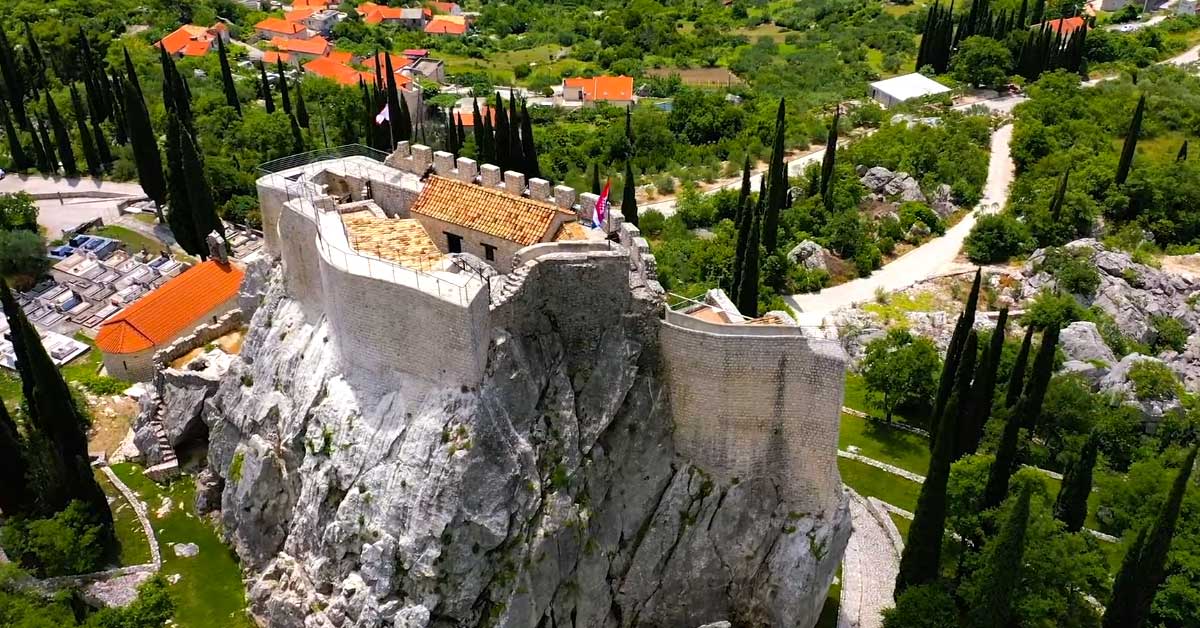
Leave the marble streets and crowded gates of Dubrovnik’s Old Town, travel inland toward the Dalmatian mountains, and you encounter an entirely different Dubrovnik – one where medieval fortifications rise from rocky peaks overlooking vast landscapes instead of harbors, where the sea is visible but distant, and where fortress architecture served completely different strategic purposes than the harbor defenses dominating the city itself. Sokol Grad, perched on a dramatic mountainous outcrop approximately 15 kilometers inland from Dubrovnik, represents this alternative medieval reality – fortification designed not to defend maritime commerce but to control inland approaches, defend against land-based threats and project power across the Dalmatian hinterland.
Sokol Grad is less visited than Dubrovnik’s urban fortifications, which paradoxically makes it one of the most rewarding destinations for visitors seeking authentic medieval fortification experience without crowds. The fortress can be difficult to reach, requiring driving inland from Dubrovnik and then hiking uphill through landscape dramatically different from the sea-facing city. Yet this remoteness preserves Sokol Grad’s character in ways that more accessible fortifications cannot match. Standing inside Sokol Grad, surrounded by Dalmatian mountains and medieval stone, you encounter medieval military strategy and fortification design freed from modern tourism infrastructure.
This guide explores Sokol Grad’s history, its architectural significance, why it matters to understanding medieval Dubrovnik’s broader territorial control and why visiting this mountain fortress provides perspective impossible to achieve from urban fortifications alone.
Table of Contents
The History of Sokol Grad: Mountain Stronghold and Territorial Control
Sokol Grad’s origins are somewhat uncertain, with construction likely occurring during the medieval period, though exact dating is debated by scholars. The fortress appears to have been built during a period when Dubrovnik’s territorial reach extended significantly inland, and the city needed to control and defend these interior lands against threats from competing powers, brigands and rival nobility claiming authority over mountain regions. Unlike harbor fortifications defending maritime commerce, Sokol Grad existed to defend territorial claims and control passage through Dalmatian interior.
The fortress changed hands multiple times throughout its history, passing between different rulers and authorities as political control of the region shifted. Venetian, Ottoman and local nobility all exercised authority over the fortress at different periods. This history of changing control reflects the complicated medieval political geography where Dubrovnik’s authority was not absolute but negotiated and contested with multiple rival powers claiming overlapping territorial jurisdiction.
By the time Dubrovnik became major tourist destination in the late 20th century, Sokol Grad was largely abandoned, its military function long obsolete. The fortress had not been actively used as military installation for centuries. Unlike urban fortifications that were maintained and continually adapted to new military technology, Sokol Grad was left to the elements. Centuries of weathering, earthquakes and simple deterioration took significant toll. The fortress that stands today is partially ruined, its walls partially collapsed, its interior spaces partially preserved.
In recent years, local authorities and cultural heritage organizations have undertaken selective restoration, stabilizing structures and making the fortress more accessible to visitors while attempting to maintain historical authenticity. These restoration efforts aim to preserve what remains without reconstructing what is lost, allowing visitors to see authentic medieval ruins rather than imaginative modern recreations.
Location and Geography of Sokol Grad: The Logic Behind a Mountain Defense
Understanding Sokol Grad requires understanding why anyone would build a fortress on a steep mountain far from the sea when Dubrovnik’s economy depended on maritime trade. The answer lies in recognizing that medieval Dubrovnik controlled substantial inland territory that needed defending for multiple reasons.
The inland mountains were not empty wilderness but inhabited by communities engaged in agriculture, pastoral herding and mountain settlements that contributed to Dubrovnik’s overall economy and tax base. Controlling these mountain territories meant collecting taxes, maintaining order and preventing rival powers from using mountain regions as bases for raids against the coast. A fortress like Sokol Grad served these functions by projecting power into the mountains, demonstrating that Dubrovnik’s authority extended beyond the harbor.
The mountain location also provided strategic advantage for controlling land-based approaches to Dubrovnik. The Dalmatian interior is reached through mountain passes and valleys. A fortress positioned on elevated terrain overlooking these passages could observe approaching forces and potentially harass them as they moved toward the coast. The fortress was not intended to withstand major sieges by professional armies but to serve as warning post, harassing position and demonstration of territorial control.
The dramatic topography of Sokol Grad’s location on a steep rocky outcrop shows sophisticated understanding of fortress positioning. The height provided observation capability and defensive advantage. Approaching forces would have to climb uphill against defenders positioned above. The rocky terrain was difficult to traverse, limiting how quickly attackers could assemble siege equipment. The remoteness meant that supply lines for besieging forces would be extremely extended and vulnerable.
Architectural Features of Sokol Grad: A Masterpiece of Medieval Mountain Engineering
Sokol Grad’s physical structure reveals adaptation to mountain environment and the specific military challenges of inland defense. The fortress consists of partially preserved stone walls, towers and defensive structures arranged across the rocky peak. The walls follow the natural terrain contours, using rock formations as natural fortification rather than fighting against the landscape. This approach shows sophisticated understanding of how to minimize construction effort by working with geography rather than against it.
The towers that survive are constructed from local stone precisely cut and fitted together. The craftsmanship visible in these structures is comparable to urban fortifications, suggesting that skilled masons were employed despite the remote location. The towers were positioned to command approaches and provide overlapping defensive coverage. Though partially ruined, the tower positions still reveal the strategic thinking behind their placement.
Water sources were critical for any mountain fortress intended to withstand siege. Medieval documents reference wells and cisterns at Sokol Grad, designed to collect and store rainwater. These hydraulic systems allowed the garrison to maintain water supply independent of external sources, essential when besieging forces attempted to cut off water access. Evidence of these water management systems remains visible in the fortress ruins.
Garrison quarters and storage spaces are partially preserved within fortress walls. The remains show that the fortress maintained permanent garrison of soldiers, officers and support personnel. These interior spaces were modest – defensive function was prioritized over comfort – but adequate for sustained occupation. The compact size of interior spaces reflects the harsh conditions of mountain fortress life.
Garrison Life at Sokol Grad: The Practical Reality of a Mountain Fortress
Living conditions at Sokol Grad would have been extremely challenging compared to urban fortifications or larger garrison fortresses. The remote mountain location meant limited supply availability, harsh weather conditions during winter months, and difficulty accessing medical care or other services available in towns. Soldiers stationed at Sokol Grad would have endured significant hardship. Yet medieval military recruitment often relied on feudal obligation or mercenary payment, meaning that whether garrison soldiers wanted to be at Sokol Grad was largely irrelevant – they went where military authority directed.
The isolation was probably intentional. A garrison isolated on a mountain peak was less likely to abandon position or mutiny. The hardship reinforced the military character of the posting. Soldiers knew they were placed in difficult circumstances for military purpose. The remoteness and challenge became part of military identity.
Supply challenges were significant. Food, ammunition and replacement equipment had to be transported uphill from lower elevations. This meant that regular supply operations were necessary and vulnerable to disruption. During wartime or when Sokol Grad was under threat, the garrison would have been aware that supply lines could be cut, leaving them isolated. This awareness would have influenced garrison behavior and defensive strategy.
Sokol Grad and Medieval Territorial Politics: Why Mountain Fortresses Mattered
Sokol Grad represents medieval political reality that modern visitors sometimes overlook. Medieval states did not control continuous, clearly bounded territories like modern nation-states. Instead, medieval power was fragmented, with multiple authorities claiming overlapping jurisdictions and constantly negotiating whose authority applied in specific places.
Dubrovnik’s control of inland mountain territories was always contested. Local mountain nobility, Ottoman authorities and Venetian interests all claimed competing rights to these regions. Building fortresses like Sokol Grad was way of asserting Dubrovnik’s authority and defending territorial claims against rivals. The fortress demonstrated that Dubrovnik possessed military capability to project power inland and was willing to invest resources in defending mountain territory.
Over time, Ottoman expansion gradually reduced Dubrovnik’s control of inland territories. By the 16th and 17th centuries, Ottoman authority extended into Dalmatian interior, limiting Dubrovnik’s territorial reach. Sokol Grad’s military relevance diminished as Dubrovnik’s inland territorial control shrank. The fortress that once represented important military asset became increasingly marginal, eventually abandoned as Dubrovnik focused on maintaining control of coastal areas and harbor through diplomatic accommodation with Ottoman power.
Visiting Sokol Grad: Access and Practical Considerations
Sokol Grad is located approximately 15 kilometers inland from Dubrovnik, in the direction of the village of Ponikve. The fortress cannot be reached by public transportation easily, requiring either private vehicle, rental car or organized tour. Driving from Dubrovnik takes approximately 20–30 minutes along mountain roads to reach the base of the fortress ascent.
Access Route: The drive follows inland roads through Dalmatian countryside toward the mountains. Signage directing to Sokol Grad may be limited, so using GPS navigation or asking for directions locally is advisable. The final approach requires parking vehicle and hiking uphill to the fortress itself – approximately 20–30 minutes of uphill walking on rough terrain.
Admission: As an unexcavated archaeological site and cultural monument, Sokol Grad does not charge formal admission, though access may be restricted during archaeological or restoration work. Visiting is generally free, though some organized tours offer guided visits with established fee structures.
Time Required: 1–2 hours for thorough exploration including the hike to reach the fortress. The hike itself takes 20–30 minutes, exploration of the site takes another 45–60 minutes, and descent takes similar time. If you enjoy fortresses but want an easier roadside stop on another trip, add Ram Fortress on Serbia’s Danube as a low-effort medieval site with a completely different setting.
Physical Considerations: The hike to Sokol Grad is moderately strenuous, involving uphill climbing over rough terrain with uneven footing. Visitors should be in reasonable physical condition and comfortable with hiking. The final approach to the fortress involves scrambling over rocks in places. Sturdy hiking boots with excellent grip are essential.
What to Bring: Bring substantial water – there are no facilities at the fortress site. Sunscreen and hat are essential as there is minimal shade on the approach and at the fortress itself. Snacks are advisable given the physical exertion of hiking. A camera is important for documentation – the views from Sokol Grad encompassing surrounding Dalmatian landscape are exceptional.
Best Time to Visit: Spring and fall offer optimal weather for hiking – not too hot, not too cold. Summer can involve intense heat on exposed mountain slopes. Winter is possible but challenging due to potentially icy or wet conditions on rocky terrain. Early morning is preferable to avoid midday heat and for better photography lighting.
Guides and Tours: Several Dubrovnik tour operators offer organized visits to Sokol Grad, sometimes combined with other inland cultural sites. Guided tours provide historical context and local knowledge about the fortress and surrounding countryside that independent visitors might miss.
Exploring Sokol Grad: Nearby Attractions and the Broader Regional Context
The inland region around Sokol Grad contains other medieval sites and traditional Dalmatian villages worth exploring as part of broader fortress visit. The countryside surrounding the fortress preserves agricultural landscapes and settlement patterns that have existed for centuries. Visiting Sokol Grad in broader context of regional exploration provides understanding of medieval Dubrovnik’s territorial extent and interior geography.
Several traditional villages exist within driving distance of Sokol Grad, offering authentic Dalmatian rural experience contrasting dramatically with urban Dubrovnik. These villages preserve traditional architecture, agricultural practices and cultural traditions in ways that coastal tourism has disrupted in the city itself.
FAQ – Sokol Grad
Why would Dubrovnik build a fortress so far inland when the city’s wealth depended on maritime trade?
Medieval Dubrovnik controlled significant inland territory that required defending against rival powers and brigands. Sokol Grad projected authority into mountains, defended tax-paying communities and controlled land-based approaches to the coast. Mountain territories contributed substantially to overall economy beyond maritime trade.
How does Sokol Grad’s strategic purpose differ from harbor fortifications like Lovrjenac?
Lovrjenac defended maritime commerce and harbor access. Sokol Grad defended inland territorial claims and land-based approaches to Dubrovnik. Together they represent complete defensive system covering maritime and land-based threats. Visiting both provides comprehensive understanding of medieval military strategy.
Why is Sokol Grad less visited than other medieval fortifications despite being significant historically?
Sokol Grad’s remote mountain location requires substantial effort to reach and challenging hike to access. Unlike urban fortifications accessible from Old Town, Sokol Grad requires deliberate planning and physical exertion. This remoteness preserves its authentic medieval character but limits casual tourism.
What is the condition of Sokol Grad compared to other medieval fortifications?
The fortress is partially ruined, with some walls and towers significantly deteriorated. Recent restoration efforts have stabilized structures without reconstructing what is lost. Visitors see authentic medieval ruins rather than modern reconstructions, providing different experience than fully preserved fortifications.
How does the mountain location affect fortress defense strategy?
Mountain terrain provides natural defensive advantages: height for observation and fire control, difficult approach terrain, extended supply lines for besiegers. The fortress was designed to harass approaching forces rather than withstand major sieges, reflecting its role as outpost rather than primary fortification.
Is Sokol Grad worth visiting if I have limited time in Dubrovnik?
The hike and remoteness require significant time investment. If time is limited, Sokol Grad may be lower priority than more accessible fortifications. However, if you have full day and interest in comprehensive medieval fortification understanding, Sokol Grad provides invaluable perspective impossible to achieve from urban sites alone.
Our Most Popular Tours To Sarajevo
We offer many tours that include a visit to Sarajevo and its most popular locations:
- Full Day tour from Sarajevo to Belgrade (Most Popular)
- Full Day tour from Sarajevo to Međugorije & Mostar
- Full Day Tour from Sarajevo to Travnik and Jajce
- Full-Day 5 Cities Tour from Sarajevo to Herzegovina (Mostar)
- Full day Tour from Sarajevo to Dubrovnik (Kotor or Split)
Don’t Hesitate To Say Hi!
Got any questions about our tours or the city? Don’t hesitate to contact us anytime for more info and booking.
Use the following phone number and email: