
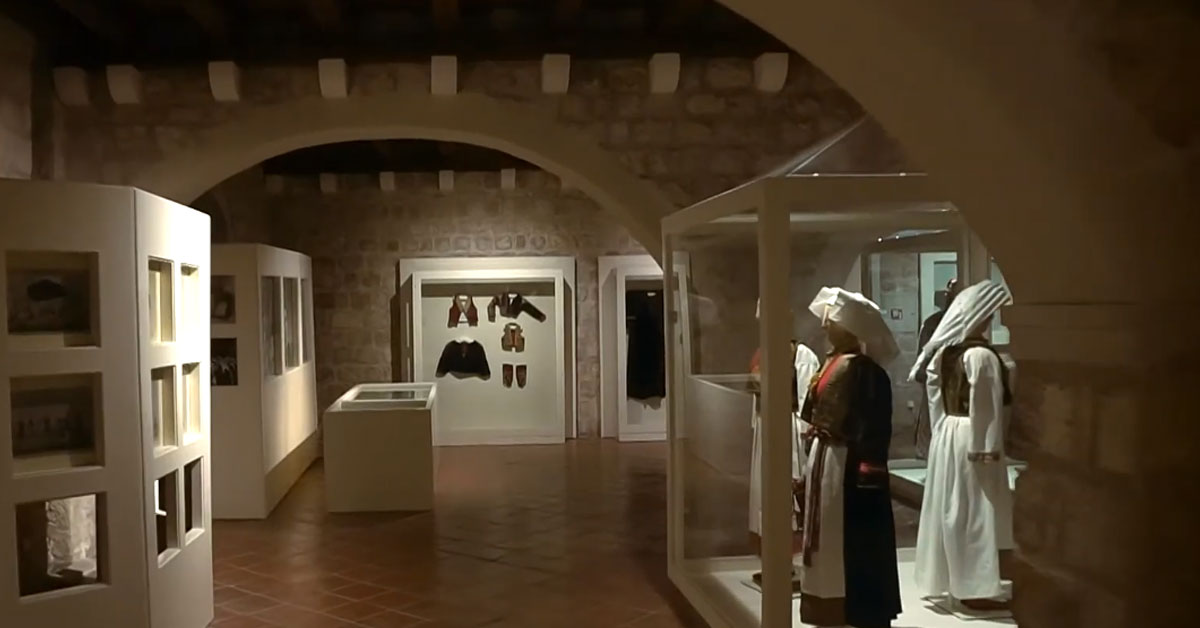
Walking into the Ethnographic Museum Dubrovnik feels like stepping into someone’s grandmother’s house – the kind of house that preserved everything because every object told a story about who the family was and where they came from. The difference is that this “grandmother’s house” documents not one family but entire communities, centuries of tradition and the cultural identity of people who lived along the Dalmatian coast. If you have spent your Dubrovnik visit admiring medieval palaces and walking fortified walls, the Ethnographic Museum offers something equally valuable but completely different: intimate insight into how ordinary people actually lived, what they wore, how they worked and what they valued beyond the stone monuments tourists typically photograph.
Located in Cosmacendi Palace on Ante Starčevića Street, the Ethnographic Museum preserves the material culture of Dalmatian communities spanning centuries. The collection tells stories not through grand historical narratives but through textiles, tools, household objects, jewelry and clothing that reveal the aesthetics, practical concerns and cultural values of everyday life. These are the objects that filled homes, decorated bodies and shaped daily existence for people who built Dubrovnik’s supporting countryside and maritime communities.
This guide explores why the Ethnographic Museum matters, what you will encounter inside and why understanding folk culture deepens your appreciation for contemporary Dubrovnik in ways that medieval history alone cannot provide.
Table of Contents
Understanding Ethnographic Collections at the Ethnographic Museum Dubrovnik: Why Objects Matter
Before examining specific exhibits, it helps to understand what ethnographic museums actually do and why they matter. Unlike archaeological museums that document extinct civilizations, ethnographic museums preserve the material culture of communities that still exist. The people whose traditions are displayed in this museum – or their direct descendants – still live in Dalmatia. Their grandmothers wore the costumes on display. Their grandfathers used the tools preserved in cases. The traditions documented here are not dead history but living cultural knowledge that continues, transforms and adapts into the present.
Ethnographic collections demonstrate that culture is not something abstract or intellectual. It is embodied in objects. The way people decorated textiles reveals aesthetic values. The tools they created show practical problem-solving. The clothes they wore communicate social status, regional identity and personal taste. The household objects they kept show daily priorities and available resources. Together, these material objects create a comprehensive picture of human existence that historical documents alone cannot convey.
The Dubrovnik Ethnographic Museum’s collection originated, like most Dubrovnik museums, in the 1872 Patriotic Museum. Citizens contributed household objects, traditional clothing and folk crafts, recognizing that these materials documented aspects of Dalmatian identity distinct from the official political and religious history preserved in palaces and churches. Over 150 years, the collection grew to include thousands of artifacts representing different communities across Dalmatia and neighboring regions.
Traditional Costumes at the Ethnographic Museum Dubrovnik: Identity Woven Into Fabric
The most visually striking exhibits in the Ethnographic Museum are the traditional costumes displayed in carefully lit cases throughout the galleries. These are not costumes in the theatrical sense – preserved specifically because they are rare or exotic. They are the actual clothing that Dalmatian people wore for generations, the garments they chose when they wanted to look their best, the outfits they put on for festivals, weddings, religious ceremonies and community celebrations.
What becomes immediately apparent when examining these costumes is the extraordinary labor involved in their creation. Nearly every piece shows hand embroidery, elaborate decoration and technical skill executed by individuals without industrial sewing machines or manufactured embellishments. Women (for these were almost exclusively created by women) spent hundreds of hours stitching intricate patterns onto textiles using techniques passed down through families across generations.
The level of decoration varies by region and social status, but even modest costumes display careful attention to aesthetic detail. Embroidery patterns are not random. Each region developed characteristic designs, colors and techniques that identified the wearer’s place of origin. Someone from the Pelješac Peninsula would be recognized by their costume pattern. Someone from Konavle wore different embroidered designs than someone from the islands. These costumes functioned as visual identity cards, immediately communicating where a person was from and what community they belonged to.
The colors tell their own story. Indigo blue appears frequently, a dye imported from distant sources and expensive enough that wearing clothes dyed with indigo demonstrated wealth and status. Red appears in many embroidered patterns, created using madder root, a plant that produced rich color but required careful preparation. White linen, difficult to keep clean in communities lacking modern washing facilities, would have signaled careful maintenance and resource commitment. The choice of which colors appeared in which regions reflects both available resources and aesthetic preferences that developed over centuries.
Gold and silver thread embellishment appears on costumes belonging to wealthy families or worn for particularly important occasions. The presence of metal threads required investment and demonstrated that a family had enough resources to spend on luxury decoration. Some costumes are so heavily embroidered with metal thread that they would have felt stiff and formal – clothing meant to be seen, to be impressive, not meant for practical everyday work.
Jewelry Exhibits at the Ethnographic Museum Dubrovnik: Personal Adornment and Wealth Display
Displayed alongside the costumes are pieces of traditional jewelry – rings, bracelets, necklaces and decorative pins – that reveal how personal adornment functioned in traditional Dalmatian society. Unlike modern jewelry, which people often wear for personal aesthetic enjoyment, traditional jewelry in agrarian communities frequently served as portable wealth storage. When you had money, you invested in jewelry made from precious metals. These pieces were valuable, durable, portable and recognizable as wealth.
The jewelry on display shows considerable sophistication in design and metalworking. Filigree work – extremely fine metalwork creating intricate patterns – appears on many pieces, demonstrating technical skill and patience on the part of craftspeople. Coral and semi-precious stones are set into silver and gold, showing that decorative materials were actively traded and valued.
Some jewelry pieces are enormous by modern standards, heavy bracelets and elaborate necklaces that would seem uncomfortable or impractical to contemporary sensibilities. Yet for the communities that created them, these pieces made perfect sense. They were valuable, they demonstrated wealth, they were beautiful and they were durable enough to be passed down through families and worn for decades. A piece of jewelry that weighed several hundred grams and was made from silver or gold represented genuine wealth that could survive economic disruption better than land or cash.
Household Objects and Daily Life in the Ethnographic Museum Dubrovnik Collection
Beyond costumes and jewelry, the museum preserves the ordinary objects that filled homes and structured daily life: cooking implements, storage vessels, lighting devices, tools and furniture. These objects might seem mundane, but they reveal how people organized their domestic existence and solved practical problems with available materials and technology.
Wooden objects predominate – spoons, bowls, storage boxes and furniture – because wood was the primary available material in Dalmatian communities. The craftsmanship visible in these wooden objects demonstrates that even utilitarian items received aesthetic attention. A wooden spoon was not simply a functional tool but an object that could be carved or decorated to be visually pleasing. Storage boxes were not crude containers but carefully constructed pieces with attention to proportions and sometimes decorative carving.
Ceramics and pottery reveal both practical and aesthetic concerns. Storage vessels needed to be large enough to hold preserved foods – olives, cheese, grain – that would sustain families through seasons when fresh food was unavailable. The shapes and sizes of these vessels show how families solved the problem of food preservation before refrigeration. Serving vessels and eating ceramics show the social rituals of eating and sharing food.
Lighting devices – candles, oil lamps – reveal what was available before electricity transformed human relationship with darkness. The quality and design of these objects suggests that even in darkness, people invested effort into creating reliable light and making that light aesthetically pleasing when possible. Embroidered textiles meant for display, rugs woven with intricate patterns and decorative household linens show that homes were not simply functional spaces but places where aesthetic expression mattered.
Textile Arts at the Ethnographic Museum Dubrovnik: Weaving and Embroidery Traditions
One entire section of the museum celebrates textile production – weaving, embroidery and the production of fabrics that clothed Dalmatian communities for centuries. The museum displays looms, spinning wheels and other textile production equipment, showing the technology available to craftspeople before industrial textile manufacturing.
The skill required to produce textiles by hand becomes apparent when examining finished pieces. Woven fabrics show complex pattern structures requiring careful planning and execution. Embroidered pieces display stitching so intricate and precise that it is difficult to believe they were created without modern tools or lighting. The pattern consistency across large pieces demonstrates incredible patience and muscle memory – embroiderers could execute complex stitches almost mechanically after years of practice, their hands knowing what to do through repetition and training.
Different regions developed characteristic textile patterns and techniques that are represented in the museum’s collection. These regional variations show that textile traditions were not uniform across Dalmatia but adapted to local materials, available dyes and aesthetic preferences that developed over centuries. A textile expert could examine a piece and identify not just that it was Dalmatian but which specific community created it based on pattern and technique.
Social Structure Revealed Through the Collections of the Ethnographic Museum Dubrovnik
Examining the ethnographic collection reveals social hierarchies and distinctions that structured Dalmatian communities. Wealthy families had more elaborate costumes, more jewelry, better-quality tools and more decorated household objects. Poorer families had simpler versions of the same items or fewer possessions altogether. These distinctions, visible in the museum’s collection, demonstrate that traditional communities were not egalitarian. Status, wealth and social position determined access to resources and shaped daily existence.
The presence of clergy and leadership garments shows religious authority and community governance. Objects associated with specific professions – fishing tools, weaving implements, agricultural equipment – reveal the different occupations that structured community life. Some communities were primarily engaged in maritime activities, others in agriculture, others in craft production or trade. The objects preserved in the museum reflect these different economic specializations.
Understanding Regional Diversity Within Dalmatia Through the Ethnographic Museum Dubrovnik Exhibits
A crucial insight provided by the Ethnographic Museum is that Dalmatia is not culturally uniform. While the entire region shares certain characteristics and was under common political rule for many centuries, different communities developed distinct cultural expressions. The museum preserves objects from various Dalmatian regions – the coastal areas, the islands, the interior valleys and mountain regions.
Comparing objects from different regions reveals how geography shaped culture. Island communities developed maritime traditions and fishing technology. Coastal areas produced different textiles and tools than interior regions. Mountain communities created different cultural expressions than lowland areas. These distinctions are not dramatic, but they are visible in costume patterns, tool types and aesthetic preferences represented across the collection.
Ethnographic Museum Dubrovnik: Location, Hours and Planning Your Visit
Location: Cosmacendi Palace on Ante Starčevića Street in Dubrovnik’s Old Town. The museum is positioned in the quieter residential sections of the Old Town, away from the main tourist flow of Stradun and the city walls.
Summer Hours (April 1 – October 31): Daily 9 AM – 6 PM.
Winter Hours (November 1 – March 31): 9 AM – 4 PM, closed Wednesdays.
Admission: Approximately 6–10 euros for adults. Dubrovnik Pass offers discounts or bundled access to multiple museums.
Time Required: 60–90 minutes for meaningful engagement with the collection. You can move through more quickly, but the displays reward careful examination and reflection.
Accessibility: The palace features some stairs and uneven floors, though the layout is relatively compact.
Nearby Attractions: The museum is within walking distance of the Cathedral, Dominican Monastery, Sponza Palace and other Old Town attractions.
FAQ – Ethnographic Museum Dubrovnik
What makes the Ethnographic Museum different from other Dubrovnik museums?
Where the Maritime Museum documents commercial history and the Archaeological Museum preserves ancient artifacts, the Ethnographic Museum celebrates the cultural accomplishment of ordinary Dalmatian people across centuries. It reveals how folk traditions, textile arts and personal adornment expressed cultural identity and aesthetic values outside elite institutional contexts.
Are the traditional costumes on display actually authentic historical garments?
Yes, the costumes are genuine pieces worn by Dalmatian people, not theatrical reproductions or modern recreations. Many pieces are several hundred years old, preserving the hand embroidery, textile techniques and decorative choices of previous generations. The museum carefully documents the provenance and age of each piece.
How does jewelry function differently in traditional versus modern society?
In agrarian communities, jewelry served as portable wealth storage and status display, not primarily for personal aesthetic enjoyment. Pieces were often made from precious metals like silver and gold specifically to preserve wealth in durable, recognizable form. This explains why traditional jewelry pieces are often larger and heavier than modern jewelry – they had to represent substantial value.
Can I visit the Ethnographic Museum efficiently if time is limited?
Yes, while 60–90 minutes allows meaningful engagement, you can see the highlights in 30–45 minutes by focusing on the most visually striking costumes and jewelry. The collection is contained in a relatively compact palace, making it possible to visit without spending entire afternoons.
Is the museum suitable for visitors without specific interest in folk culture?
Absolutely. The objects on display are visually compelling and tell interesting human stories regardless of formal interest in ethnography. The costumes are beautiful, the jewelry is impressive and the household objects reveal practical ingenuity. Visitors often find themselves drawn into the museum by aesthetic appeal and visual interest even if ethnography initially seemed obscure or academic.
How does the Cosmacendi Palace setting enhance the ethnographic experience?
Displaying folk culture objects in an aristocratic Renaissance palace creates interesting juxtaposition between elite architecture and ordinary folk culture. The palace’s elegant proportions and refined spaces provide dignified presentation of objects that come from humble communities, suggesting that folk cultural accomplishment deserves respect equal to elite institutional achievements.
Our Most Popular Tours To Sarajevo
We offer many tours that include a visit to Sarajevo and its most popular locations:
- Full Day tour from Sarajevo to Belgrade (Most Popular)
- Full Day tour from Sarajevo to Međugorije & Mostar
- Full Day Tour from Sarajevo to Travnik and Jajce
- Full-Day 5 Cities Tour from Sarajevo to Herzegovina (Mostar)
- Full day Tour from Sarajevo to Dubrovnik (Kotor or Split)
Don’t Hesitate To Say Hi!
Got any questions about our tours or the city? Don’t hesitate to contact us anytime for more info and booking.
Use the following phone number and email: