
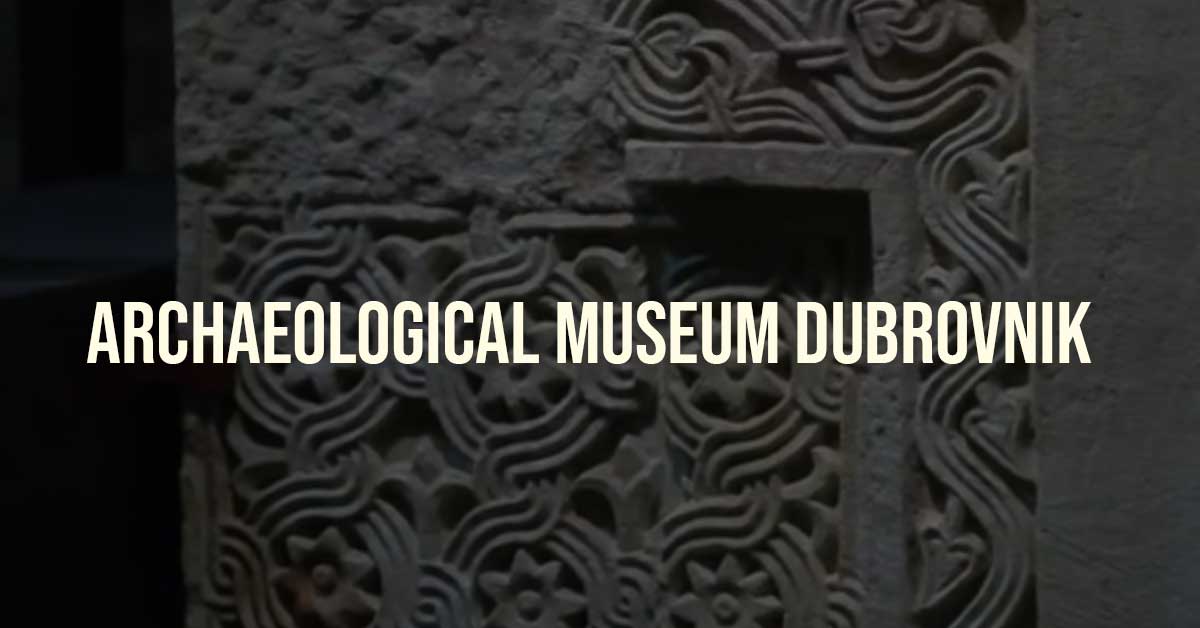
If the Maritime Museum tells the story of how Dubrovnik became a medieval commercial power, the Archaeological Museum Dubrovnik tells the story of what came before. It reveals centuries of history buried beneath the marble streets and stone walls, civilizations that lived and died in this location long before the Republic of Ragusa existed. Walk into the Archaeological Museum and you encounter tangible evidence that Dubrovnik’s location at the crossroads of Mediterranean trade was recognized as valuable by Greeks, Romans and Illyrians centuries before medieval merchants built their trading republic.
The Archaeological Museum occupies Revel Palace on Računa Street in the Old Town and contains one of the most important collections of ancient Adriatic artifacts in the region. The collection spans from prehistoric times through the medieval period, but the strongest emphasis falls on Greek and Roman material, reflecting the centuries when this area was part of first Greek colonial networks and then the Roman Empire.
This guide explores what the Archaeological Museum contains, why these artifacts matter and what they tell us about how the location of modern Dubrovnik was valued and utilized by ancient civilizations. Understanding this pre-medieval history deepens appreciation for how Dubrovnik inherited a location already recognized for centuries as strategically and economically significant.
To balance the focus on ruins and ancient artefacts with the stories of ordinary people, you can also visit the Ethnographic Museum Dubrovnik, which showcases traditional costumes, tools and textiles from Dalmatian communities.
Table of Contents
Origins and Development of the Archaeological Museum Dubrovnik
The Archaeological Museum was founded in 1872 as part of the Patriotic Museum (Museo Patrio), the same institution that eventually spawned the Maritime and Natural History museums. From its beginning, the museum collected artifacts that citizens found or excavated in Dubrovnik and surrounding areas. Early collectors and scholars recognized that the region contained layers of archaeological significance that deserved systematic documentation.
Formal organization of the archaeological collection took decades. In 1949, the Yugoslav Academy of Sciences and Arts officially established the Archaeological Museum as a separate institution with curatorial oversight and scholarly mission. Since 1987, it has been part of the Dubrovnik Museums network, alongside the Maritime and Natural History museums.
The museum has occupied its current home in Revel Palace since the 1950s. The palace itself is an architectural treasure, a Renaissance building with graceful arches and carefully proportioned spaces that create an elegant environment for artifact display. The interior design of the museum balances aesthetic presentation with scholarly documentation, allowing visitors to both appreciate objects as works of art and understand their historical context through careful labeling and interpretation.
The collection has grown to contain approximately 3,000 artifacts spanning from prehistoric times through the medieval period. While this number is substantial, the museum exercises careful curatorial judgment about what is displayed versus what is stored in climate-controlled archives. The result is a focused exhibition that tells a coherent story rather than an overwhelming accumulation of fragments.
Greek and Hellenistic Artifacts at the Archaeological Museum Dubrovnik
The oldest and in many ways most fascinating exhibits at the Archaeological Museum are Greek. These objects document direct contact between Dubrovnik’s location and the Greek world, demonstrating that the harbor and surrounding territory were recognized as valuable centuries before medieval merchants discovered them.
Greek pottery from the 5th and 6th centuries BCE provides evidence of trade or settlement. These ceramic vessels were not casually discarded. They reached Dubrovnik deliberately, either carried by Greek traders or by locals who valued them enough to acquire them through commerce or contact. The pottery represents a form of material connection across the Mediterranean, suggesting that even in ancient times, Dubrovnik’s location made it a natural point of exchange between different maritime cultures.
Greek coins form another important component of the collection. These coins are not simply currency. They are historical documents. The marks stamped on them identify which city or kingdom issued them, providing evidence of economic networks and trade relationships. Finding Greek coins in Dubrovnik tells us that Greek merchants or Greek-influenced traders were conducting business at this location, valuing the harbor and local population as commercial partners.
Hellenistic artifacts from the period after Alexander the Great’s conquests show continued Greek influence in the region. The Hellenistic period (roughly 323–31 BCE) represents the final chapter of Greek cultural dominance before Roman expansion subordinated the Mediterranean to Roman political and economic systems. Hellenistic objects in the Dubrovnik collection suggest that this transition from Greek to Roman dominance happened gradually, with Greek cultural forms persisting even as political power shifted.
Roman Presence in the Archaeological Museum Dubrovnik: Glass & Coins
Roman artifacts dominate the Archaeological Museum’s collection, and for good reason. When Rome conquered the Adriatic region, Dubrovnik’s location immediately became valuable to Roman strategic and economic interests. The artifacts on display provide intimate glimpses into Roman daily life in the region.
Roman glass represents one of the most stunning exhibits. The museum holds a collection of glass vessels, oil lamps and decorative items that showcase the sophisticated glass-working technology Romans had developed. Glass production was expensive and technically demanding in the Roman period, making glass vessels luxury goods accessible primarily to wealthy and privileged people. The existence of Roman glass in Dubrovnik suggests that the settlement contained people of means, individuals who could afford luxury items. This in turn suggests that Dubrovnik was not a marginal settlement but a place of sufficient importance and prosperity that wealthy Romans chose to live there or trade there.
Roman coins provide clear evidence of when Romans were present and which emperors were actively ruling. Coins are inherently datable. A coin stamped with the image of Emperor Augustus tells us that at some point during Augustus’s reign (27 BCE – 14 CE), that coin circulated in Dubrovnik. Finding multiple coins from different periods shows continuous Roman presence spanning centuries.
Everyday objects reveal how Romans lived. Pottery vessels used for cooking, storing food and serving meals show the practical concerns of daily life. Fragments of roof tiles reveal construction techniques. Metal tools and implements show what kinds of work people did. Jewelry and decorative items suggest personal adornment and aesthetic concerns. Together, these objects create a picture of ordinary Roman existence at this location on the Adriatic coast.
Medieval Artifacts at the Archaeological Museum Dubrovnik
The museum transitions from Roman artifacts into medieval materials, documenting how the settlement evolved from a Roman trading post into the medieval city that would eventually become the powerful Republic of Ragusa. This transition was not instantaneous. The “Dark Ages” in the Mediterranean involved real decline, population loss and disruption of Roman administrative systems. Yet archaeological evidence shows that settlement at Dubrovnik continued through these centuries, suggesting the location’s inherent advantages (a protected harbor, defensible position, access to trade routes) made it valuable enough to persist even when broader Mediterranean civilization was contracting.
Medieval pottery, coins, architectural elements and religious artifacts show how the settlement developed its medieval character. Objects become increasingly “recognizably medieval” – pottery styles change, coin designs reflect medieval rulers rather than Roman emperors, religious artifacts become more prominent, reflecting the Christianization that occurred in this region.
These medieval artifacts essentially bridge the gap between Roman Dubrovnik and the medieval Republic of Ragusa, showing that what we know as medieval Dubrovnik was built upon centuries of prior occupation. The site was never abandoned. Instead, it was continuously inhabited and continuously valued, passed from Roman hands to Slavic settlers to the medieval rulers who eventually established the Republican government.
Special Collections and Exhibitions of the Archaeological Museum Dubrovnik
Beyond the permanent collection, the Archaeological Museum occasionally hosts special exhibitions highlighting particular themes or recently discovered artifacts. These temporary exhibitions change seasonally or annually, giving reasons to visit multiple times and providing fresh perspectives on the collection.
The museum’s approach to presentation emphasizes scholarly rigor without sacrificing accessibility. Labels provide information in both Croatian and English, making the collection understandable to international visitors. Objects are displayed in chronological order, allowing visitors to move through history as they move through the gallery. Display cases use lighting and arrangement to emphasize important pieces while providing context for less visually dramatic but historically significant artifacts.
What the Archaeological Museum Dubrovnik Reveals About History
The Archaeological Museum teaches a broader lesson about how history works. It demonstrates that the borders and cities we see on modern maps often have roots extending centuries or millennia into the past. Dubrovnik’s location, strategically positioned at the Mediterranean crossroads, was valuable to Greeks, Romans and Slavic settlers before medieval merchants recognized its potential. Understanding this longer history provides context for the medieval story that dominates Dubrovnik’s tourist narrative.
The collection also reveals how civilizations transition and change. The gradual shift from Greek to Roman artifacts, then from Roman to medieval materials, shows that historical change typically occurs gradually rather than abruptly. The same location served different peoples and different economic systems across centuries, adapted to the needs and capabilities of each successive civilization.
Practical Information for Visiting the Archaeological Museum Dubrovnik
Location: Revel Palace on Računa Street in Dubrovnik’s Old Town. The museum is located near the eastern side of the Old Town, not far from the Cathedral and Sponza Palace.
Summer Hours (April 1 – October 31): Daily 9 AM – 6 PM.
Winter Hours (November 1 – March 31): 9 AM – 4 PM, closed Wednesdays.
Admission: Approximately 6–10 euros for adults. Dubrovnik Pass offers discounts or bundled access to multiple museums.
Time Required: 45–60 minutes for most visitors.
Accessibility: Stairs and uneven floors limit wheelchair access, though the palace is relatively compact.
Nearby Attractions: Cathedral, Sponza Palace, Franciscan Monastery and city walls are all within short walking distance.
FAQ – Archaeological Museum Dubrovnik
Why should I visit the Archaeological Museum when Dubrovnik has so many medieval attractions?
The Archaeological Museum provides essential context showing that Dubrovnik’s location was valuable long before medieval merchants built their republic. Understanding the Greek, Roman and early medieval layers of history deepens appreciation for why Dubrovnik became successful. The city inherited a strategically important location already recognized for centuries.
What is the most impressive artifact in the collection?
The Roman glass collection is consistently highlighted as exceptional, showcasing sophisticated glass-working technology and suggesting that wealthy people lived in Roman Dubrovnik. The collection of Greek and Roman coins is also compelling, providing direct evidence of trade connections and historical dating.
Is the museum suitable for children?
Yes, children often enjoy examining ancient coins, glass and jewelry, which are visually interesting and connect to tangible understanding of history. The museum is not enormous, so it does not overwhelm younger visitors with scale and complexity.
How does the Archaeological Museum compare to the other Dubrovnik museums?
The Maritime Museum focuses on commercial history from the medieval period onward, the Natural History Museum documents Adriatic wildlife, while the Archaeological Museum reveals the pre-medieval foundation upon which Dubrovnik was built. Together, they provide a comprehensive view of Dubrovnik’s history across different dimensions.
What languages are the exhibits documented in?
Documentation appears in both Croatian and English, making the museum accessible to international visitors without Croatian language knowledge.
Can I visit the Archaeological Museum as part of a quick museum tour?
Yes. At 45–60 minutes, the Archaeological Museum fits efficiently into a broader Dubrovnik exploration alongside the Maritime Museum and visits to medieval sites like the Cathedral or Franciscan Monastery.
Our Most Popular Tours To Sarajevo
We offer many tours that include a visit to Sarajevo and its most popular locations:
- Full Day tour from Sarajevo to Belgrade (Most Popular)
- Full Day tour from Sarajevo to Međugorije & Mostar
- Full Day Tour from Sarajevo to Travnik and Jajce
- Full-Day 5 Cities Tour from Sarajevo to Herzegovina (Mostar)
- Full day Tour from Sarajevo to Dubrovnik (Kotor or Split)
Don’t Hesitate To Say Hi!
Got any questions about our tours or the city? Don’t hesitate to contact us anytime for more info and booking.
Use the following phone number and email: