
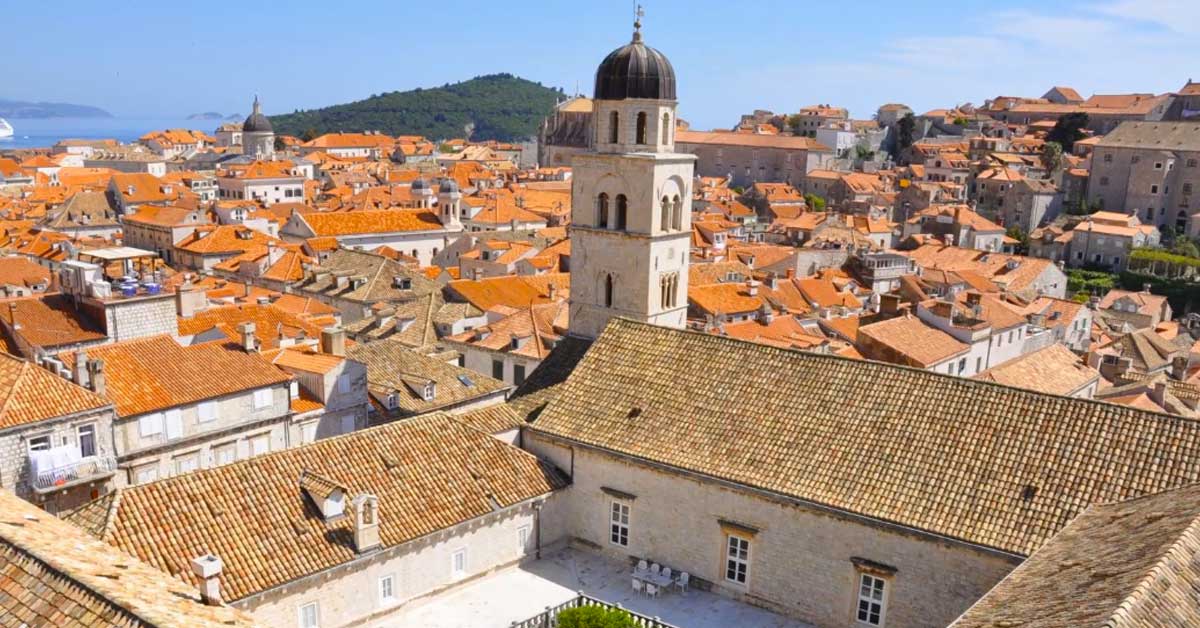
When you first glimpse the Franciscan Monastery in Dubrovnik from the street level, what strikes you is how the building seems to have grown organically from the medieval city itself, as if the stone walls and arches emerged directly from the limestone landscape rather than being consciously built. Yet as soon as you step through the entrance and into the cloister, you understand that this is not organic growth. This is a carefully designed spiritual sanctuary built with intentional geometry and artistic precision. The Franciscan Monastery represents nearly seven centuries of continuous religious, intellectual and medical practice, making it one of the most historically significant monastic institutions in the Mediterranean.
The monastery is often overshadowed by more famous attractions like the Cathedral or the City Walls, but knowledgeable visitors and scholars consider it equally important, if not more so, for understanding medieval Dubrovnik. This is where the city’s spiritual life centered. This is where scholarly learning was preserved and developed. Most remarkably, this is home to the oldest continuously operating pharmacy in Europe, a institution that has dispensed medicines continuously since 1317 across more than seven centuries of history.
This guide explores the history of Franciscan Monastery, explains its architectural and spiritual significance and tells you what you will encounter when you visit. You will learn why medieval Dubrovnik invested such resources into establishing and maintaining this religious community, understand the artistic treasures housed within its walls and discover how a medieval monastery evolved to meet the needs of a growing commercial city.
The monastery is often overshadowed by more famous attractions like the Cathedral or the City Walls, but knowledgeable visitors and scholars consider it equally important, if not more so, for understanding medieval Dubrovnik. This is where the city’s spiritual life centred. This is where scholarly learning was preserved and developed. Most remarkably, this is home to the oldest continuously operating pharmacy in Europe, a institution that has dispensed medicines continuously since 1317 across more than seven centuries of history. Complement your monastery visit with our Top 5 things to do in Dubrovnik.
Table of Contents
Origins of the Franciscan Monastery Dubrovnik: Arrival and Community
The Franciscan order arrived in Dubrovnik in 1272, during the early period of the order’s expansion across Europe. The Franciscans, founded by Francis of Assisi in the early 13th century, represented a radical departure from traditional monastic life. Instead of withdrawing from the world into isolated contemplation, Franciscans actively engaged with urban communities, established schools, provided medical services and participated in intellectual life. They were known as the friars minor, the “little brothers,” and embodied a spirituality based on humility, service and commitment to the poor.
The Dubrovnik authorities, eager to establish the city as a sophisticated cultural and spiritual center, actively recruited the Franciscans. The presence of an intellectual religious order enhanced Dubrovnik’s prestige. More practically, Franciscans provided education, medical services and spiritual guidance that a growing commercial city required. The initial settlement was modest, but support grew quickly.
By 1317, the monastery was sufficiently established that the Franciscans created the pharmacy, known in Latin as the Apothecaria or Aromatica. This was not an invention unique to Dubrovnik, but the continuous operation of Dubrovnik’s pharmacy for over 700 years is remarkable. Most medieval pharmacies either disappeared, were relocated or ceased operations during wars, plagues or political upheaval. The Dubrovnik Franciscan Pharmacy continued uninterrupted, making it the oldest continuously operating pharmacy in Europe. Some sources claim it is the oldest in the world, though a few other institutions in the Middle East and Asia also claim similar antiquity.
The pharmacy originated as a service to the poor and ill. Franciscan theology emphasized care for the vulnerable. Monks with knowledge of herbs and their medicinal properties created medicines and distributed them to those who could not afford commercial apothecaries. Over time, the pharmacy became more sophisticated, documented in detailed records that have survived centuries. These records provide invaluable information about medieval medicine, the herbs and compounds used to treat illness and the costs of medicines in the medieval economy.
Architectural Development of the Franciscan Monastery Dubrovnik: Cloister, Church and Community Space
The physical structure of Franciscan Monastery developed gradually over centuries, with major construction phases occurring after the devastating 1667 earthquake. The main entrance from the street leads directly into one of the most architecturally significant features, the cloister, a covered walkway that surrounds a central open garden. This cloister is a masterpiece of Dubrovnik Baroque architecture, built to replace the medieval structure that was damaged in the earthquake.
The cloister arcade consists of rounded Baroque arches supported by columns, creating a rhythmic visual pattern that guides the eye around the rectangular perimeter. The arches are not excessively ornate. They emphasize proportion and clarity. The effect is meditative rather than overwhelming. Walking around the cloister, you experience the interplay of light and shadow, open air and sheltered passage, creating a space that feels both contemplative and connected to the active life of the monastery.
The cloister garden at the center is carefully planted with Mediterranean vegetation including orange and lemon trees, herbs and flowering plants. These are not random decorations. Monastic gardens served practical functions. Herbs were grown for medicinal use in the pharmacy. Fruits and vegetables provided food. The garden also served spiritual purposes, representing the Garden of Eden in Christian theology and offering a space for peaceful reflection. The presence of fountains and the sound of water added to the serene atmosphere.
The church attached to the monastery is a Gothic structure that required massive restoration after the 1667 earthquake and again after damage sustained during the 1991 war. The interior is relatively simple compared to the Cathedral or Rector’s Palace, reflecting Franciscan theology that rejected excessive ornamentation. But the simplicity is sophisticated, with carefully balanced proportions and refined artistic details. The altar area contains important paintings and sculptures. The wooden choir stalls where monks sat during services are intricately carved with religious imagery.
Multiple attached structures surrounding the cloister served specific functions. The refectory, where monks gathered for meals, is a large hall with high ceilings. One monk would read aloud during meals while others listened, a practice intended to nourish both body and spirit. The library, containing medieval manuscripts and books, housed the community’s intellectual resources. Dormitory cells where individual monks slept were simple but adequate. The pharmacy itself occupied dedicated space with specialized storage for medicinal compounds, dried herbs and other pharmaceutical materials.
The Pharmacy at Franciscan Monastery Dubrovnik: Medieval Medicine and Uninterrupted Operation
The Franciscan Pharmacy at Dubrovnik Monastery represents perhaps the most unusual historical achievement of the institution. Operating continuously since 1317, it survived the great earthquake of 1667, multiple wars, the transition from the Venetian Republic to the Ottoman Empire and finally to modern statehood. Only brief closure during the 1991-1995 war interrupted this remarkable continuity, after which it reopened and continues operating today.
The pharmacy operated under monastic supervision for centuries. Franciscan friars with knowledge of herbs, minerals and other medicinal substances prepared medicines for patients who came seeking treatment. The pharmacy maintained detailed records of what was sold, to whom and at what cost. These records, preserved in the monastery archives, provide extraordinary documentation of medieval medicine and disease.
Reading through the pharmacy records reveals fascinating details about medieval Dubrovnik society. They show which diseases were most common and costly to treat. Gout appears frequently, suggesting high-protein diets among the wealthy. Skin diseases and infections are constant. Digestive problems are common. Some medicines listed in the records contained ingredients that modern pharmaceutical research has confirmed contain genuine medicinal compounds. Others relied on beliefs that lack scientific basis, but the intention was always to help the sick.
The pharmacy was expensive for most people. A dose of medicine might cost as much as a laborer earned in a day. This meant that while the pharmacy provided service to the poor with financial assistance from the monastery’s charitable budget, many medicines were expensive luxuries. Wealthy merchants and nobles purchased the finest preparations. The monastery balanced charitable provision with commercial operations that helped fund their broader activities.
What makes the Dubrovnik pharmacy unique historically is not that it served medical functions. Many medieval monasteries included medical facilities. What is remarkable is that this specific pharmacy continued operation for more than 700 years in the same location with continuous institutional memory. The knowledge of how to compound medicines, which formulas worked and which were ineffective, passed from one generation of Franciscan pharmacists to the next. When modern pharmaceutical science emerged in the 19th and 20th centuries, the pharmacy gradually adopted modern medicines and methods while maintaining its historical identity.
Today, the pharmacy operates as both a functioning apothecary shop and a museum. You can purchase modern medicines and herbal remedies while also examining the preserved medieval pharmacy with its original wooden cabinets, ceramic jars labeled with Latin names of compounds and historical documents describing medieval medical practice. This combination of living history and preserved tradition is unique. You do not simply observe history. You encounter it operating continuously into the present.
Art and Treasures within the Franciscan Monastery Dubrovnik
Franciscan Monastery houses significant artworks that rival in importance what you find in other Dubrovnik churches. The collection developed over centuries as the monastery received donations from wealthy patrons and accumulated works as part of its religious mission. The paintings and sculptures are not grouped in a separate gallery but remain in their original religious contexts throughout the monastery spaces.
The most celebrated artwork is the large polyptych, a multi-panel painting, attributed to Nikola Bozidarevic and dating to the 15th century. The painting depicts religious figures and scenes important to Franciscan spirituality. The composition, coloring and artistic technique demonstrate the sophistication of medieval Dubrovnik artistic traditions. The work is displayed in the church sanctuary where it functioned as originally intended, focusing the attention of worshippers during religious services.
Other significant paintings include works by Petar Mattei, a Dubrovnik painter who created religious artwork in the 16th and 17th centuries. His works often depicted saints and biblical scenes, and several are preserved in the monastery. Crucifixion scenes appear multiple times throughout the monastery, reflecting the centrality of Christ’s sacrifice to Franciscan theology. Mary, the mother of Jesus, appears in numerous paintings, particularly in scenes of the Assumption, her bodily elevation to heaven according to Christian tradition.
The library contains medieval manuscripts of incalculable scholarly value. These documents include biblical texts, theological commentaries and practical monastic regulations. Some manuscripts date to the 13th and 14th centuries, making them among the oldest surviving written documents from Dubrovnik. The manuscripts are carefully preserved and only scholars with specific research needs are typically permitted access, but some holdings are occasionally displayed in exhibitions or photographed for academic research.
The cloister garden, while not strictly “art” in the traditional sense, is designed as an aesthetic experience. The arrangement of plants, the placement of fountains and the circulation paths through the garden were carefully planned to create visual harmony and promote spiritual contemplation. Monastic gardens were understood as outdoor rooms designed with the same intentionality that medieval craftspeople applied to architecture or painting.
Medieval Intellectual Life at Franciscan Monastery Dubrovnik: Learning and Teaching
Beyond its spiritual and medical functions, Franciscan Monastery was a center of learning in medieval Dubrovnik. The Franciscans maintained a school where boys received education in Latin, theology, basic mathematics and other subjects deemed essential for an educated person. This school served the broader Dubrovnik community, not only those who intended to become monks. Sons of wealthy merchants attended alongside those destined for religious life.
The monastery maintained contact with other Franciscan institutions across Europe, creating an intellectual network where ideas, books and scholarly developments circulated. Dubrovnik’s monks were not isolated from European intellectual movements. They received new theological works from Rome and elsewhere, participated in debates about religious interpretation and contributed to ongoing scholarly discussions about faith and reason.
The preservation of manuscripts in the monastery library exemplifies this intellectual function. Medieval monasteries served as repositories of knowledge at a time when books were extremely expensive and most people could not read. The monastery library preserved classical texts, theological commentaries and practical knowledge that might otherwise have been lost. This was understood as a sacred duty. Knowledge itself was considered a gift from God, and preserving and transmitting knowledge was part of the monastic vocation.
The scholastic approach of medieval Dubrovnik Franciscans followed the broader European intellectual tradition of attempting to reconcile faith and reason. This was not a narrow fundamentalist approach that rejected intellectual inquiry. Rather, Franciscan scholars sought to understand how human reason could illuminate divine truth without contradicting revealed faith. This balanced approach influenced educated laypeople in Dubrovnik who consulted monks for advice on intellectual questions.
War and Restoration History of the Franciscan Monastery Dubrovnik
The 1667 earthquake caused severe damage to the monastery, destroying much of the medieval structure. The subsequent reconstruction created what you see today, a building that combines Baroque new construction with preserved fragments of medieval elements. This mixing of styles and eras is typical of post-earthquake Dubrovnik, where practical necessity to rebuild quickly sometimes meant preserving what could be saved while adding new elements.
The monastery did not escape damage during the 1991 war when Dubrovnik came under bombardment. Shell fragments struck walls, windows were blown out and interior spaces were damaged. The monastery’s cloister, relatively exposed to the surrounding terrain, sustained visible damage. However, the massive walls protected the most valuable interior spaces and artworks. After the war, careful restoration returned the building to functional status, with repairs following historical documentation to ensure authenticity.
The visible scars from the war, like those on other Dubrovnik monuments, remain deliberately visible. A few stones show shrapnel marks. Some areas of new stone repair are slightly different in color from the original medieval fabric, visible if you examine carefully. These marks serve as physical reminders that this building, like Dubrovnik itself, endured destruction and recovered.
The monastery remains an active religious community today. A small number of Franciscan friars live there, following the Rule of Saint Francis as their medieval predecessors did. The church continues to function as a place of worship. Services are held regularly, and visitors are welcome to attend if they wish. This living spiritual continuity, spanning back seven centuries, is perhaps the most remarkable aspect of the monastery.
Visiting Franciscan Monastery Dubrovnik: Practical Information and What to Expect
The Franciscan Monastery entrance is located on Stradun, near the western end of the main street close to the Pile Gate. The entrance is marked and obvious, with a large wooden door opening to a passage that leads into the cloister. Admission is approximately seven to nine euros, which provides access to the cloister, church, museum areas and the pharmacy.
Plan to spend approximately 45 minutes to an hour for a thorough visit. This allows time to walk around the cloister, examine the church interior, view the artworks and explore the pharmacy museum. You can move more quickly if time is limited, but the space rewards slow contemplation.
The cloister is the main attraction for most visitors. Walking around the arcade provides perspective on monastic life and offers peaceful refuge from the crowded streets outside. The central garden is particularly appealing in spring and summer when flowers are blooming. The architectural harmony of the Baroque arches creates numerous excellent photography opportunities, especially with light and shadow interplay.
The pharmacy museum displays original medieval pharmaceutical equipment and documents. Staff provide context about how medieval medicine operated and how the pharmacy functioned continuously for over 700 years. The operating pharmacy sells herbal teas, salves and modern medicines, allowing visitors to participate in a tradition that extends back centuries.
The church interior is quiet and reverent. If you attend a service during your visit, you experience the monastery as a living religious community rather than simply as a historical site. The simplicity of Franciscan architecture becomes more apparent when you see people actually engaged in worship rather than simply viewing the space.
Respectful behavior is essential. This is an active monastery and sacred religious space. Dress modestly, keep voices low and avoid distracting others who may be praying or meditating. Photography is usually permitted but without flash, which protects artworks from light damage.
FAQ – Franciscan Monastery Dubrovnik Frequently Asked Questions
When did the Franciscan order arrive in Dubrovnik?
The Franciscans arrived in 1272 during the early expansion of the order across Europe. The monastery developed gradually over subsequent centuries with major additions after the 1667 earthquake.
When was the pharmacy established?
The pharmacy was officially established in 1317, making it one of the oldest continuously operating pharmacies in Europe. It has remained in operation at the same location for over 700 years.
Is the pharmacy still operating today?
Yes, absolutely. The pharmacy functions as both a historical museum and a functioning apothecary selling modern medicines and herbal remedies. This combination of living history and preserved tradition is unique.
What caused the damage to the monastery in 1667?
The catastrophic earthquake of April 6, 1667 destroyed much of the medieval monastery structure. The subsequent Baroque reconstruction created the building you see today, mixing preserved medieval elements with new Baroque additions.
What is the most significant artwork in the monastery?
The large polyptych attributed to Nikola Božidarević dating to the 15th century is among the most celebrated artworks. Multiple Crucifixion scenes and paintings by Petar Mattei are also important.
Did the monastery have a school?
Yes, the Franciscans maintained a school where sons of wealthy merchants and those destined for religious life received education in Latin, theology and other subjects considered essential for an educated person.
Our Most Popular Tours To Sarajevo
We offer many tours that include a visit to Sarajevo and its most popular locations:
- Full Day tour from Sarajevo to Belgrade (Most Popular)
- Full Day tour from Sarajevo to Međugorije & Mostar
- Full Day Tour from Sarajevo to Travnik and Jajce
- Full-Day 5 Cities Tour from Sarajevo to Herzegovina (Mostar)
- Full day Tour from Sarajevo to Dubrovnik (Kotor or Split)
Don’t Hesitate To Say Hi!
Got any questions about our tours or the city? Don’t hesitate to contact us anytime for more info and booking.
Use the following phone number and email: