
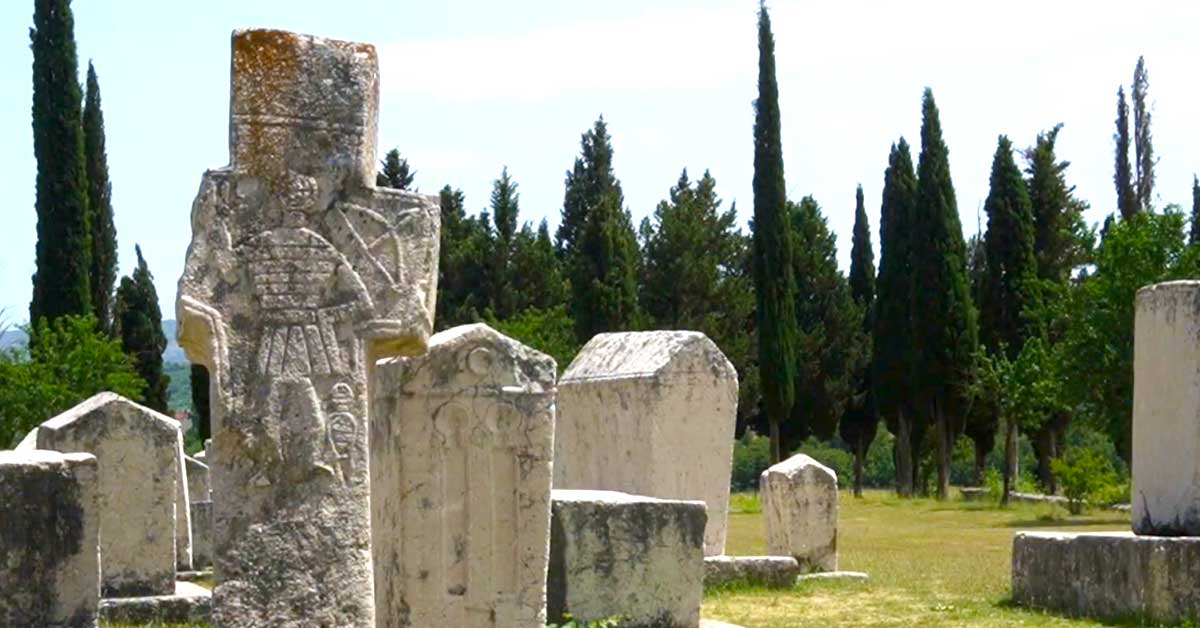
When you stand at Radimlja Necropolis for the first time, something unexpected happens. You do not feel like you are visiting a cemetery. Instead, you feel like you have stepped into a frozen moment of history, where 130 white limestone monuments arranged in the Vidovo polje field hold conversations with a civilization that stopped speaking centuries ago. These are stećak tombstones, and Radimlja is not just any collection of medieval grave markers. It is one of the most important archaeological and cultural treasures of Bosnia and Herzegovina, a UNESCO World Heritage Site, and a physical connection to a world that disappeared when the Ottoman conquest reshaped the Balkans.
If you are traveling to Herzegovina and asking yourself what Radimlja Necropolis is and why you should care, this guide answers both questions. You will discover the history embedded in limestone, understand why these stones matter to modern Bosnia, learn what to expect when you visit and develop an appreciation for why medieval people invested so much effort and artistry into marking their dead.
Table of Contents
What Is Radimlja Necropolis and Where Is It Located?
Radimlja is a necropolis, which means a large cemetery or burial ground, located in Vidovo polje field, approximately three kilometers west of Stolac in southeastern Herzegovina. Stolac itself sits about an hour south of Mostar on the road toward the coast. The site is positioned directly along the modern road that connects Stolac and Čapljina, which means you can literally drive past and stop at a clearly marked entrance.
The necropolis contains approximately 133 stećak tombstones, though historical records suggest the original site held around 150 before some were destroyed during early 20th century road construction through the area. The stones are arranged in their original orientation, running roughly northwest to southeast, following a pattern that aligns with both medieval burial customs and the geological direction of the Dinarides mountains that dominate the region.
What strikes most visitors immediately is the appearance of the site itself. The white limestone monuments create an almost ethereal landscape that seems to float in the field. They are not uniform. Some are simple flat stones. Others are carved with intricate reliefs. A few are taller, more elaborate structures. Together, they create a visual texture that changes dramatically depending on light and time of day. Early morning light creates deep shadows in the carved details. Late afternoon sun turns the limestone almost golden. Even overcast days bring out the subtle variations in stone color and carving quality.
Radimlja is surrounded by cypress trees on its southeastern boundary and bordered by the Radimlja River on its western and southern sides. This geography is not accidental. Medieval people understood landscape symbolism. Water and trees held spiritual meaning. The site feels intentionally placed, not randomly scattered.
History Behind Radimlja Necropolis: Understanding Stećak Tombstones
To understand Radimlja, you first need to understand stećak tombstones. The word stećak comes from the older word stojećak, which roughly means “something that stands.” Stećci are monumental carved grave markers that appeared across the medieval Balkans, reaching their peak artistic and cultural prominence between the 12th and 16th centuries.
What makes stećci unique is their combination of practical function and artistic ambition. They served as grave markers, yes, but they also functioned as public art, family monuments, advertisements of status and expressions of religious and cultural identity. Unlike many medieval grave markers that attempted to be humble and understated, stećci were deliberately prominent and often elaborately decorated.
Historical records suggest that approximately 60,000 stećci originally existed across Bosnia and Herzegovina, with an additional 10,000 scattered across neighboring regions of Croatia, Montenegro and Serbia. Most are now in poor condition, broken or eroded by centuries of weather and human disruption. But some sites, particularly Radimlja, preserve examples in remarkable condition, allowing us to see what medieval communities valued enough to spend time carving and decorating.
The stećci at Radimlja date primarily to the 15th and 16th centuries, with the earliest examples potentially reaching back to the 12th and 13th centuries. This timing is crucial. These stones were created during a fascinating historical moment when Bosnia and Herzegovina were transitioning from medieval kingdoms and noble family rule into the Ottoman period. The site itself is closely connected to the Miloradović-Stjepanović family, a noble Serbian Orthodox family from the genus Hrabren who held power in the region from the 14th century onward.
The founder, Milorad, lived in the second half of the 14th century as a Vlach chieftain, commanding warriors and controlling cattle. His descendants, particularly Petar and Vukić Stjepanović, were titled as voivodes and knezes, military commanders who successfully navigated the transition from independent medieval power to Ottoman integration. Historical documents mention Petar as first appearing in 1473 and last in 1486. Radoja Stjepanović died between 1475 and 1477. Vukić appears for the last time in 1496. The necropolis essentially marks the burial ground of this powerful family and their extended social network.
Art and Symbolism Carved at Radimlja Necropolis
Of the 133 stećci at Radimlja, 63 are decorated with carvings, making this one of the most richly ornamented necropolises in the entire region. The decorative techniques are relatively consistent. Artisans used shallow relief carving, meaning the designs do not project far from the stone surface but create dramatic visual effects through light and shadow.
The imagery tells stories about medieval life and beliefs. Male figures appear frequently, often shown with their right hand raised in a gesture that scholars interpret as greeting, blessing or authority. These figures typically have pronounced hands with large fingers, almost exaggerated in their size relative to the body. According to local interpretation, these raised hands symbolize hospitality and welcome, representing the character of Herzegovina’s people.
Beyond the male figures, the carved reliefs show hunting scenes with riders and animals. Battle tournaments and military processions appear on some stones, reflecting the martial culture of the noble families who commissioned these monuments. There are examples of heraldic symbols and religious imagery. Some stones include inscriptions with the names of those buried, dates and epitaphs. Five stećci at Radimlja carry inscriptions mentioning specific individuals including Radoje Miloradović, Radoje Vuković, Vukac Napetović and Vlađ Vlahović. The names of three stonemasons are also recorded, giving us rare insight into the craftspeople who created these monuments.
The decorative patterns themselves reveal the cultural synthesis happening at this historical moment. While stećci were used by Orthodox, Catholic and Bogumil populations, the symbols and decorative motifs suggest a blending of different religious and cultural traditions. This is part of what makes stećci historically important. They represent a moment when medieval Bosnia held multiple faiths and communities in rough equilibrium, each creating monuments that looked similar enough to suggest shared cultural values while containing enough variation to express distinct identities.
The Bogumils Connection to Radimlja Necropolis
A significant portion of stećci across Herzegovina were created by the Bogumils, a heretical Christian movement that flourished in medieval Bosnia. Understanding Bogumilism provides context for why Radimlja matters beyond just being a cemetery of old stones.
Bogumilism began in Bulgaria in the 10th century and gradually spread westward into Bosnia, where it became the dominant religious belief among significant portions of the population, particularly the nobility. Bogumils rejected many elements of both Catholic and Orthodox Christianity that they saw as corrupted by worldly power. They opposed the veneration of icons, rejected the idea that material structures like churches were necessary for faith and resisted the authority of both the Catholic and Orthodox hierarchies.
This made Bogumils extremely controversial. The Catholic Church considered them heretics. The Orthodox Church agreed. By the time the Ottomans arrived in the 15th century, many Bogumils had already been persecuted for centuries. Some scholars argue that the Ottoman conquest, paradoxically, offered Bogumils a form of religious freedom compared to what they faced from European Christian powers. Some Bogumil families converted to Islam. Others integrated into Orthodox communities. The tradition essentially disappeared by the 17th century.
Radimlja preserves evidence of this lost world. Some scholars argue that certain stećak designs and the very tradition of creating monumental tombstones reflect Bogumil beliefs and practices. The rejection of institutional religious authority and the emphasis on individual family commemoration aligned with Bogumil theology. Whether you accept this interpretation or not, Radimlja clearly marks a transition point in history. The stones you see represent a medieval world that no longer exists, preserved in limestone like insects in amber.
The Practical Experience: Visiting Radimlja Necropolis
From a practical perspective, visiting Radimlja is straightforward. The site is located three kilometers west of Stolac, directly along the main road connecting Stolac and Čapljina. Parking is available right at the site. The necropolis is open year round and free to enter, though donations support site maintenance.
The best time to visit is early morning or late afternoon. At midday, the sun is intense and the site offers minimal shade. Early light creates definition in the carved details. Late light creates atmosphere. The site is fully accessible to both pedestrian and vehicle traffic, though walking through allows you to approach individual stones and read any inscriptions.
Budget approximately 45 minutes to an hour for your visit if you want to look at the stones carefully and reflect on the history. You can rush through in 15 minutes if you prefer just seeing the overall collection. Individual stones reward close inspection. The carved details, the inscriptions, the variations in size and style all become clear only when you take time.
Bring water. Bring a hat or sunscreen. Bring a camera if you want photographs. The site is generally quiet even in summer, though you may encounter other visitors or tour groups. The field around the necropolis offers an excellent meditation space if you want to sit and absorb the atmosphere.
Radimlja pairs perfectly with other nearby attractions. Stolac itself is worth exploring for its Ottoman architecture, bazaars and churches. The neighboring Blagaj sits about 25 kilometers north and contains the Teqiah, a Dervish house built at the source of the Buna River. Mostar is about 60 kilometers north and includes the famous Stari Most bridge and Ottoman old town. If you are doing the organized tour from Sarajevo through Herzegovina, Radimlja can be added as a specific stop in addition to the standard itinerary, making it part of a comprehensive day of Herzegovinian history and culture.
Radimlja Necropolis in the Broader Context of Medieval Tombstone Traditions
While Radimlja is the most famous stećak necropolis in Herzegovina, it exists within a broader landscape of medieval tombstone sites. UNESCO recognized the cultural importance of stećci in 2016, inscribing approximately 4,000 individual monoliths grouped in necropolises at 28 locations across the Balkans onto the World Heritage List. Twenty of these sites are in Bosnia and Herzegovina, making the country the primary guardian of this cultural tradition.
Other significant stećak sites include Zgošća Stećak, which contains one of the most representative individual examples of stećak in terms of size, artistic processing and ornamentation. Stećak Bosanskih bogumila in Osenik offers another important collection. But Radimlja stands out for several reasons. It has the highest number of decorated stones relative to total stones. It has maintained relatively good condition despite centuries of exposure and early 20th century disruption. It has clear historical documentation connecting it to specific medieval families and individuals. And it occupies a visually striking landscape that makes the emotional and spiritual impact strong even for visitors with no deep historical knowledge.
The recognition by UNESCO reflects growing understanding that stećci represent a uniquely important medieval tradition that has no close parallel in other parts of Europe. These are not grand cathedral monuments created by wealthy institutions with armies of craftspeople. They are family monuments created by communities for their own members. They represent democratic access to monumental art in a way that medieval societies rarely achieved.
The Significance of Radimlja Necropolis for Modern Bosnia and Herzegovina
Today, Radimlja Necropolis carries significance that extends well beyond archaeology and history. The site represents a moment when Bosnia and Herzegovina contained religious and cultural diversity in relative equilibrium. Medieval Bosnia was never religiously uniform. Orthodox, Catholic and Bogumil populations coexisted. The stećci themselves represent this coexistence, using similar artistic forms while maintaining distinct identities.
For modern Bosnia, Radimlja offers something psychologically important. It provides evidence that diverse communities once lived together in this land and that sophisticated art and culture flourished under those conditions. After the conflicts of the 1990s when ethnic and religious identities became tools of division and violence, sites like Radimlja remind people that other models of coexistence are historically possible.
Radimlja was officially declared a National Monument of Bosnia and Herzegovina in 2002. The site is protected by law and surrounded by a buffer zone that prevents development. The decision reflected recognition that these stones contain knowledge and meaning that contemporary society needs to preserve and study.
FAQ – Radimlja Necropolis Frequently Asked Questions
What exactly are stećak tombstones?
Stećak are monumental medieval tombstones that served as grave markers, family monuments and public art across the medieval Balkans from the 12th to 16th centuries. They are carved from limestone and often decorated with reliefs, inscriptions and symbolic imagery.
Why is Radimlja Necropolis important?
Radimlja is one of the best preserved necropolises of stećak tombstones with 133 stones including 63 decorated examples. It is UNESCO protected, historically documented and represents a crucial moment in medieval Balkan history.
How old are the tombstones at Radimlja?
The majority date from the 15th and 16th centuries, though some examples may reach back to the 12th and 13th centuries. The site is approximately 500 to 900 years old.
What do the carvings on the stones mean?
The carvings represent medieval life and beliefs. Male figures with raised hands symbolize hospitality and authority. Hunting and battle scenes reflect the martial culture of the time. Religious symbols represent spiritual beliefs.
Who was buried at Radimlja?
Primarily members of the Miloradović-Stjepanović family, a powerful Serbian Orthodox noble family from the 14th to 16th centuries, along with members of their extended social networks and military followers.
How long does it take to visit Radimlja?
Budget 45 minutes to an hour for a meaningful visit where you examine individual stones and reflect on the history. You can see the site in 15 minutes if you prefer a quick visit.
Our Most Popular Tours To Sarajevo
We offer many tours that include a visit to Sarajevo and its most popular locations:
- Full Day tour from Sarajevo to Belgrade (Most Popular)
- Full Day tour from Sarajevo to Međugorije & Mostar
- Full Day Tour from Sarajevo to Travnik and Jajce
- Full-Day 5 Cities Tour from Sarajevo to Herzegovina (Mostar)
- Full day Tour from Sarajevo to Dubrovnik (Kotor or Split)
Don’t Hesitate To Say Hi!
Got any questions about our tours or the city? Don’t hesitate to contact us anytime for more info and booking.
Use the following phone number and email: