
Walk through Mostar’s labyrinth of narrow Kujundžiluk bazaar streets, the air thick with copper dust and centuries of commerce, and suddenly the crowds thin. You emerge into a small courtyard where a mosque stands impossibly perched on cliffs overhanging the Neretva River like a stone ship defying gravity. This is Koski Mehmed Pasha Mosque – one of Mostar’s most photographed and visited attractions, yet paradoxically one of the least understood. Most visitors come for the minaret climb and the Instagram views of Stari Most framed by stone arches. Few pause to contemplate the 400-year history embedded in these walls, the war damage that nearly destroyed them, or the Ottoman vision that positioned this sanctuary so magnificently above the Neretva’s emerald waters.
The mosque was constructed in 1618-1619 by Mehmed Koskija, a high-ranking Ottoman official who served as chronicler to the great vizier Lala Mehmed Sokolovic. Mehmed died before seeing his vision completed; his brother Mahmud finished the work, ensuring the family’s patronage transformed Mostar’s spiritual and architectural landscape. The timing matters historically – 1618 places Koski Mehmed Pasha Mosque in classical Ottoman architecture’s golden age, when the empire had perfected the balance between spiritual function and aesthetic beauty that defines the greatest mosques from Istanbul to Cairo. The architects designed it in Istanbul’s central imperial office, then sent plans to Mostar’s master builders, who translated classical Ottoman geometry into local limestone blocks extracted from Herzegovina’s abundant quarries.
For nearly 400 years, the mosque endured – earthquakes, Ottoman decline, Austro-Hungarian occupation, Yugoslav communism. Then came 1992-1995, when Mostar’s war transformed cultural heritage into battleground. Croatian forces deliberately targeted the mosque, understanding that destroying Islamic symbols would inflict psychological wounds beyond mere structural damage. The minaret was shattered, walls pockmarked by shrapnel, interior devastated, the spiritual heart ripped out. The destruction felt personal to Mostar’s Muslim community – not just a building damaged but identity attacked, continuity severed, centuries of meaning reduced to rubble.
Yet what emerged from painstaking 1996-2001 restoration is arguably more powerful than the original – a reborn mosque bearing visible scars transformed into testament of resilience. The restoration used original techniques where possible, rebuilt using limestone from the same quarries, recreated lost elements based on archival photographs. The result is authentic rebirth rather than sanitized reconstruction. Visitors today encounter genuine Ottoman architecture rebuilt stone-by-stone by hands determined to resurrect meaning from destruction.
Table of Contents
Classical Ottoman Architecture of Koski Mehmed Pasha Mosque
Koski Mehmed Pasha Mosque exemplifies classical Ottoman design stripped to essential perfection: a single domed space (rather than the sprawling multi-chambered layout of Istanbul’s largest mosques), supporting dome of harmonious proportions, windows precisely calculated to illuminate the interior with shifting light throughout the day. The square floor plan (approximately 15×15 meters) requires perfect geometric balance – the dome must seem to float weightlessly above, not crush the space below. Ottoman architects achieved this through centuries of mathematical refinement, understanding how dome height, window placement, and supporting columns create spaces where spiritual elevation feels architectural.
The exterior presents clean lines executed in precisely-fitted local limestone blocks laid with narrow mortar joints nearly invisible. Unlike ornamental later Ottoman styles emphasizing surface decoration, classical Ottoman architecture emphasizes structural honesty – the dome’s weight flows visibly through supporting walls and buttresses, creating exterior profile that reads as honest expression of interior function. The minaret rises 54 meters (slightly lower than Mostar’s Karadzoz Beg Mosque), simple cylindrical shaft with sherefe (balcony) featuring basic geometric carvings rather than the elaborate stalactite decoration common in larger monuments.
The porch features three domes supported by columns, creating transition space between profane street and sacred interior. This porch isn’t merely decorative – it serves essential ritual function, providing sheltered area for ablution (ritual washing) before prayer, for removing shoes, for psychological preparation entering sacred space. The hexagonal stone structure in the courtyard containing ritual purification fountains (shadirvan) exemplifies Ottoman attention to sacred geometries and water’s spiritual significance in Islamic tradition.
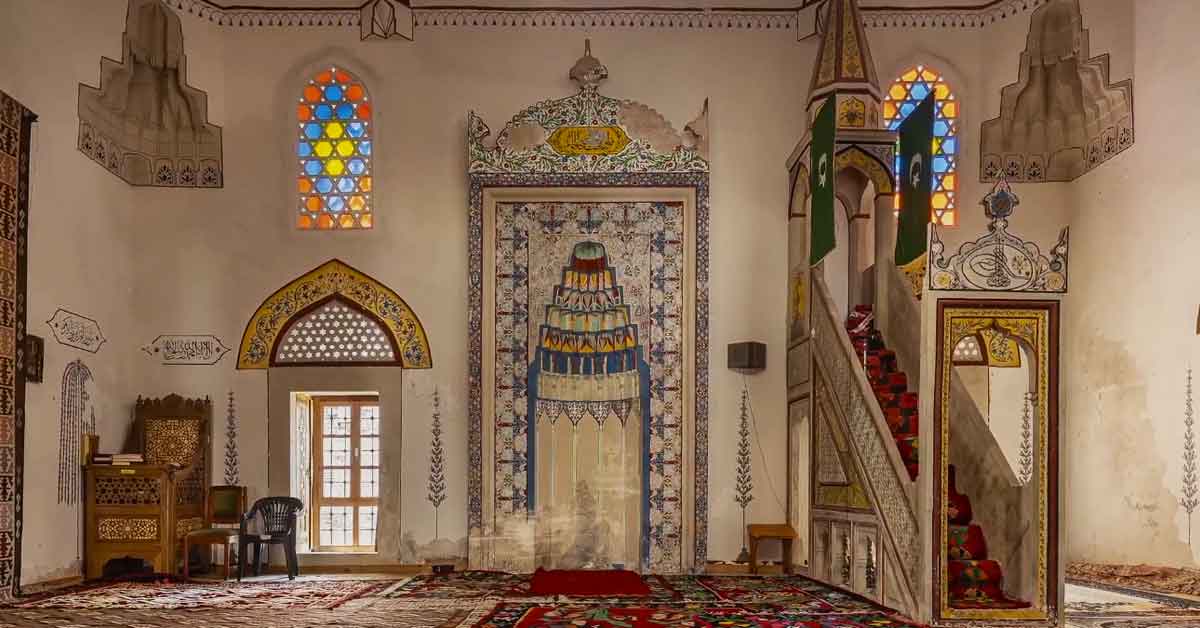
Interior decoration emphasizes spiritual focus rather than visual distraction. The mihrab (prayer niche indicating Mecca’s direction) features beautifully carved stone work guiding worshippers’ intent precisely toward Islam’s spiritual center. The minbar (pulpit stairs where the imam delivers sermons) displays intricate wooden craftsmanship – hand-carved rails, angled steps ascending toward elevated preaching platform positioned to address gathered worshippers. Carpets cover the floor in geometric patterns reflecting Islamic mathematical principles forbidding figurative representation. Calligraphy panels inscribe Quranic verses in flowing Arabic script, transforming walls into spiritual text.
Light matters profoundly in Koski Mehmed Pasha Mosque’s design. Windows positioned strategically cast dawn light across the prayer space, illuminating different sections at different times, creating dynamic sacred geometry reflecting daily cycles. The dome’s curved interior surface diffuses light evenly, preventing harsh shadows that would disrupt contemplation. Ottoman architects understood light’s spiritual power – how illumination can lift consciousness, how shadow can draw attention inward, how the interplay between light and dark structures time and prayer.
War, Destruction, and Resurrection of Koski Mehmed Pasha Mosque
The 1992-1995 Bosnian War targeted Koski Mehmed Pasha Mosque deliberately. In 1993, when Croatian forces controlled Mostar’s west bank, the mosque endured sustained bombardment. Photographs from that period show the minaret shattered into jagged stump, walls gouged by shrapnel, interior charred by fire. The destruction was comprehensive – whoever aimed shells at this mosque intended obliteration, not mere damage. Spiritually and psychologically, the targeting made clear: this community’s cultural identity faced erasure.
Yet the restoration process itself became act of resistance and healing. Local craftspeople, many themselves displaced by war, spent five years painstakingly reconstructing what shells destroyed. They matched stonework using period techniques, rebuilt the minaret according to archival documentation, restored interior decoration drawing on historical records and memory. The restoration wasn’t clinical historical recreation but emotional resurrection – community members rebuilding their spiritual home through personal effort, transforming trauma into determination.
Visiting today, you encounter visible scars transformed into meaning. The restored minaret, though reconstructed, bears witness to destruction survived. The patched stonework where shrapnel gouged walls becomes testimony to violence endured and overcome. Rather than sanitizing these marks, the restoration preserves them – visible reminder that heritage survived attack, that cultural continuity persists despite attempted erasure. Koski Mehmed Pasha Mosque stands as Mostar’s most powerful monument to resilience, its rebirth more eloquent than pristine preservation could ever be.
Climbing the Minaret at Koski Mehmed Pasha Mosque
The minaret climb represents Koski Mehmed Pasha Mosque’s most popular experience for visitors, and justifiably so. The approximately 90 steps spiral upward in tight concentric circles, ascending inside a cylindrical stone shaft where walls nearly touch – the space confines physically, demanding awareness of your body’s relationship to stone surrounding you. The staircase widens slightly midway, permitting a ledge where climbers can pause, breathe, gaze downward through apertures toward the courtyard below shrinking into miniature.
The ascent becomes meditative rhythm: step, turn, step, turn, hand trailing along worn stone polished by generations of hands. Modern climbers – photographers, tourists, curious souls – join centuries of muezzins (prayer callers) who climbed these steps five times daily to broadcast the adhan (call to prayer) across Mostar’s rooftops. The monotonous spiral creates trance-like state where individual consciousness expands beyond self, becoming aware of your insignificance within the mosque’s verticality, within Mostar’s setting, within Bosnia’s mountain landscape.
Emerging onto the sherefe (balcony) at the minaret’s crown, your perspective transforms instantaneously. Mostar spreads 360 degrees below: Stari Most framed perfectly in limestone arch, Kujundžiluk bazaar’s tangled streets, the Neretva River winding between cliffsides, the East Bank rising toward Orthodox areas, the West Bank’s Catholic church spires, surrounding mountains framing everything in natural embrace. The perspective from the minaret reveals Mostar’s true geography – the bridge’s strategic positioning, the river’s constraint, the mountains’ dominance. You understand viscerally why Mostar exists precisely here: the river forces narrowing, the bridge spans necessity, the town settles in constrained valley floor.
Photography from the minaret top is extraordinary – the bird’s-eye perspective of Stari Most, the converging lines of Old Town streets, the Neretva River’s emerald clarity, the crowd of tourists on the bridge appearing as anthill’s ant parade from this elevation. Many visitors spend 20-30 minutes aloft, varying apertures and focal lengths attempting to capture the vista’s scale. The crowds below on Stari Most remain unaware of observers above – the minaret becomes secret vantage point, providing participation without being seen, observation privilege rarely possible in tourism.
Descent demands caution – the spiral’s hypnotic repetition creates vertigo risk, the narrow width means you’ll encounter others coming up as you descend, requiring polite squeezing past in confined space. Locals joke about romantic couples colliding mid-staircase during minaret climbs – it’s a real hazard, lending adventure element to otherwise straightforward climb. The descent seems to take longer than ascent, as if descending consciousness expands while the spiral’s confines compress space psychologically.
Visiting Koski Mehmed Pasha Mosque – Practical Details for Respectful Encounter
Koski Mehmed Pasha Mosque remains active religious site, not museum or entertainment attraction. Prayer occurs five times daily (Fajr approximately 5-6 AM, Dhuhr around noon, Asr mid-afternoon, Maghrib sunset, Isha evening). The mosque closes during these prayer times for worshippers’ benefit. Plan visits outside these hours, or coordinate with the mosque staff who can sometimes accommodate visitors outside normal times if approached respectfully in advance.
Entrance Fee and Access: Admission costs approximately 15 KM (roughly 8 euros), payable at the courtyard entrance kiosk. The ticket permits mosque interior access, courtyard exploration, and garden viewing. Climbing the minaret incurs additional 10 KM (approximately 5 euros), for total access cost around 12-13 euros. Prices may fluctuate seasonally or based on restoration needs. Staff accept cash only – euros or local currency both work; card payment isn’t available.
Dress Code and Conduct: While the mosque accommodates non-Muslim visitors, respect demands appropriate dress. Women should wear headscarves covering hair – the mosque provides loaner scarves if you arrive uncovered, though bringing your own respects local custom better. Long pants or skirts covering knees are expected. Shoulders should be covered (t-shirts without jackets may cause comment, though not strict refusal). Men should wear long pants; sleeveless shirts are increasingly tolerated but long-sleeve shirts show greater respect. Shoes are removed entering the prayer space – you walk on carpeted floor in socks or bare feet.
Hours and Seasonal Variations: The mosque typically opens 9 AM to dusk, though these times shift seasonally as prayer times move with sunrise/sunset. Early morning visits (8-9 AM) encounter fewest crowds, offer best light for photography, provide peaceful atmosphere before tour groups arrive. Afternoon (3-5 PM) sees peak tourist flow. Evening visits (after 6 PM) provide sunset light and fewer crowds, though diminishing daylight affects minaret views.
Minaret Climbing Considerations: The 90-step ascent suits ages 8 and up generally, though fitness matters more than age. The narrow spiral and confined space challenge anyone experiencing claustrophobia or severe vertigo. People with significant knee/leg problems may find descending more difficult than ascending. Parents should assess children’s comfort with confined spaces and heights before committing. The climb requires 10-15 minutes ascent, 10-20 minutes aloft, 10-15 minutes descent – total approximately 45 minutes including queue time.
Photography Notes: The minaret offers exceptional perspective but challenging light during midday (harsh shadows, bright sky). Early morning or late afternoon light proves superior for photography. The narrow balcony accommodates approximately 3-4 people comfortably – crowding and queue times exist during peak hours. Wide-angle lenses capture expansive Mostar panoramas; telephoto lenses isolate architectural details of Stari Most and surrounding structures. Tripods don’t fit on the balcony; hand-held shooting necessary.
Islam in Mostar and the Role of Koski Mehmed Pasha Mosque
Visiting Koski Mehmed Pasha Mosque forces confrontation with complex religious and cultural questions. The mosque was deliberately destroyed in war targeting Muslim identity. Its restoration symbolizes community determination to persist culturally despite attempted erasure. Yet today, the mosque operates simultaneously as living religious site and tourist attraction – worshippers entering for genuine prayer encounter cameras and crowds seeking photo opportunities. This collision creates discomfort for many, yet it also represents genuine coexistence: different groups sharing sacred space with different intentions, negotiating mutual respect within shared geography.
The mosque’s reopening in 2001 represented symbolic return of Muslim Bosniaks to Mostar’s west bank, claiming presence in territory conquered militarily by Croats. The act of reconstruction was political – reasserting community identity through rebuilt heritage. Contemporary tourists visiting might not appreciate these undertones, experiencing only beautiful architecture and spectacular views. Yet the deeper story – of destruction as ethnic cleansing attempt, of reconstruction as resistance, of coexistence negotiated within post-war Mostar – remains embedded in these walls invisibly but powerfully.
Respectful visitation means acknowledging this complexity: understanding that your tourist experience occurs within contested space, that architectural appreciation carries political significance beyond aesthetic pleasure, that the mosque’s beauty emerges from trauma survived and determination persisting. The entrance fee supports ongoing maintenance – your payment contributes directly to sustaining this symbol of cultural survival.
FAQ – Koski Mehmed Pasha Mosque Questions
Is Koski Mehmed Pasha Mosque worth visiting beyond minaret views?
Yes, the mosque showcases exceptional classical Ottoman architecture revealing 17th-century imperial design principles. The visible war damage and restoration process tell Mostar’s trauma story more honestly than any museum could.
How does it compare to Karađoz Beg Mosque in Mostar?
Karađoz Beg (1557) is older with more elaborate minaret decoration; Koski Mehmed Pasha (1618) represents later classical style with superior Neretva views. Visit both if time permits – they’re 10 minutes apart.
How much time should I allocate for the mosque?
Minimum 45 minutes: 15 minutes minaret climb/descent, 20 minutes interior exploration, 10 minutes courtyard viewing. Photography enthusiasts should allocate 90 minutes total.
Can I visit both the mosque and Stari Most in one morning?
Absolutely – they’re adjacent. Realistic morning routing: 90 minutes mosque, 60 minutes Old Town exploring, 30 minutes bridge crossing – total 3 hours including café stops.
What was the war damage to the mosque?
The 1993 bombardment shattered the minaret into fragments, cratered walls with shrapnel, charred interior with fire. The damage was clearly intentional, targeting Muslim spiritual identity in religiously mixed city.
How does the mosque balance religious function and tourism?
The mosque maintains prayer schedules while welcoming non-Muslim visitors outside prayer hours – a negotiated coexistence reflecting post-war Mostar’s multicultural reality.
Our Most Popular Tours To Sarajevo
We offer many tours that include a visit to Sarajevo and its most popular locations:
- Full Day tour from Sarajevo to Belgrade (Most Popular)
- Full Day tour from Sarajevo to Međugorije & Mostar
- Full Day Tour from Sarajevo to Travnik and Jajce
- Full-Day 5 Cities Tour from Sarajevo to Herzegovina (Mostar)
- Full day Tour from Sarajevo to Dubrovnik (Kotor or Split)
Don’t Hesitate To Say Hi!
Got any questions about our tours or the city? Don’t hesitate to contact us anytime for more info and booking.
Use the following phone number and email: