
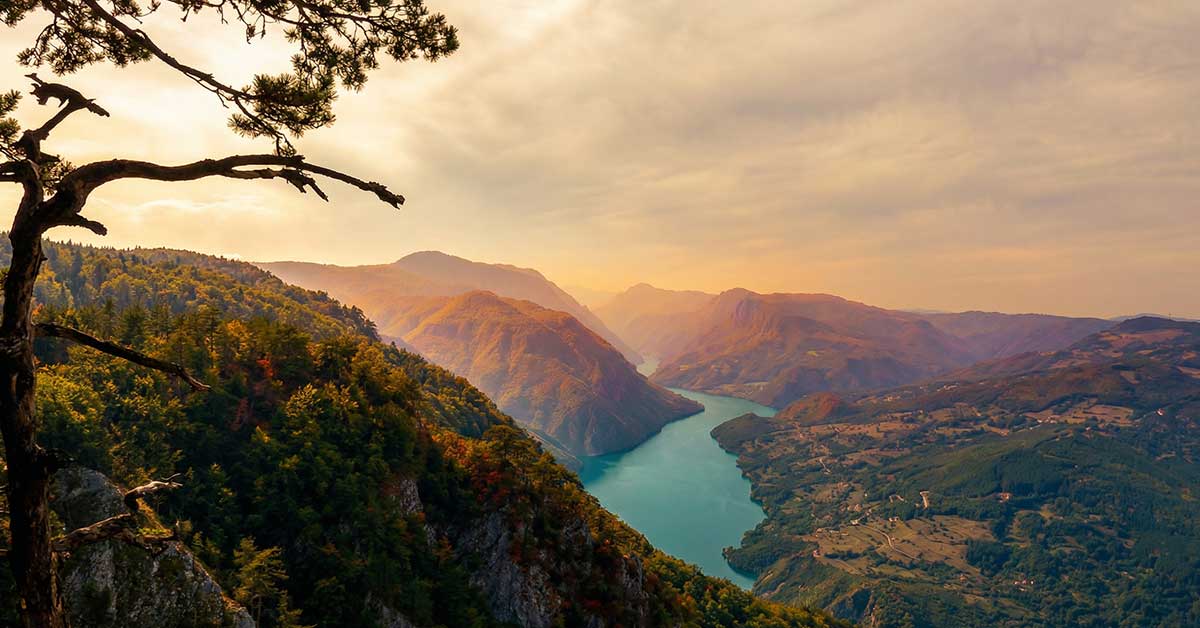
When you travel through Tara National Park or climb to the highest points of the mountain, you will surely hear about Kozja Stena – a viewpoint that looks as if it was built for those who want to see the last point before the sky begins. Kozja Stena is a viewpoint at an altitude of 1091 meters on Mount Tara in Serbia, a place where nature ends and where infinity begins – it is the highest point on Mount Tara that is accessible to the public, and it is a place where your stay makes you feel as if you are flying.
This is not just a viewpoint. Kozja Stena is an experience of the boundary between the earthly and the heavenly, between man and nature, between the edge of knowledge and infinity. The name “Kozja Stena” comes from legend – stories of goats that fed on steep slopes and that remained on this place as if guarding the summit’s secret. Kozja Stena is geographically positioned at a place where the Drina canyon is at its greatest depth and width, where the forest ends and where bare stone begins, where time seems to stand still because the sky is so close that you can touch it.
This is not a place for those in a hurry or those who need tourist centers with information. Kozja Stena is for those who want to experience nature in its purest form – where you have nothing but the peak, the sky, and the ability to see everything below. This is why Kozja Stena has become one of the strangest and least visited attractions in Tara National Park, a place that few tourists know about and even fewer people visit – which makes it perfect for those seeking peace and true nature without tourist crowds.
Table of Contents
What is Kozja Stena and Where is it Located
Kozja Stena is a natural viewpoint on Mount Tara located at an altitude of 1091 meters, which makes it the highest publicly accessible point in Tara National Park. It is located at a place where the forest ends and where alpine tundra begins – low, hardy plants that can survive at high altitudes where the wind is strong and where the temperature is often near freezing even in summer.
Geographically, Kozja Stena is located on the southwestern part of Tara, with a clear view of the Drina canyon that extends in all directions. From Kozja Stena, you see the Drina Valley more than 1000 meters deep, and on the other side you see mountains extending towards Montenegro and Bosnia. The viewpoint is completely isolated – there are no other structures, no restaurants, not even protection from the wind – just a viewpoint, nature, and infinity.
Access to Kozja Stena is through Tara National Park, usually from the entrance near Bajina Bašta or Užice. The route is a combination of an asphalt road to a certain point, then a macadam road, and finally a hiking trail of 3–5 kilometers which is steep and requires between 1–2 hours of hiking depending on physical condition. The trail is not officially marked except for a few signs – which means you can easily get lost if you don’t know where you’re going. It is recommended that you go with a local guide or that you have a GPS because the trail has several deteriorated sections.
Parking is available at the end of the macadam road, usually near the station where the trail begins. There is no parking guard service, which means parking is free but also unguarded. Physical accessibility is limited – only those who can hike a steep trail can reach Kozja Stena, which makes it inaccessible for people with mobility problems.
Kozja Stena is not protected as a special monument, but it is part of Tara National Park which is protected by Serbia. The location is known to locals and mountaineers, but is relatively unknown to the world public – which is probably because it is not promoted like Banjska Stena or other main attractions of Tara.
History of Kozja Stena from Ancient Times to Today
Kozja Stena as a geographical location has probably been known for thousands of years – local shepherds knew about it because it was a place where goats came to feed on high slopes. The name “Kozja Stena” (which means “Goat Stone” in English) comes from that heritage – a place where goats lived on almost impossible slopes because they are the only animals that can live on such steep terrain.
During the Ottoman period (16th–19th centuries), Kozja Stena was known as a hunting location – hunters knew they could reach it because the viewpoint allowed an overview of the entire valley. However, there was no official documentation or protection.
During the Austro-Hungarian period (1878–1918), Kozja Stena became known as a mountain location worth visiting. Several travelers and naturalists wrote about it as a “wild mountain where time seems to stand still.”
After World War II, Kozja Stena was part of an area that was protected as part of Tara’s wilderness. However, it was not systematically promoted as a tourist attraction until the 1990s when tourism began to develop in the park.
During the 1992–1995 war, Kozja Stena was not seriously damaged because it is located far from military action. The park was abandoned during the war, but Kozja Stena remained unchanged because few people knew about it.
In the early 2000s, the park was reactivated and locals and mountaineers began visiting Kozja Stena again. However, it never became a main tourist attraction like Banjska Stena or Lake Zaovine – which is probably good because it has remained pure, undamaged, and without tourist infrastructure.
Today, Kozja Stena remains a quiet, almost hidden place that few tourists know about and even fewer visit – which makes it a true gem for those seeking authentic nature without crowds.
Geology and Nature of Kozja Stena – Peak of Bare Stone
Kozja Stena is located at the top of Mount Tara where the forest ends and where alpine tundra begins. The stone at the top is limestone that is exposed directly to the sun and wind – which means it continuously erodes and reforms. Plants at the top are special types that can survive extreme conditions – low grasses, small shrubs, and lichens that have adapted to little water and lots of wind.
Wind: At a peak of 1091 meters, the wind can be very strong, even when it is completely calm at the bottom of the valley. The wind comes from the Atlantic and goes directly over the mountain without protection – which means the temperature is often 5–10 degrees colder than at the bottom.
Temperature: Even in summer, the temperature at the top can be 10–15 degrees Celsius, which is cold enough for those not prepared. In autumn and spring, the temperature can be near freezing, and in winter months, the peak is often covered with snow and ice.
Flora: Plants at the peak are adapted to extreme conditions – alpine grasses, mountain pine, and meadows that cover the stone. There are no large trees because the wind can easily break them.
Fauna: Animals that come to the peak are mostly mountain goats, wild sheep, and mountain birds. Sometimes you can see an eagle or falcon circling above the peak.
Viewpoints from Kozja Stena – A View into Infinity
When you stand on Kozja Stena, you see probably the most unique viewpoint from Tara – not just because of the altitude, but because you are on the edge of something that looks like it has no end.
- Towards the Drina River: The river is seen as an unimportant line below – so far that you don’t hear its sound, but you see where it is because the water reflects sunlight
- Towards Mount Mokra Gora: Another mountain with a railway line – but from this height it looks like a pencil line
- Towards Montenegro: If the day is good, you see mountains towards Montenegro that are soft and distant
- Towards Bosnia: On the other side, mountains extend towards Bosnia and Herzegovina
What is special is that Kozja Stena is probably the only point where you can see three countries at the same time – Serbia, Bosnia and Herzegovina, and Montenegro – if visibility is good enough.
The viewpoint is a strange reflection of weather – when it is gray and cloudy, it feels as if you are in clouds. When it is sunny, it feels as if the entire world is below you. When the wind is strong, it feels as if the wind could blow you off the peak – which is why you need to be careful near the edge.
Tourism at Kozja Stena – How to Visit
Kozja Stena is accessible to tourists throughout the year, but it is easiest to visit during summer months (June to September) when the weather is mild and the slope is dry. In winter, it is often inaccessible due to snow and ice.
Location:
- From Užice: 60–70 km towards Bajina Bašta, then towards Tara National Park
- From Bajina Bašta: 20–25 km towards the mountain center of Tara
- From Belgrade: 220–270 km – the drive is 5–6 hours
Access:
- Car to parking: near the beginning of the hiking trail
- Hiking trail: 3–5 kilometers, steep and requires 1–2 hours of hiking
- The trail is not officially marked except for a few signs – it is recommended that you go with a local guide
Price:
- Admission to Tara National Park: usually 3–5 EUR for adults (prices should be verified)
- Guides: if you use a guide, usually 40–60 EUR for a group
Best time to visit:
- June to September: weather is mild, trail is dry, visibility is good
- Spring (April–May): nature is in color, but the trail can be wet
- Autumn (October): nature is in color, but it starts getting cold
- Winter: inaccessible or very difficult to access
What to see:
- Kozja Stena itself – the viewpoint at the peak
- View of the Drina Valley
- Alpine tundra with low flora
- Mountains towards Bosnia, Montenegro, and the rest of Serbia
- Probably wild animals – goats, sheep, or birds
How to prepare:
GPS or a guide – the trail is not clearly marked and can be easily lost
Bring hiking boots with good grip – the trail is steep and can be slippery
Jacket or hoodie – wind and temperature at the peak are cold even in summer
Water and light food – there is no place for food at the peak, and hiking is strenuous
Sunscreen and sunglasses – sun reflects from the stone
Surroundings of Kozja Stena – Other Attractions on Tara
Banjska Stena is 5–10 km from Kozja Stena – another viewpoint that is easier to access.
Lake Zaovine is 15 km further – an artificial lake perfect for camping or walking along the shore.
Rajačke Caves are 20–25 km from Kozja Stena – caves with stalactites and stalagmites.
Šargan Eight Railway is 30–40 km from Kozja Stena – a famous railway with a steam locomotive.
One-day route: Morning – drive to Tara and the beginning of the trail. Afternoon – hiking to Kozja Stena (1–2 hours). Afternoon – sightseeing of the peak and return (1–2 hours). Evening – return home or camping on Tara.
Symbolism of Kozja Stena – Man at the Edge of Nature
Kozja Stena is a symbol of man’s insignificance before the magnitude of nature. When you stand on a peak of 1091 meters and look at everything below, you feel as if you are at the edge of the world – as if this is the last point before the sky begins.
For mountaineers, Kozja Stena is a symbol of challenge – not because it is difficult to reach (although it is), but because it invites body and soul to face yourself before the magnitude of nature.
For locals and those who live near Tara, Kozja Stena is part of their natural heritage – a place that their ancestors knew, a place that has been guarded as a secret from tourists.
For the world, Kozja Stena remains almost completely unknown – which is probably good because it has remained pure, undamaged, and without commercial infrastructure.
Practical Tips for Visiting Kozja Stena
Safety: Never go alone – the trail is dangerous and if you fall or get injured, help can be far away. Go with a guide or with a group of at least 2–3 people who know where they are going.
Wind: Wind at the peak can be very strong – be careful near the edge because wind can blow you off the peak.
Weather: If it is raining or if the weather is bad, postpone your visit – the trail is slippery and dangerous.
Physical fitness: This is not an easy walk – you need to be in good physical condition because hiking is steep and long.
Time: Average visit lasts 4–5 hours (including travel, hiking, and time at the peak).
Water: There is no water source on the trail – bring enough water with you.
Respect: Do not leave trash, respect nature, and respect signs that prohibit entry into certain parts of the park.
FAQ About Kozja Stena
Where is Kozja Stena?
Mount Tara in Serbia, at a peak of 1091 meters.
Is it accessible to tourists?
Yes, but it requires 1–2 hours of hiking to the top.
How difficult is it to reach?
Moderate to difficult – the trail is steep and not marked.
When is the best time to visit?
June to September – the weather is mild and the trail is dry.
Is it safe?
Yes, but you need to be careful near the edge and you need to know where you’re going.
Do I need a guide?
It is recommended because the trail is not clearly marked.
Our Most Popular Tours To Sarajevo
We offer many tours that include a visit to Sarajevo and its most popular locations:
- Full Day tour from Sarajevo to Belgrade (Most Popular)
- Full Day tour from Sarajevo to Međugorije & Mostar
- Full Day Tour from Sarajevo to Travnik and Jajce
- Full-Day 5 Cities Tour from Sarajevo to Herzegovina (Mostar)
- Full day Tour from Sarajevo to Dubrovnik (Kotor or Split)
Don’t Hesitate To Say Hi!
Got any questions about our tours or the city? Don’t hesitate to contact us anytime for more info and booking.
Use the following phone number and email: