
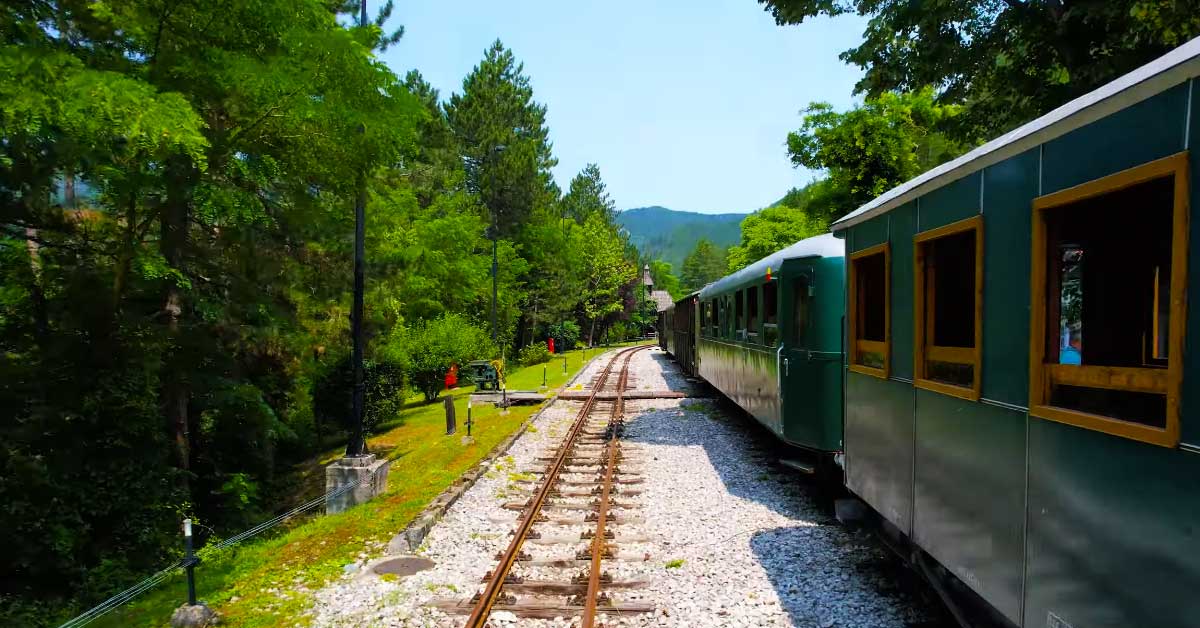
When you hear about Šargan Eight, most people think of something related to mathematics or codes – but it is one of the most peculiar railways in the world, built by a man who was a better engineer than he was known. Šargan Eight, also known as Šargan Eight Railway or Šarganska Osmica, is a narrow-gauge railway 15.6 kilometers long that winds through Mount Šargan at altitudes between 645 and 970 meters, making eighteen turns with spiral geometry that is a geometric wonder that tourists are only now beginning to understand.
This railway is not just a tourist attraction. It is a document of human perseverance, engineering genius, and love of detail – all combined in one project that took years, cost more than expected, and which today is one of the most renowned tourist attractions in the Balkans. Šargan Eight is located between the villages of Ivanjica and Užice in Serbia, at a place where Mount Šargan rises as a natural barrier that man decided to overcome with a railway instead of going around it.
This is not a place for those in a hurry or those who think railways are boring. Šargan Eight is for those who want to see how the history of technology was written on earth, how engineers faced impossible tasks and solved them with knowledge, passion, and sometimes just perseverance.
Table of Contents
What is Šargan Eight and Where is it Located
Šargan Eight is a narrow-gauge railway (760 mm, also known as “fool’s gauge” or “Bosnian gauge”) built between 1921 and 1925 as part of a larger railway system intended to connect the Balkans with the world. It is located on Mount Šargan, between Ivanjica and Užice in Serbia, at a place where the mountain topography changes dramatically – it is an area where forest, stone, and altitude combine in a way that makes access almost impossible if you use any transport other than rail.
Geographically, Šargan Eight begins at an altitude of 645 meters near the village of Ivanjica and ends at 970 meters near the village of Užice – which means it climbs more than 300 meters over a relatively short distance of 15.6 kilometers. This steep climb requires eighteen turns, most of which are in the form of spiral loops – which means the railway crosses itself several times in order to increase the length of the track and reduce the gradient to a level where a locomotive can pull it.
Access to Šargan Eight is on foot from the village of Ivanjica or by driving a personal car to the station – the road is paved and easily accessible. Parking is available near the station, free or with minimal charge (1–2 EUR). The railway is protected as a cultural monument by Serbia and is on the UNESCO list as “Great Railway Routes of the World” – a recognition that few railways in the world have.
History of Šargan Eight from Construction to Today
Šargan Eight was built between 1921 and 1925, during a period when the Kingdom of Serbs, Croats and Slovenes (later Yugoslavia) was trying to modernize its infrastructure after World War I. The railway was part of an ambitious plan for the Moravian Railway – a project intended to connect the interior of the Balkans with the coast and enable the transport of raw materials, especially timber from mountainous areas.
The engineer who designed Šargan Eight was Stevan Jovanović, a Serbian engineer known for his combination of mathematical precision and practical knowledge. Jovanović had to solve a problem: how to cover 15.6 kilometers with a gradient of over 50 per mille (which is almost at the limit of what an ancient railway can manage) without the locomotive getting exhausted or the cars derailing?
The answer was genius: spiral loops. Instead of going directly up the mountain, the railway curves in mathematical spirals where it passes under itself several times. These spirals are not random – they are calculated so that they enable a 1–1.5% gradient which is ideal for 760 mm gauge and ancient steam locomotives that were available at the time.
Construction lasted four years and cost more than budget-makers expected – but when it was completed, it became internationally recognized as an example of Serbian engineering knowledge. After the Austro-Hungarian period (1918–1945), the railway functioned for transporting timber and other raw materials. During World War II, the railway was damaged but never completely destroyed.
During the Cold War, the railway continued to function as an industrial railway – it transported coal from the Lazarevac mining areas and timber from the Šargan mountain. However, in the 1970s, the railway began to fall into disrepair because motorized transport proved more efficient and cheaper.
In 1990, the railway was almost completely closed – only investment from local communities and railway enthusiasts saved it from total decay. In the early 2000s, the railway was reactivated as a tourist attraction with a steam locomotive from 1926 that was restored and now takes tourists on a 15.6-kilometer route that takes about 3–4 hours.
When Šargan Eight was added to the UNESCO list as part of “World Railway Heritage,” it was a major recognition because it had been forgotten by most railways in the world.
Engineering Wonders of Šargan Eight – Mathematics in Stone and Steel
Šargan Eight is an engineering marvel because it solves a problem that seems impossible: how to build a mountain railway with a gradient that is too steep for standard railway technology.
A standard railway can have a gradient of up to about 3–4% before the locomotive begins to slip. However, Mount Šargan has a natural gradient of about 50% in the section where the railway is built. How can you then build a railway?
The answer is elegant: length. Instead of going directly up, the railway goes in spirals. Each spiral is a section that goes slowly up, then comes back, crosses over its own track (at different altitudes), and continues. The result is that 15.6 kilometers of physical length is used to overcome only a few kilometers of direct distance.
The mathematics are precise: Šargan Eight has 18 turns, 4 of which are spiral loops. The spiral loops are constructed so that the railway overlaps itself at least 4 places – which means that if you stand at a certain point and look up, you see railway tracks at several different altitudes, all part of the same railway.
Locomotives: The railway uses steam locomotives with 760 mm gauge – which means it is narrower than standard railway gauge of 1435 mm. Smaller gauge brings smaller radius of turns which is necessary for spirals. The locomotive is ancient – often it is locomotive no. 1 from 1926 or similar from that period – which means that those same locomotives have carried tourists and goods for 100 years.
Bridges: The railway crosses several bridges, of which Šargan Bridge is one of the most interesting – a small concrete bridge that crosses the Ibra River at a place where the railway descends. The bridge is a detail that shows how Jovanović thought about every aspect of the project.
Tourism at Šargan Eight – How to Visit
Šargan Eight is accessible to tourists almost every day during the season (April–October). Riding in a steam locomotive is one of the most solemn railway experiences in the Balkans.
Location:
- From Užice, travel towards Ivanjica – the road is clear and marked
- The station is near the village of Ivanjica – parking is available
- Alternatively, take a bus from Belgrade to Užice or Ivanjica, then taxi to the station
Alternatively, you can try buying tickets directly at the station ticket booth (a small stand at the entrance), though I wouldn’t recommend this on summer weekends. Even if the ticket booth is open, ticket sales start about half an hour before departure. The ticket costs 1200 Serbian dinars (around €10), and there are two trains per day.
Journey time:
- Ride with steam locomotive: 3–4 hours depending on stations where it stops
- Faster ride with motor train: 2–2.5 hours
- The railway usually runs three times daily during the season
Best time to visit:
- Spring (April–May): nature in color, temperature is mild, few tourists
- Autumn (September–October): leaves change colors, view is clear
- Summer: warm, but can be crowded and hot in the coach
- Winter: the railway operates regularly, but it is colder
What to see during the journey:
- Spiral loops – places where the railway crosses itself
- Viewpoints with a view of Mount Šargan
- Ibra River that weaves through the entire route
- Forest with local flora and fauna
- Šargan Bridge – symbolic bridge on the railway
- Šargan Vitasi Station – final station at 970 meters above sea level
How to prepare:
Window seats – if possible, reserve a seat with a view
Bring a jacket – it is colder at higher altitudes
Camera or phone – scenes are spectacular, especially during spiral loops
Water and light food – the journey is long and there is no serious food on the trains
Surroundings of Šargan Eight – Nearby Attractions
Tara National Park is only 15 km from Šargan Eight – one of the most beautiful parks in Serbia with viewpoints and hiking trails.
Užice, as the nearest city (20 km), offers the Užice Republic (museum of revolution), restaurants with traditional food, and proximity to larger cities.
Ivanjica, the starting station of the railway, is a small hilly town known for tea and medljika – local products used for health.
Drina Canyon is 30–40 km further – a place where the Drina is most beautiful and where many other attractions are located such as The Bridge on the Drina, Dobrun Monastery, and Drina River House.
One-day route: Morning – Šargan Eight journey (3–4 hours). Afternoon – lunch in Ivanjica or Užice. Afternoon – Tara National Park or walking through Užice. Evening – return to Belgrade or sleep in Užice.
Symbolism of Šargan Eight – Man Against Nature
Šargan Eight is not just a railway. It is a symbol of human decision to deal with the impossible. Mount Šargan was a natural obstacle – its 50% gradient was so steep that it seemed that a bridge was impossible. However, engineer Stevan Jovanović did not say “it is impossible” – he said “I must think differently.”
The result is a railway that goes in spirals instead of directly up – which is proof that solutions to difficult problems often come when we refuse to see a problem the way others see it.
For tourists, Šargan Eight is an experience of traveling through time – riding in a steam locomotive takes you back 100 years, when travel was slow, solemn, and full of detail.
For locals, the railway is part of the identity of Ivanjica and Užice – each city contributed to railway development and economic growth that it brought.
Practical Tips for Visiting Šargan Eight
Reservations: In season (April–October), it is recommended that you book seats in advance – the railway is often full of tourists, especially on weekends.
Photography: The best angles are during spiral loops where the railway overlaps. Please don’t fall off the train for a photograph!
Physical fitness: The ride is not difficult, but if you have a problem with claustrophobia, sit near a window.
Time: The journey lasts 3–4 hours – bring enough water and something to eat.
Language: Guides usually speak Serbian and English – information will be available.
Safety: The railway is safe and professionally managed – you don’t need to worry about safety.
FAQ About Šargan Eight
Where is Šargan Eight?
Between Ivanjica and Užice in Serbia, on Mount Šargan.
How long is it?
15.6 kilometers with 18 turns.
How long does the journey take?
3–4 hours with a steam locomotive, 2–2.5 hours with a motor train.
How much does it cost?
Around €10.
Is it safe?
Yes, completely safe and professionally managed.
Our Most Popular Tours To Sarajevo
We offer many tours that include a visit to Sarajevo and its most popular locations:
- Full Day tour from Sarajevo to Belgrade (Most Popular)
- Full Day tour from Sarajevo to Međugorije & Mostar
- Full Day Tour from Sarajevo to Travnik and Jajce
- Full-Day 5 Cities Tour from Sarajevo to Herzegovina (Mostar)
- Full day Tour from Sarajevo to Dubrovnik (Kotor or Split)
Don’t Hesitate To Say Hi!
Got any questions about our tours or the city? Don’t hesitate to contact us anytime for more info and booking.
Use the following phone number and email: