
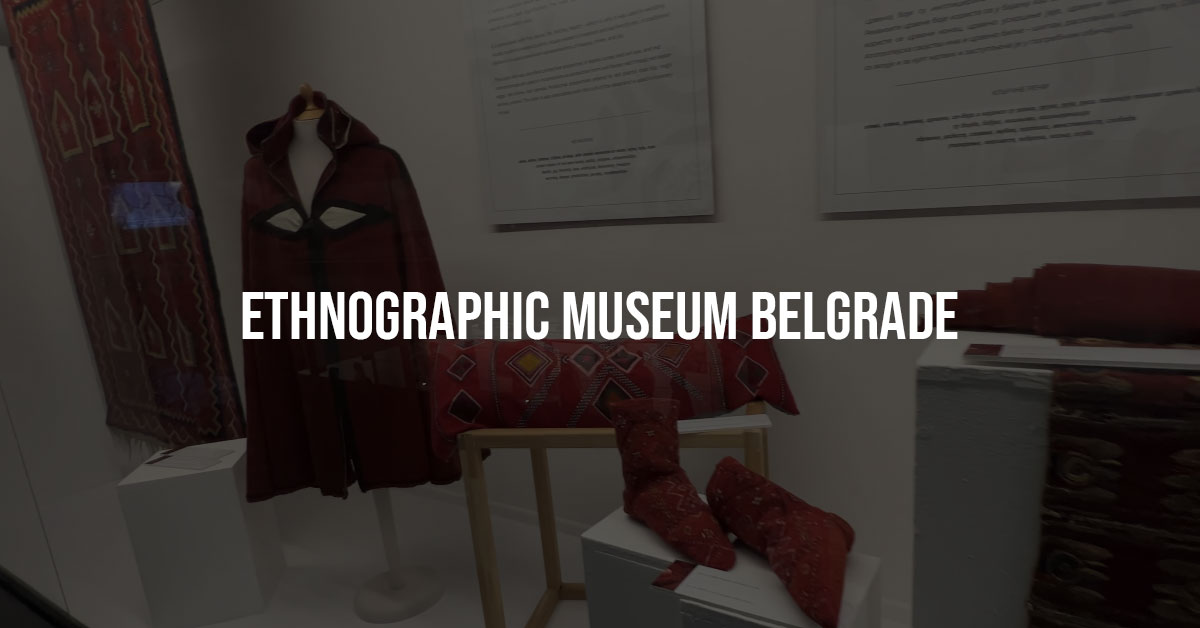
When you walk into the Ethnographic Museum Belgrade, you are not just entering a museum. You are stepping into someone else’s house, someone else’s yard, someone else’s everyday life from long ago. It is that feeling when your mind goes quiet and your eyes start “reading” the objects: embroidered sleeves, wooden spoons, woolen socks, hope chests, loom beams hanging low over the room.
Belgrade has plenty of museums, but this one has a soul. The Ethnographic Museum Belgrade is not just about folk costumes and carpets; it is a story about identity, about how people lived before electricity, Instagram and easy loans, and about how a community turns everyday life into something worth preserving for more than a century.
Table of Contents
What is the Ethnographic Museum Belgrade and where is it located
The Ethnographic Museum Belgrade is one of the oldest museums in the Balkans dedicated exclusively to folk culture, everyday life and customs of Serbs and other peoples from the former Yugoslavia. It was founded in 1901, when the ethnographic department was separated from the National Museum of Serbia in order to form a specialized institution for ethnology and anthropology.
The museum is located in the very city center, at Studentski Trg 13, in the building of the former Belgrade Stock Exchange, right next to the Faculty of Philosophy and Studentski Park. From Republic Square you reach it in a few minutes on foot, which makes it one of the most accessible cultural spots in Belgrade. The building is monumental, with a classicist facade, high windows and a wide staircase that clearly signals you are entering a place where heritage is taken seriously.
Today the museum’s collections number tens of thousands of items: original artifacts, photographs, films, books and archival material covering mostly the 19th and 20th centuries. In short, everything that made up the life of “ordinary people” before they became just a number in statistics or a generic silhouette in a history book.
The history of the Ethnographic Museum Belgrade and how it became a guardian of folk culture
The story of the Ethnographic Museum Belgrade began in the mid‑19th century, when the first ethnographic objects were informally collected within the National Museum of Serbia. As the collections grew and interest in folk culture increased, it became clear that a separate institution was needed. Officially, the museum was founded in 1901, and the first permanent exhibition opened in 1904, on the 100th anniversary of the First Serbian Uprising, as a symbolic link between national awakening and everyday life of the people.
Throughout the 20th century, the museum survived wars, regime changes and bombings. During both World Wars it suffered damage and loss of objects, but the core of the collections was protected and later renewed through fieldwork and new donations. After 1945, the museum gradually strengthened its scientific and educational role, cooperating with universities and cultural institutions across Yugoslavia. It moved into its current building on Studentski Trg between 1948 and 1951, gaining more exhibition space and better conditions for storing delicate materials such as textiles and paper.
On the centenary of its founding, in 2001, a new permanent exhibition was opened under the title “Folk Culture of Serbs in the 19th and 20th Century”, designed to show not just “what people wore and used”, but how geography, economy, religion and migration shaped everyday life. The museum has since become a key reference point for ethnological research in Serbia and a central place for presenting traditional culture to visitors from around the world.
What you can see in the Ethnographic Museum Belgrade
The permanent exhibition at the Ethnographic Museum Belgrade takes you on a journey from village to town, from log houses to urban salons, from rough homespun cloth to silk waistcoats. In the first rooms you find reconstructed interiors of traditional rural homes from different regions: hearths with soot‑blackened beams, simple wooden tables, low benches, chests filled with linens, tools for working the land, and objects for processing wool and flax. That is the part where you realise how physically demanding life once was, and at the same time how ingenious people were with limited resources.
Further along, the exhibition focuses on folk costumes, which for many visitors are the highlight of the museum. The Ethnographic Museum Belgrade holds one of the largest collections of traditional Serbian costumes, with thousands of complete outfits and individual garments from various regions such as Vojvodina, Šumadija, Kosovo, Herzegovina, Bosnia and Montenegro. Differences in cut, color and ornamentation are striking: somewhere thick black woolen skirts with red borders dominate, elsewhere white linen shirts with rich multicolored embroidery, and in some regions gold thread and heavy silver belts signal wealth and status.
The museum also preserves:
- a rich jewellery collection, including silver filigree, coin necklaces and wedding headpieces
- weapons and men’s accessories, such as decorated pistols, yataghans and ornate gunpowder flasks
- objects linked to rituals and customs – items used for baptisms, weddings, the Slava feast, agricultural holidays and calendar rites
- traditional musical instruments and documentation of dances and songs through photographs and audio‑visual material
Labels and thematic panels explain how people lived, what they ate, how they divided work between family members, how they celebrated important life events and how beliefs and superstitions intertwined with everyday routines. The exhibition is curated so that you move gradually from the material to the symbolic: first you see the object, then you learn what it meant.
How to plan your visit to the Ethnographic Museum Belgrade
From a logistical perspective, visiting the Ethnographic Museum Belgrade is very simple. Being at Studentski Trg 13, it is only a short walk away from Republic Square, Knez Mihailova Street and Kalemegdan Fortress. This makes it an excellent stop on any walking tour of central Belgrade.
According to the official website, the museum is generally open from 10:00 to 20:00, with Wednesday reserved for internal work and closed to visitors. However, opening hours can change on holidays or due to special events, so checking the latest info before your visit is always a good idea. Ticket prices are budget‑friendly, and there are discounts for students, children, pensioners as well as group visits. Some programs or specific days, such as certain Mondays, may offer free entry or free access to select exhibitions, which is especially attractive for families and school groups. There are non-guided tours to Manakova kuća (around €6) and to Otisak (around €5). Tickets are bought at museum shop or online on the official site of Ethnographic museum Belgrade.
How to get there easily:
- On foot from Republic Square or Knez Mihailova – walk through Knez Mihailova Street towards Kalemegdan, then turn to Studentski Park.
- By public transport – several tram and bus lines stop at Studentski Trg or close by, making it convenient from almost any part of the city center.
- By car – you can park in nearby streets, but keep in mind these are paid parking zones and finding a space during peak hours can be challenging.
For the visit itself you should plan at least 60 to 90 minutes for the permanent exhibition. If you enjoy reading detailed descriptions, or if you combine your visit with a temporary exhibition and a workshop, two hours will pass very quickly.
Special programs and workshops at the Ethnographic Museum Belgrade
One of the strongest features of the Ethnographic Museum Belgrade is that it does not keep tradition locked in display cases. Through special programs and workshops, the museum actively brings old skills back into people’s hands. A large part of this activity takes place in Manak’s House, a separate unit of the museum in Gavrila Principa Street, which itself is a protected cultural monument.
Workshops and courses include:
- traditional embroidery, where participants learn stitches and motifs preserved on old shirts, vests and aprons
- weaving on a loom, with authentic materials such as homespun cloth, wool, flax and hemp, under the guidance of experienced craftswomen
- courses and programs dedicated to intangible cultural heritage, organized in cooperation with the Centre for Intangible Cultural Heritage, where participants learn about rituals, songs and oral traditions recognised at national and international level
Participants often receive certificates from the museum, and their works may be displayed at joint exhibitions or used in educational programs. This approach means that the Ethnographic Museum Belgrade is not only a guardian of the past, but also an active workshop of living heritage.
For tourists, these workshops are one of the most authentic experiences in Belgrade, because they provide direct contact with techniques that are normally only seen behind glass. For locals, they are a chance to learn what previous generations once knew naturally – how to weave a belt, embroider a sleeve or set up a loom.
Why the Ethnographic Museum Belgrade still matters in a digital age
In a time when our lives are moving into the cloud, the Ethnographic Museum Belgrade reminds us that culture was created in hands, not just on screens. Every costume, every piece of embroidery, every wooden object is handmade, with hours, days and years of life behind it. When you stand in front of a richly decorated women’s costume, you are not looking at “one outfit”, but at hundreds of hours of patient work, passed from mother to daughter.
For visitors from abroad, the museum is an ideal filter through which they can see Serbia beyond clichés – not just barbecue, rakija and nightlife, but also stories of migrations, poverty, solidarity and the creativity of ordinary people. For people who live here, it is a reminder that “tradition” is not just a word used in tourism brochures, but a living fabric that can either be nurtured or slowly unravel.
The Ethnographic Museum Belgrade is quiet and unobtrusive, yet a very important guardian of identity. It shows that history is much more than dates and battles – it is the way we dress, how we celebrate, what we give each other, how we arrange our homes and how we transmit values to the next generation.
FAQ about visiting the Ethnographic Museum Belgrade
Where exactly is the Ethnographic Museum Belgrade located?
At Studentski Trg 13, in the very center of Belgrade, right next to Studentski Park and the Faculty of Philosophy. It is easy to reach on foot from Knez Mihailova Street.
What is the most interesting thing to see in the museum?
Most visitors are impressed by the traditional costumes from different parts of Serbia, reconstructed village houses and objects associated with customs such as the Slava feast and weddings.
How long does a visit to the Ethnographic Museum Belgrade take?
For a quick overview, around 60 minutes is enough. For a more detailed visit with reading the panels and exploring the temporary exhibitions, plan up to 2 hours.
Are there guided tours in English?
Yes. The museum offers guided tours in Serbian and English, and most labels in the halls are bilingual. For group guided tours it is best to book in advance.
Is the Ethnographic Museum Belgrade suitable for children?
Yes. Children usually react very well to reconstructed interiors, costumes and hands‑on workshops where they can touch and try things. The museum often organizes special programs and creative workshops for the youngest visitors.
Can I attend a workshop without speaking Serbian fluently?
Many workshops can be followed with basic English and a bit of visual learning, and staff are used to working with international guests. For specific programs, it is worth checking in advance whether an English‑speaking guide or translator can be provided.
Our Most Popular Tours To Sarajevo
We offer many tours that include a visit to Sarajevo and its most popular locations:
- Full Day tour from Sarajevo to Belgrade (Most Popular)
- Full Day tour from Sarajevo to Međugorije & Mostar
- Full Day Tour from Sarajevo to Travnik and Jajce
- Full-Day 5 Cities Tour from Sarajevo to Herzegovina (Mostar)
- Full day Tour from Sarajevo to Dubrovnik (Kotor or Split)
Don’t Hesitate To Say Hi!
Got any questions about our tours or the city? Don’t hesitate to contact us anytime for more info and booking.
Use the following phone number and email: