
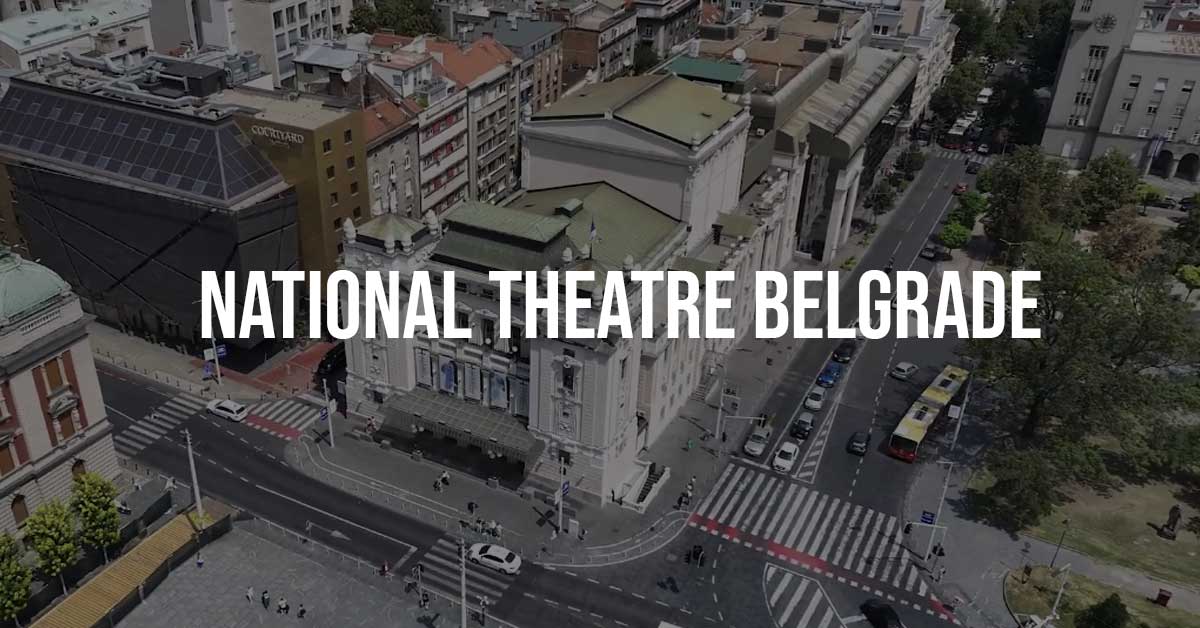
When you stand on Republic Square, your gaze probably first flies to the monument of Prince Mihailo, then to the crowds in Knez Mihailova Street. But right behind the bronze prince’s back stands a building that has been the heart and soul of Belgrade culture for over 150 years – the National Theatre.
Let’s be honest: many of us have prejudices. We think that the theatre is stiff, boring, too expensive, or reserved only for older gentlemen in bow ties and ladies with pearl necklaces who whisper “bravo” at weird moments. It is time to send that myth into history, where it belongs.
Visiting the National Theatre is probably the best “cheap” luxury activity you can afford in Belgrade. For the price of a better pizza or two cocktails in the city center, you can get an experience that is reserved for the elite in Milan, Vienna, or Paris – a grandiose opera, an elegant ballet, or a powerful drama that makes you rethink life.
This is not just a guide through the building and repertoire. This is a manual on how to experience something memorable for little money, how not to feel like a stranger in your own city, and how to understand why this institution is much more than just an ordinary building.
Table of Contents
The Turbulent History of the National Theatre
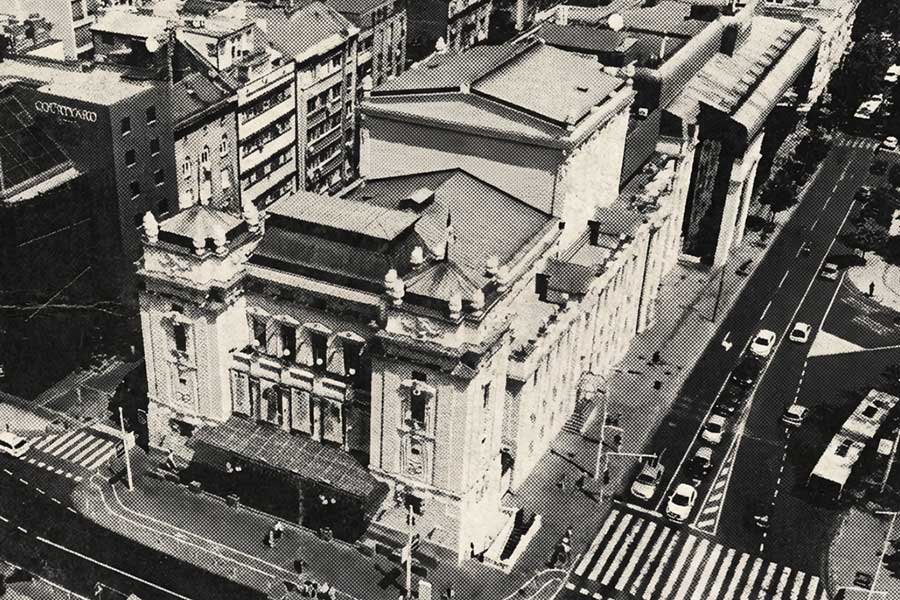
The story of the National Theatre is the story of Belgrade itself, full of dreams, ambition, destruction, and defiant rebirth. To understand its soul, we must go back to the 19th century. Imagine Belgrade then: still a somewhat oriental town struggling to shake off its Ottoman heritage, with muddy streets, but with a huge desire to become a true European capital.
The idea of a permanent theatre was pushed by none other than Jovan Sterija Popović back in the 1840s, but it took more than two decades for the dream to become reality. Prince Mihailo Obrenović, a man with a vision of Europeanizing Serbia, ordered its construction. The location was not chosen by chance, the theatre rises on the site of the former Stambol Gate, an infamous symbol of Turkish rule. Its demolition and the construction of a temple of culture on the same spot was a powerful symbolic message: The Orient is leaving, Europe is coming.
The building was designed by architect Aleksandar Bugarski, and the famous La Scala in Milan served as his model. This is still visible today in its neo-renaissance style and classic interior organization with lavish boxes arranged in a horseshoe shape. The first play, “The Posthumous Glory of Prince Mihailo,” was performed on October 30, 1869. Belgrade finally got its theatre.
But fate did not spare it. The building was heavily damaged in both World Wars. During the bombing on April 6, 1941, the entire rear part of the building was hit and almost destroyed. Despite the war, the theatre somehow functioned, showing incredible spirit and resilience. The last major reconstruction, completed in the late 1980s, gave it its current appearance, with the modern glass part facing the Square. That reconstruction was a drama in itself – it lasted for years and caused numerous controversies. Today, when you enter, you walk through all those layers of history. You feel the spirit of the 19th century – the heavy red plush, the gilding that discreetly shimmers, the massive chandeliers, and that special, thick silence of anticipation before the performance begins. It’s not just a building, it’s a living monument.
What’s on the “Menu” at the National Theatre Belgrade?
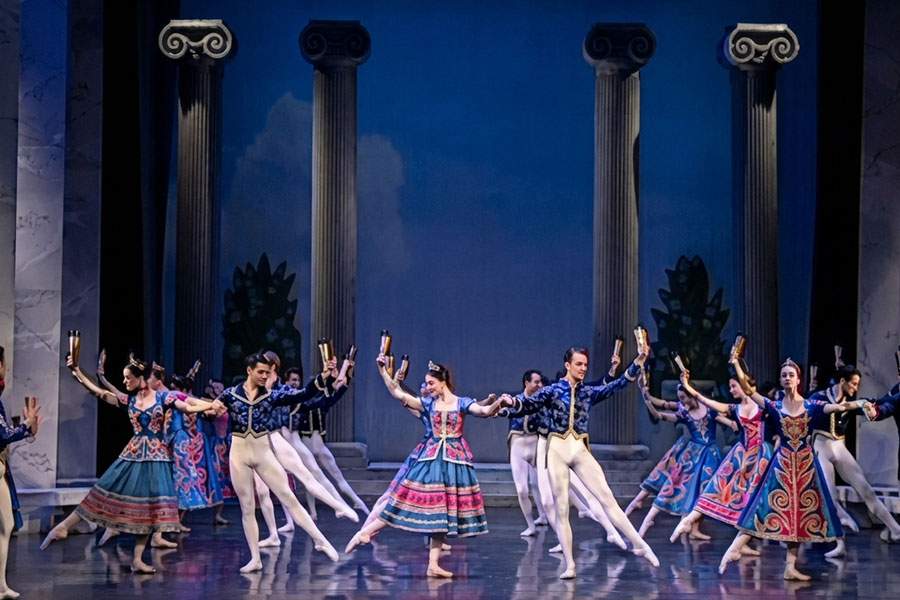
The National Theatre rests on three pillars: Opera, Ballet, and Drama. Each offers a completely different experience. Not sure what to choose? Here is a detailed “tasting menu.”
Opera: A Blockbuster for the Soul
If you have never been to an opera, forget the stereotype of a fat lady screaming and breaking glasses. Opera is like the most expensive Hollywood blockbuster, only everything is live and ten times more intense. The scenography is often monumental, with dozens of people on stage (choir, extras), costumes are lavish, and the power of the human voice accompanied by a live symphony orchestra gives you energy that no cinema 7.1 system can reproduce.
- For beginners: Start with the classics. Verdi’s “Aida” (a spectacle about love and war in ancient Egypt), Bizet’s “Carmen” (a passionate story about fatal love and jealousy), or Rossini’s “The Barber of Seville” (a hilarious comedy) are a sure bet.
- Don’t worry if you don’t understand the language: Above the stage, there is a large display with subtitles (translation) in Serbian and English, so you can follow the plot at any moment. Your only task is to surrender to the music and emotion.
Ballet: Athletics Disguised as Poetry
Ballet is not just for little girls in pink tutus. Watching classical ballet like “Swan Lake” or “The Nutcracker” live is pure athletics disguised as art. It’s like watching top athletes perform impossible moves with ease and grace, all while telling a story without a single spoken word. The strength of male ballet dancers lifting their partners as if they were feathers and the precision of ballerinas dancing on their tiptoes will leave you speechless. It is visual poetry that hits right in the emotions. Ideal if you want to impress someone without needing much talk – just surrender to the magic.
Drama: Stories That Bite and Make You Think
If you are more attracted to the power of the spoken word, the drama ensemble is your choice. The National Theatre nurtures classics of domestic and world literature but is not afraid of modern, provocative plays either. The theatre has two stages for drama: the Main Stage (for large, classical plays) and the smaller, more intimate “Raša Plaović” Stage (for chamber and experimental performances).
- Domestic classics: Plays like “The Cabinet Minister’s Wife” (Gospođa ministarka) by Branislav Nušić are always current, guarantee laughter to tears, and show that our mentality hasn’t changed in 100 years. On the other hand, heavy dramas like “Death and the Dervish” (Derviš i smrt) by Meša Selimović pull you into deep philosophical dilemmas about life, power, and faith.
- Drama is an excellent choice if you want to hear powerful text and see some of Serbia’s best actors in action, just a few meters away from you.
Your First Time Visiting the National Theatre Belgrade
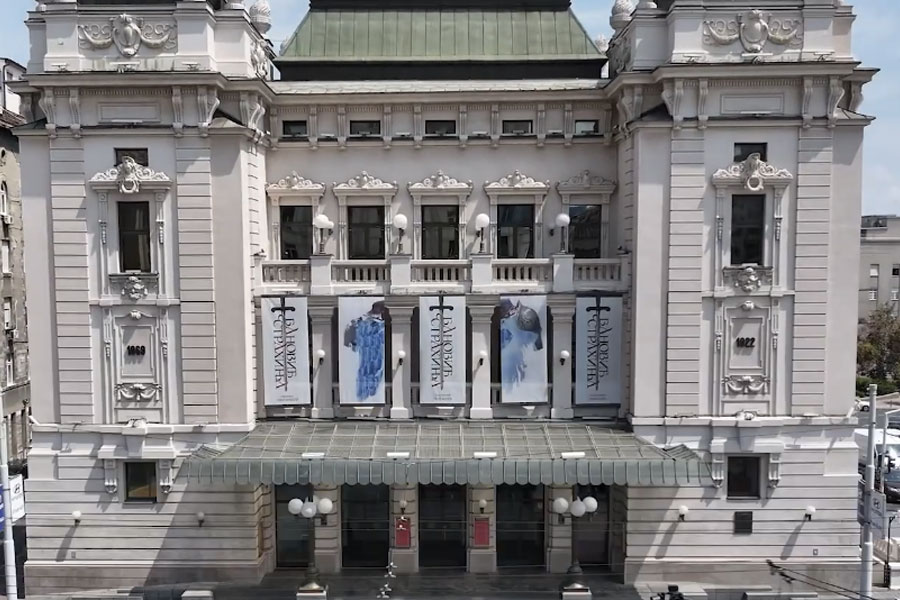
Ready to go, but feeling a slight nervousness about the unknown? Don’t worry, here is a detailed guide, step by step, so your first visit to the National Theatre Belgrade goes as smoothly as a ballet move.
The Art of Buying Tickets
- Online (easiest way): Visit the official website of the National Theatre. There you will find the repertoire for the whole month. Click on the play, and the seating plan will open. Seats are colored by price categories. Choose a seat that suits you, pay by card, and the ticket arrives in your email in PDF format. You don’t even have to print it, you can show it from your phone at the entrance.
- At the Box Office (for traditionalists): The theatre box office is located on the left side of the main entrance. It is open every day except Sunday (unless there is a performance then). Here you can also get a recommendation from the seller.
- PRO TIP: The repertoire for the next month usually comes out around the 15th of the current month. The best seats for popular operas and ballets sell out in a day or two. Be fast!
How Much Does This Pleasure Cost?
Here comes the best part. The prices are shockingly affordable.
- “Cheap” tickets (300 – 600 RSD): These are seats in the gallery (the highest level) or in the last rows of the parterre and balcony. Visibility might be partially reduced, but the acoustics are often excellent. For the price of a coffee and mineral water, you are in the National Theatre.
- Golden Middle (800 – 1,500 RSD): For this money, you get an excellent seat in the parterre (first level in front of the stage) or on the first balcony. Everything is perfectly seen and heard from here.
- Luxury Seats (over 2,000 RSD): These are seats in central boxes or the first rows of the parterre. Reserved for premieres, special occasions, or if you simply want royal treatment.
The Myth of “Dress Code”: What to Wear?
Forget about a black suit and evening gown as an obligation (unless it’s a premiere, then it’s desirable). For 99% of performances, the rule is “smart casual”. Think of it this way: dress as if you are going on a first date with someone you want to impress.
NO: Tracksuits, shorts, tank tops, slippers, flip-flops, sports sneakers, ripped jeans, caps.
The point is to show respect for the institution, the artists who have been preparing for months, and other visitors. You don’t have to be formal, just neat and polite.
YES: Shirt, trousers, blazer (not mandatory), sweater, dress, skirt. Clean and whole jeans (no rips) are perfectly acceptable if combined with something more elegant on top (e.g., shirt and blazer).
Where Exactly Is the National Theatre Belgrade and How to Get There?
The National Theatre Belgrade is the zero point of culture in the city. You literally cannot miss it. It is located at Francuska 3, but it is actually the dominant building on Republic Square, right next to the National Museum and the monument to Prince Mihailo.
- Arrival by public transport: This is the simplest option. Almost every important line leads here. Trolleybuses (28, 29, 41) stop at Studentski trg (a few minutes walk) or in Vasina Street. Buses 24, 26, 31, 37 stop at the Square itself or at the stop near Palace Albanija.
- Arrival by car (where to park?): The city center is a “twilight zone” for parking, but you have a solution. The nearest and largest public garage is “Obilićev venac”. From there to the theatre, you have exactly 3-4 minutes of easy walking through the pedestrian zone of Knez Mihailova. Another option is the parking lot near “Politika”, which is also close.
- On foot: If you are already in the center, everything is in the palm of your hand. The theatre is at the beginning of Knez Mihailova Street (or at the end, depending on where you look from), the epicenter of all events.
Behind the Scenes of the National Theatre Belgrade
What you see on stage is just the tip of the iceberg. Behind the heavy curtains of the National Theatre Belgrade hides an entire city, an army of people who make magic possible. In the workshops of the National Theatre, top masters work: carpenters who make scenography, tailors and costume designers who sew lavish dresses, wigmakers, prop masters… It is a dream factory.
Inside the building itself, there is also the Museum of the National Theatre. Most visitors don’t even know it exists. Costumes of legendary actors, old posters, personal items, and photographs testifying to the rich history are kept there. Visiting the museum is like peeking into the secret diary of the theatre and a perfect way to round off your experience.
Our Most Popular Tours To Sarajevo
We offer many tours that include a visit to Sarajevo and its most popular locations:
- Full Day tour from Sarajevo to Belgrade (Most Popular)
- Full Day tour from Sarajevo to Međugorije & Mostar
- Full Day Tour from Sarajevo to Travnik and Jajce
- Full-Day 5 Cities Tour from Sarajevo to Herzegovina (Mostar)
- Full day Tour from Sarajevo to Dubrovnik (Kotor or Split)
Don’t Hesitate To Say Hi!
Got any questions about our tours or the city? Don’t hesitate to contact us anytime for more info and booking.
Use the following phone number and email: