
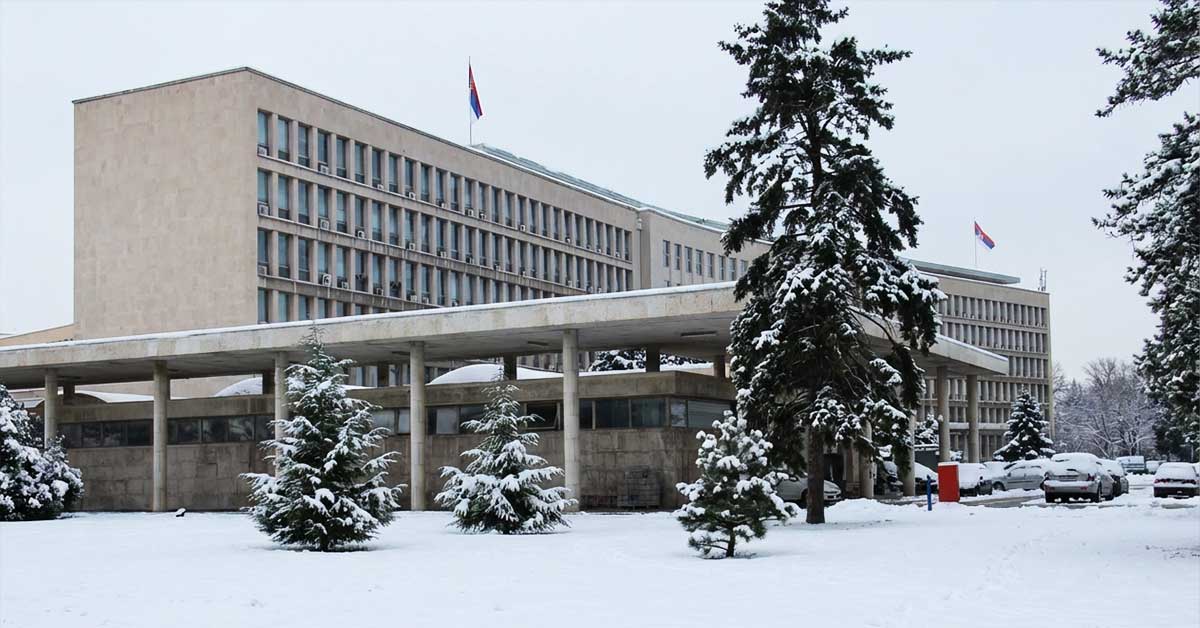
If Kalemegdan preserves Belgrade’s ancient and medieval past, Palace of Serbia (formerly known as SIV) is a time capsule of the 20th century. Set on the wide boulevards of New Belgrade, this building is not just a government seat; it is an architectural and artistic monument to one grand ambition – to create a new, modern metropolis on the flat land between the rivers.
Many tourists only glimpse it from a taxi on the way from the airport, but Palace of Serbia is arguably the most important example of modernist architecture in the entire former Yugoslavia. Though you cannot simply walk in like a museum, its story and striking exterior are an essential part of understanding New Belgrade.
Table of Contents
From Marshland to Symbol: The History of Palace of Serbia
Today it is hard to imagine that where this colossal structure stands, there was once sand and swamp. Construction began in 1947, immediately after World War II, as a symbol of the new state. The building was originally conceived as the seat of the Federal Executive Council (SIV) – the government of the Socialist Federal Republic of Yugoslavia.
The project was started by a Zagreb-based team of architects led by Vladimir Potočnjak, and completed by Belgrade architect Mihajlo Janković. When it was finally opened in 1961, on the occasion of the First Conference of Non-Aligned Countries, it was a demonstration of “total design”: everything from the façade of white Brač marble to the door handles was carefully crafted to impress world leaders. The building has an H-shaped footprint and covers an enormous area of approximately 5,500 square meters at its base.
Six Republics in Six Salons: Inside Palace of Serbia
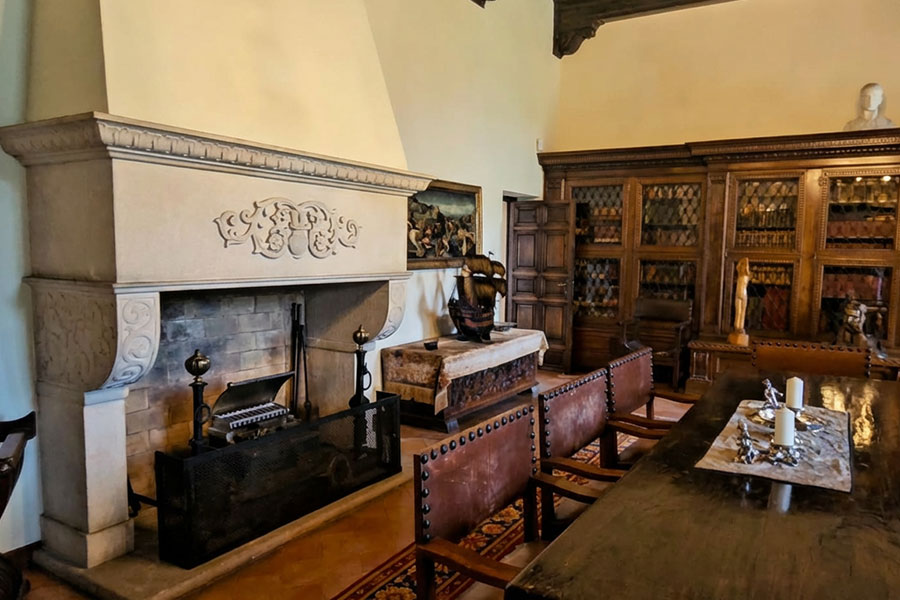
What makes Palace of Serbia truly unique is not just its scale, but what it hides inside. It is essentially a hidden museum of Yugoslav art. The interior is divided into six ceremonial salons, each dedicated to one of the six Yugoslav republics (Serbia, Croatia, Slovenia, Bosnia and Herzegovina, Macedonia, Montenegro).
Each salon was designed to reflect the tradition and aesthetics of its republic through a modern lens. The Serbian salon features carpets inspired by medieval frescoes. The Macedonian salon is known for its warm red tones and woodwork. The Slovenian salon is dominated by cooler tones and chandeliers reminiscent of stalactites from Postojna Cave. The Bosnian salon features recognizable elements of wood and marquetry.
Beyond the salons, corridors and ceremonial halls are filled with works by the greatest artists of the era, including Petar Lubarda, Milo Milunović, and Đorđe Andrejević Kun. Particularly impressive is the “Sutjeska” mosaic and the gigantic chandelier in the main hall (Tito’s salon), which has hundreds of bulbs and weighs several tons.
Architectural Significance of Palace of Serbia
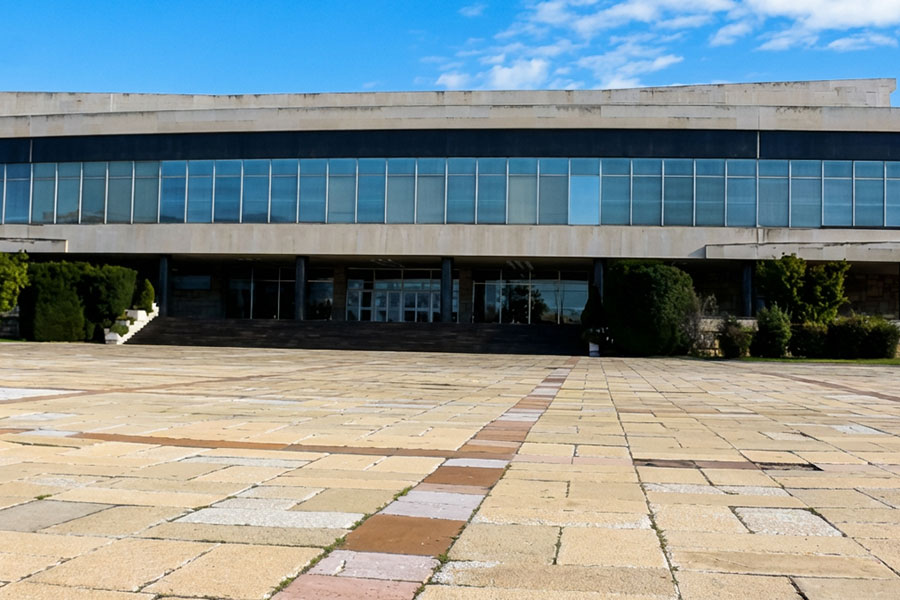
Palace of Serbia stands as a defining achievement of post-war Yugoslav modernism. Its clean lines, functional layout, and monumental scale embody the “international style” that dominated mid-century architecture worldwide, yet it was adapted to the socialist context and infused with regional artistic traditions.
The building’s H-shaped plan was not just aesthetic—it served a practical purpose, allowing natural light into interior offices and creating multiple wings for different government functions. The use of white Brač marble on the exterior gave the structure a sense of permanence and prestige, while the interiors combined modernist minimalism with handcrafted Yugoslav artworks.
For students of architecture and design, Palace of Serbia represents a rare moment when political ambition, artistic vision, and functional design converged in a single project.
How to Visit Palace of Serbia Today
This is the most common question, and the answer is somewhat complicated. Palace of Serbia is still an active building of the Government of the Republic of Serbia, and security is at the highest level. It is not open for individual tourist visits like a regular museum.
However, the doors do open on special occasions. The best opportunity is during the European Heritage Days in September, when the Tourism Organization of Belgrade usually organizes free guided tours. These spots fill up extremely quickly, so you need to follow announcements closely. The Night of Museums sometimes includes the palace in its program as well. Specialized groups, such as architecture faculties or professional associations, can occasionally obtain special permission for group visits. If you are not lucky enough to get inside, don’t worry, the exterior is an experience in itself.
Walking Tour Around Palace of Serbia
Even if you cannot enter, Palace of Serbia is worth visiting from the outside. The building is located in Block 13 of New Belgrade, surrounded by a vast park. The best way to experience it is by walking along Nikola Tesla Boulevard or Mihajlo Pupin Boulevard.
Stand in front of the main entrance (from the side of Mihajlo Pupin Boulevard) to feel its monumentality. The enormous white blocks, symmetry, and spacious plaza in front of the building speak of a time when people believed in grand ideas. This is also an excellent spot for photographing the brutalist and modernist architecture of New Belgrade. From here, you are a 15-minute walk from Ušće (the shopping center and park) or Hotel Jugoslavija.
Palace of Serbia in the Context of New Belgrade
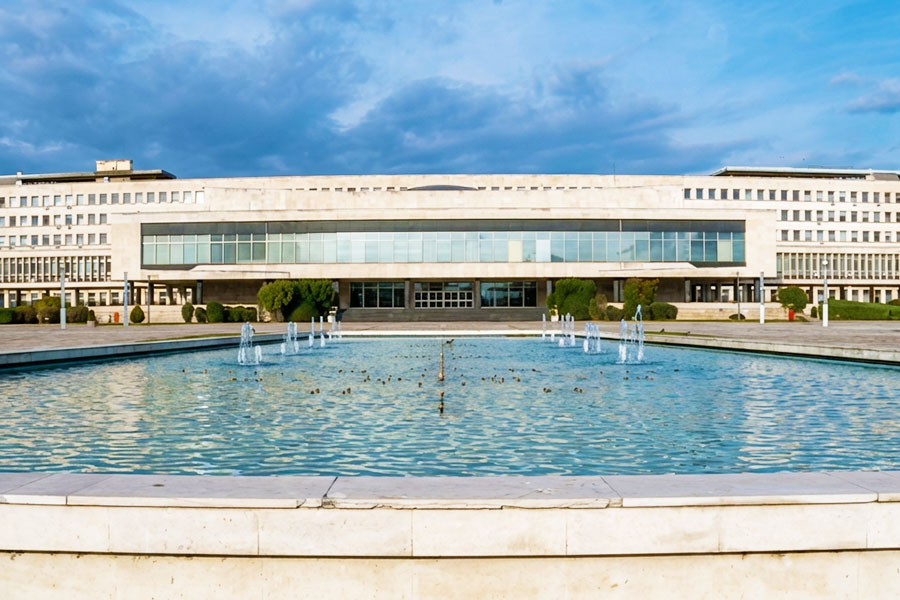
To truly understand Palace of Serbia, you need to see it as part of the broader New Belgrade project. After World War II, the flat land across the Sava River from old Belgrade became a blank canvas for urban planners and architects who wanted to build a modern socialist capital.
Wide boulevards, massive residential blocks, green spaces, and monumental public buildings were all part of a vision to create a city of the future. Palace of Serbia was the crown jewel of this vision—the seat of federal power in a federation that no longer exists. Walking around New Belgrade today, you see layers of that ambition: some buildings have aged well, others less so, but Palace of Serbia remains a striking reminder of what was possible when architecture and ideology aligned.
Why Palace of Serbia Matters Today
Palace of Serbia is more than a government building, it is a monument to a country that no longer exists. The six salons, each representing a Yugoslav republic, are now relics of a political entity dissolved in the 1990s. Yet the building endures, adapted to new purposes but still carrying the artistic and architectural weight of its original mission.
For visitors interested in 20th-century history, Cold War politics, or modernist architecture, Palace of Serbia offers a unique lens into a specific moment when Yugoslavia positioned itself as a leader of the non-aligned world. The artworks inside many created by artists who are now considered masters—remain largely hidden from the public, making the rare opportunities to visit all the more valuable.
FAQ About Palace of Serbia
Can I enter Palace of Serbia anytime?
No. Palace of Serbia is an active government building and closed to the public, except during organized tours such as European Heritage Days.
Where is Palace of Serbia located?
It is located in New Belgrade, in Block 13, between Mihajlo Pupin Boulevard and Nikola Tesla Boulevard.
Is photography allowed at Palace of Serbia?
Photographing the exterior is allowed and popular among tourists. Interior photography (if you are on a tour) may be restricted in certain areas.
How does Palace of Serbia compare to other Yugoslav-era buildings?
It is considered one of the finest examples of Yugoslav modernist architecture, both for its scale and for the quality of its interior art and design.
Our Most Popular Tours To Sarajevo
We offer many tours that include a visit to Sarajevo and its most popular locations:
- Full Day tour from Sarajevo to Belgrade (Most Popular)
- Full Day tour from Sarajevo to Međugorije & Mostar
- Full Day Tour from Sarajevo to Travnik and Jajce
- Full-Day 5 Cities Tour from Sarajevo to Herzegovina (Mostar)
- Full day Tour from Sarajevo to Dubrovnik (Kotor or Split)
Don’t Hesitate To Say Hi!
Got any questions about our tours or the city? Don’t hesitate to contact us anytime for more info and booking.
Use the following phone number and email: